
Sourdough Log: Starter Tracker
Sourdough Log: a starter feeding tracker and bread baking journal
Sourdough Log is a starter feeding tracker and bread baking journal for home bakers who are tired of guessing whether the jar on the counter is ready. Set a feed interval per starter, log every feeding and bake, and photograph the jar for an AI activity read instead of relying on the float test alone.


- Price
- Free, Pro upgrade
- Platforms
- Android now, coming to iPhone
- Languages
- 10
- Version
- 1.0
A starter has to be fed roughly every day or it degrades.
That one rule is the whole reason a sourdough log exists. Miss a feeding and the jar slides past where it tells you anything useful, so the app's first job is a reminder that lands on that starter's own interval and cancels itself the moment you feed again.
What it is
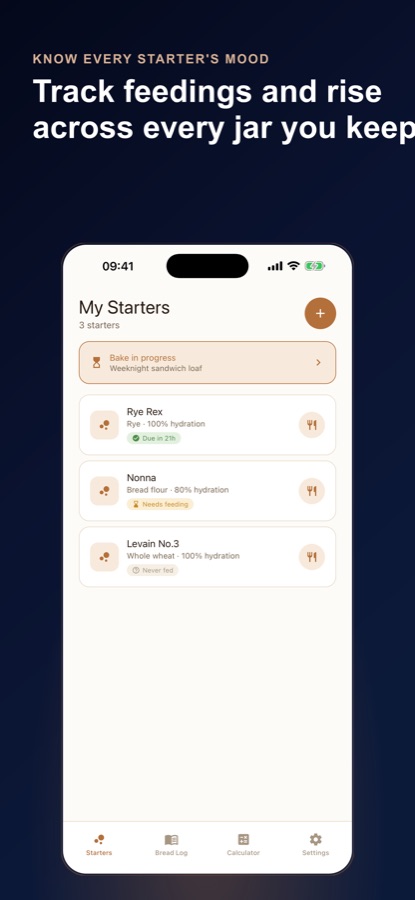
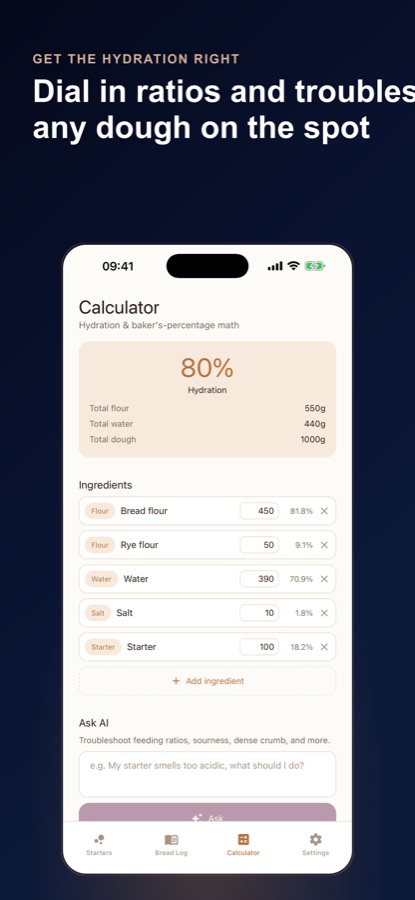
Sourdough Log is a free Android app (coming to iPhone) for tracking a sourdough starter and logging bread bakes. You set a feed interval per starter, get a reminder when it's due, and log every feeding with its ratio. A baker's-percentage and hydration calculator splits a starter's own weight into its flour and water components, an AI troubleshooting chat answers questions about a specific dough, and Starter Doctor reads a photo of the jar for an activity level and a wait-time estimate.
Inside the app
What it looks like
Background
How do you know when a sourdough starter is actually ready?
A starter is ready to bake with somewhere near its peak — the point after a feeding where it has risen the most and is about to fall back. Getting there depends on feeding ratio, flour, kitchen temperature and the starter's own personality, so the same recipe can peak in three hours in a warm kitchen and eight in a cold one. Most of the usual tests — watching the rise, the float test, the smell — are proxies for that one moving target.
Feeding ratiostarter:flour:water
Written as three numbers, such as 1:1:1 or 1:5:5 — parts starter, fresh flour and water by weight. A tighter ratio like 1:1:1 peaks fast and suits a daily counter starter; a looser ratio like 1:5:5 stretches the rise out over a longer, slower cycle, which suits once- or twice-a-week baking.
Hydrationwater as % of flour
The water weight in a starter or dough expressed as a percentage of the flour weight. A starter kept at 100% hydration is equal parts flour and water by weight; a stiffer starter at 50-60% behaves and smells noticeably different and often peaks more slowly.
Peakthe window, not a single moment
The stretch after feeding where a starter has risen the most and the bubbles are most active, just before it starts to fall and turn more sour. Baking during this window generally gives the most reliable rise; baking well past it tends toward a denser, more acidic loaf.
Discardwhat a feeding leaves behind
The portion of starter removed before adding fresh flour and water, so the jar doesn't grow without limit. How much gets kept versus discarded is set by the feeding ratio itself — a 1:1:1 feed keeps one part of the old starter for every one part of flour and water added back.
How it works
How the app is used
The habit repeats daily at the jar and occasionally at the oven. Everything else — the reminder timing, the rhythm it learns, the math behind a recipe — runs from those two kinds of entries.
Set a feed interval per starter
Create a starter with its flour type and hydration, then set how often it needs feeding — from a fast summer 1:1:1 every few hours to a fortnightly fridge starter kept at 14 days. A local reminder is scheduled from the moment you feed and cancels itself the instant you feed again, so there is one notification per starter, timed to that jar.
Log feedings, then read Starter Rhythm
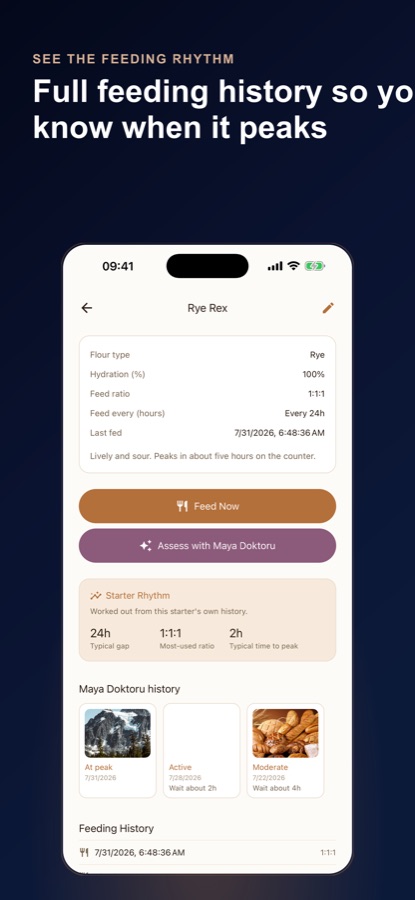
Feed with one tap and the ratio is logged. As the log fills in, the app works out your own median feeding interval, your most-used ratio and, once a starter has three or more logged peaks at the same ratio, the typical hours it takes that specific jar to peak — derived from your own taps, not a generic tip.
Log the bake and compute the recipe
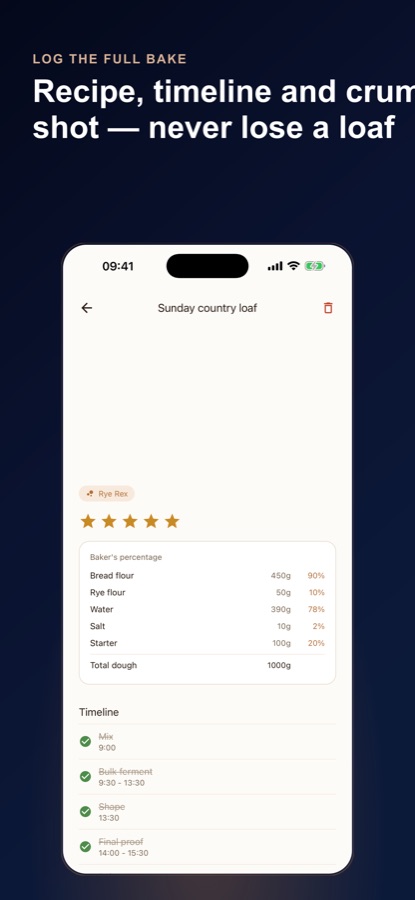
Enter a bake's ingredients by weight and the calculator returns true baker's percentages and hydration, splitting the starter's own weight into its flour and water share by its hydration — the step most calculators skip. Track the bake through a timeline, add a crumb photo, and rate it so a five-star loaf is easy to find and repeat.
What's inside
What the app tracks
Feed
Feeding reminders & history
A feed interval set per starter, from a fast summer 1:1:1 to a fortnightly fridge starter, with a reminder when it's due and a one-tap feed that logs the ratio and cancels the notification.
AI
Starter Doctor
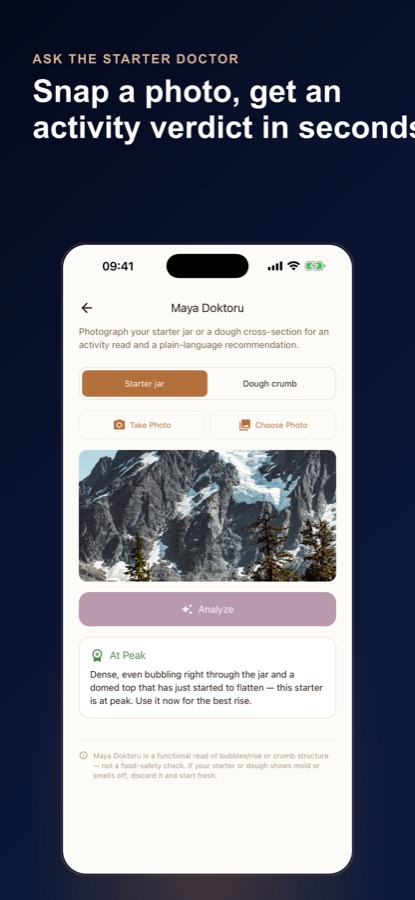
Photograph a starter jar or a dough cross-section and get an activity read — low, moderate, active or at peak — plus a plain-language "use now" or "wait about N hours" call. It is a functional read of bubbles and rise, not a food-safety check: if anything looks or smells off, the app says to discard and start fresh. One free lifetime read, unlimited on Pro.
Rhythm
Starter Rhythm
Your own median feeding interval, your most-used ratio, and the typical hours-to-peak logged for that exact starter and feed ratio, worked out on-device from your feeding and Starter Doctor history once enough data points exist.
%
Baker's percentage & hydration calculator
Enter flour, water, salt and starter by weight for true baker's percentages, including splitting the starter's own weight into its flour and water components by hydration — the part most calculators get wrong.
Ask
AI troubleshooting chat
Ask a specific question — a starter that smells too acidic, a dense crumb, a slack dough — in plain language and get a suggested ratio or fix. Unlimited on both free and Pro.
Log
Bread Log
Every bake tracked with its ingredients, a timeline checked off step by step, a crumb photo and a star rating, so a five-star loaf is easy to find again. An in-progress bake stays pinned until it's finished.
Fit
Who it's for — and who it isn't
A good fit if you
- Feed a starter regularly and keep losing track of when it was last fed
- Want more than a float test to judge whether a starter is actually at peak
- Want a baker's-percentage calculator that handles the starter's own hydration correctly
- Keep notes on bakes and want the recipe, timeline and photo in one dated record
- Get stuck on a specific dough problem and want a quick troubleshooting answer
Not the right tool if you
- Want a food-safety verdict on a starter or dough — Starter Doctor reads activity and rise, not mold or spoilage
- Want to keep more than one starter for free — the free plan keeps one, Pro adds unlimited
- Are on iPhone today — the app is on Android now, with an iOS release coming
- Want ready-made same-day and overnight bake timeline templates without upgrading — that's a Pro feature
Safety and limits
A functional read, not a food-safety check
Starter Doctor reads a photo of a starter jar or a dough cross-section for activity and rise — low, moderate, active or at peak — and a wait-time estimate. It is not a mold or spoilage check.
If a starter or dough looks discolored, has fuzzy spots, or smells off rather than pleasantly sour, discard it and start fresh rather than relying on a photo read. When in doubt, trust what you see and smell at the jar over any app.
Questions
Frequently asked questions
What's a good app for tracking a sourdough starter?
The useful test is whether it reminds you to feed before the jar degrades, and whether it logs enough to show your own starter's pattern rather than a generic one. Sourdough Log is built that way: a feed interval and reminder per starter, a feeding history that derives your median interval and most-used ratio, a baker's-percentage calculator that handles starter hydration correctly, and a photo-based Starter Doctor for a plain-language activity read. Free on Android, with an iOS release coming.
How do I know if my sourdough starter is ready to use?
Look for it near its peak: risen the most it will after that feeding, with an active, domed or just-starting-to-flatten surface and a lively, slightly sour smell. The timing depends on feeding ratio, flour and kitchen temperature, so the same starter can peak in a few hours in a warm room and much longer in a cold one. Sourdough Log's Starter Doctor gives a photo-based activity read and a wait estimate, and Starter Rhythm learns the typical hours-to-peak for that specific starter and ratio from your own logged peaks.
How often do you need to feed a sourdough starter?
A counter starter kept at room temperature generally needs feeding roughly once a day or it starts to degrade — that is the core rule most tracking tools ignore. A tighter ratio such as 1:1:1 in a warm kitchen can need feeding more than once a day, while a starter stored in the fridge can go as long as one to two weeks between feedings. Sourdough Log sets a feed interval per starter, from 4 hours up to 14 days, and schedules one reminder timed to that jar.
What is a sourdough feeding ratio and which one should I use?
A feeding ratio is written as three numbers — starter:flour:water by weight, such as 1:1:1 or 1:5:5. A tighter ratio like 1:1:1 ferments and peaks quickly, which suits daily baking from a counter starter. A looser ratio like 1:5:5 stretches the cycle out, which suits baking once or twice a week or a starter kept in a cooler spot. Sourdough Log logs the ratio with every feeding, so Starter Rhythm can show which one you actually reach for most.
How do you calculate hydration for a sourdough starter?
Hydration is the starter's water weight expressed as a percentage of its flour weight. A starter fed equal parts flour and water by weight is at 100% hydration; a stiffer starter fed less water sits at 50-60% and behaves differently in a recipe. Sourdough Log's calculator uses this figure to split a starter's own weight into its flour and water components when working out a full recipe's baker's percentages, which is the step basic calculators usually skip.
Can I store a sourdough starter in the fridge, and does that change feeding?
Yes — cold slows fermentation down, which is exactly why fridge storage is used to stretch the interval between feedings, commonly to once every one to two weeks rather than daily. A starter typically needs a day or two of counter feeding to wake back up and regain its usual strength before it's used in a bake. In Sourdough Log, a fridge starter gets its own longer feed interval set on its own schedule, separate from any counter starter kept alongside it.
What do you do with a sluggish or inactive sourdough starter?
A starter that has gone quiet after a long gap, a cold snap, or neglect usually responds to a few consecutive feedings closer together than usual, at room temperature, before it's judged. Watch for a clear rise and bubbling resuming rather than guessing after one feed. Sourdough Log's Starter Doctor can give an activity read along the way, and the AI troubleshooting chat takes a specific question about what it looks or smells like and suggests a next step.
Is Sourdough Log free, and what does Pro add?
Yes. Sourdough Log is free on Android, with an iPhone release coming. The free plan keeps one starter, logs unlimited bakes, and includes the baker's-percentage calculator and the AI troubleshooting chat without limit, plus one lifetime Starter Doctor photo read. Pro adds unlimited starters, unlimited Starter Doctor reads, ready-made same-day and overnight bake timeline templates, and removes ads. No sign-in is required — everything works as a guest from the first launch.
Is Sourdough Log available on iPhone?
Not yet. Sourdough Log is live on Google Play for Android today, and an App Store release for iPhone is coming. The iOS listing exists in advance of launch, so the app page and store link are ready once it ships.
What does the AI troubleshooting chat in Sourdough Log actually do?
It answers a specific question typed in plain language — a starter that smells too acidic, a dough that won't hold shape, a consistently dense crumb — with a suggested ratio change or fix. It works from the question you ask rather than scanning a photo, and it's available without limit on both the free plan and Pro, separate from the photo-based Starter Doctor.
Get started
Give your starter the log it deserves
Free on Android, with an iPhone release coming — feeding reminders, Starter Doctor and real baker's math.
More from CoddyKit
Available on Android.