

Lightkeeper: Nonogram Story
Lightkeeper: Nonogram Story — A picross picture puzzle where every solve relights a lighthouse
Lightkeeper: Nonogram Story is a free-to-play nonogram (picross) game for iPhone and iPad. The lighthouse has gone dark and its keeper has forgotten what it looked like — every picture you work out from the row and column numbers is a memory it gets back. Every puzzle has exactly one answer, and logic alone is enough to reach it.

- Price
- Free to play, optional purchases
- Platforms
- iPhone and iPad
- Play
- Offline
- Age rating
- 4+
- Requires
- iOS 15.0 or later
Never guess.
Each puzzle is checked by a solver before it ships, so it has one answer and that answer can always be reached by logic. When you are stuck there is still something left to work out, never something left to gamble on.
What it is
Lightkeeper: Nonogram Story is a free-to-play nonogram (picross) puzzle game for iPhone and iPad. The numbers beside each row and column say how many squares to fill; work out which ones and a picture appears. The puzzles are grouped into five floors of a lighthouse that lights up as you finish them, solved pictures are kept in a gallery, a new daily puzzle appears every morning, and the whole game plays offline in portrait with one hand.
Highlights
What the game looks like
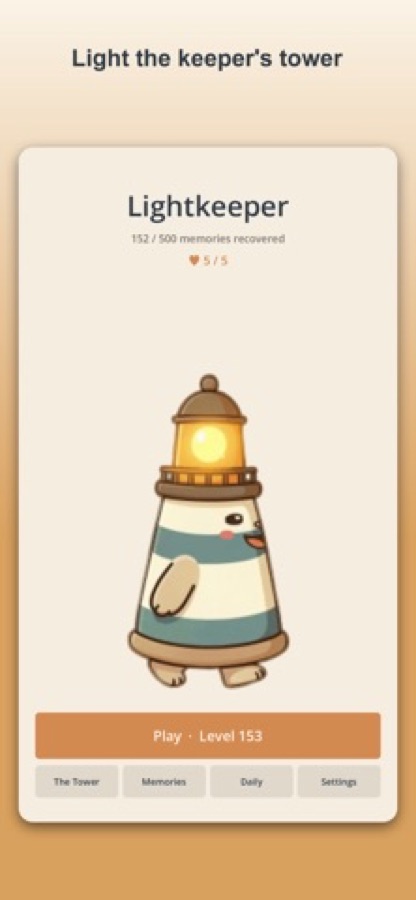
A keeper with a lamp for a head
The home screen shows the keeper — a striped lighthouse on little feet — with the count of memories recovered so far above him and a single button that continues with your next puzzle.
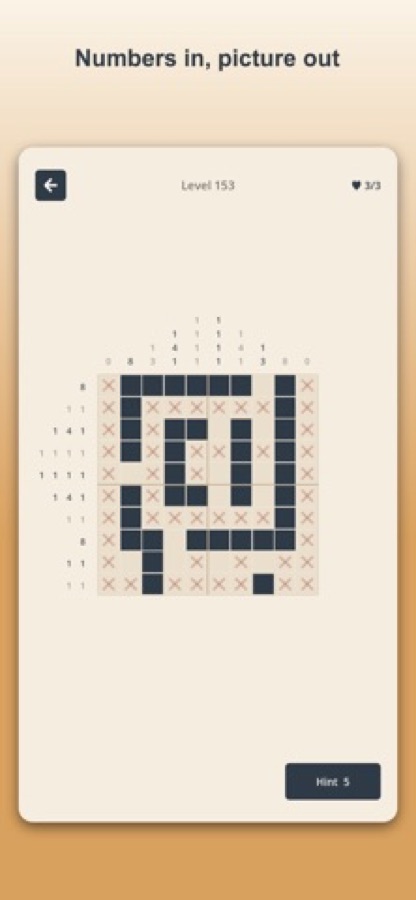
Numbers in, picture out
The board is plain on purpose: clue numbers on two edges, dark squares for filled and faint crosses for empty. A small attempts counter sits at the top and a Hint button at the bottom for a stuck moment.
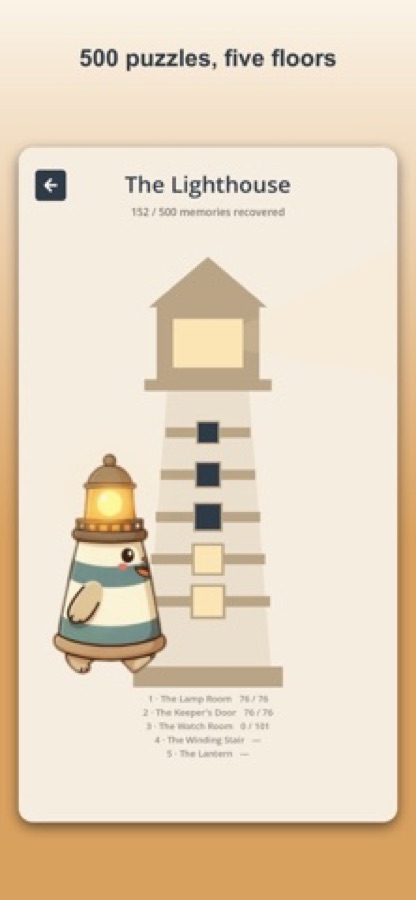
Floors that light up
The puzzles are laid out as a tower with a progress line per floor. Windows come on as you finish them, which makes progress something you see on the building rather than read in a list.
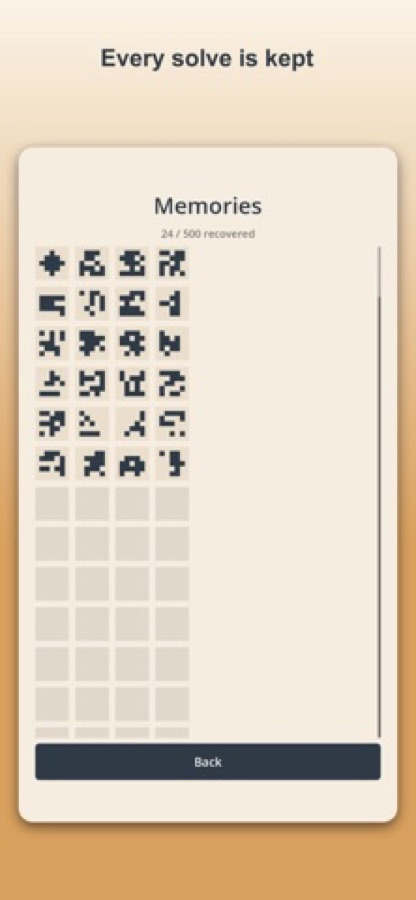
Every solve is kept
The Memories screen is a wall of small pictures, one for every puzzle you have solved, with empty slots for the rest. It is a collection you can scroll back through.
A reason to come back tomorrow
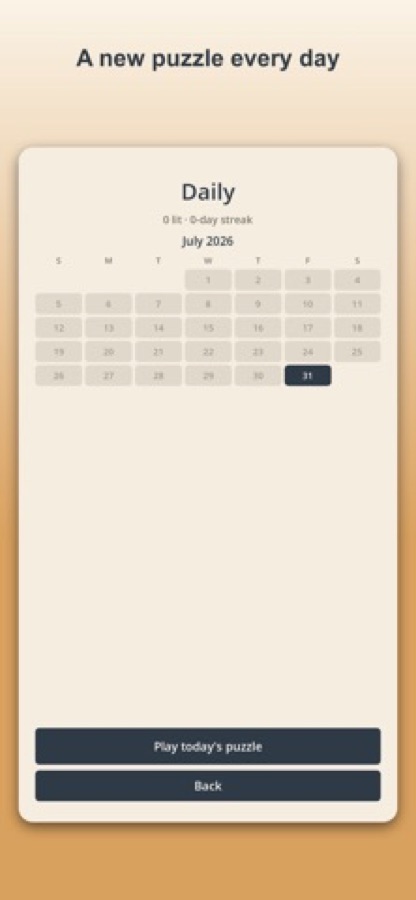
The Daily screen is a calendar with a streak counter. One puzzle a day, the same for every player, and a single button to play it.
How it works
How a puzzle goes
A puzzle is a single grid, a few numbers and as long as you want to think about it.
Read the numbers
Start from the home screen with the Play button, which takes you to your next puzzle. The numbers along each row and column say how long the runs of filled squares are, in order.
Fill and cross out
Drag across the board to fill squares and mark the ones you know are empty. On the bigger grids, pinch to zoom in. If you want the help, settled lines can be crossed out for you automatically.
Keep the picture
When the last square falls into place the picture appears, the tower's windows come a little closer to lighting, and the solved picture goes into your Memories gallery. A hint is there for a stuck moment, but the puzzle can always be solved without one.
Background
What is a nonogram, and how do you solve one without guessing?
A nonogram is a logic puzzle played on a grid. Numbers beside each row and above each column give the lengths of the unbroken runs of filled squares in that line, in order, and the squares you fill in reveal a picture. The same puzzle is sold under other names — picross, hanjie, griddlers, pic-a-pix, paint by numbers — and the rules do not change. A good nonogram can always be finished by deduction: you never need to try a square to see what happens.
Reading the cluesnumbers are runs, not counts
A clue of 3 1 means a run of three filled squares, then at least one empty square, then a single filled square, somewhere along that line. The numbers tell you the order and the lengths of the runs, not where they sit, which is why each line is a small puzzle of its own.
Overlapthe first deduction to learn
In a ten-square row with a clue of 7, the run can slide by three squares at most, so the four squares in the middle are filled whichever way it slides. Large clues leave very little room to move, and that overlap is usually where a puzzle opens up.
Crossing outmarking what cannot be filled
Once a line's clues are fully satisfied, every remaining square in it must be empty. Marking those squares with a cross shrinks the puzzle for the crossing lines, and the new certainties from there feed back into the rows. Lightkeeper can cross out settled lines for you if you turn that option on.
A unique answerwhy guessing is never needed
Some hand-made nonograms have more than one valid picture, which forces a guess near the end. A puzzle with exactly one solution can be completed line by line using deduction alone, and that is the standard Lightkeeper holds every puzzle to.
What's inside
What is in the game
1
One answer, always by logic
Every puzzle is checked by a solver before it ships. Each has exactly one answer, and that answer can be reached by deduction without guessing.
5
A lighthouse of five floors
The puzzles are not a flat list. They are five floors — the Lamp Room, the Keeper's Door, the Watch Room, the Winding Stair and the Lantern — and a finished floor's windows stay lit for good.
Memories
A gallery of every picture
Each solved puzzle is kept in the Memories gallery, so you can look back at the whole collection and see how many are still to recover.
Daily
A puzzle every day
A new puzzle each morning, the same for everyone, marked off on a calendar with a streak counter.
Offline
Plays fully offline
Portrait, one hand, on iPhone and iPad. No connection is needed to play, so it works on a commute, on a plane or in a waiting room.
Light
Light and night themes
Switch between a light and a dark palette in Settings, drag to fill, pinch to zoom the large grids, and turn automatic crossing-out on or off.
Fit
Who it's for — and who it isn't
A good fit if you
- Like nonograms, picross, griddlers or hanjie and want one with a story around it
- Want puzzles that never need a guess and always end in a picture
- Prefer a quiet game to end the day with, played with one hand in portrait
- Want to play offline, on iPhone or iPad
- Enjoy collecting — a gallery of solved pictures and a tower that lights up
Not the right tool if you
- Want a fast, competitive or multiplayer game
- Use an Android phone, because the game is on iOS only for now
- Want a game with no purchases at all — hints and an ad-free upgrade are optional extras
Questions
Frequently asked questions
What is Lightkeeper: Nonogram Story?
Lightkeeper: Nonogram Story is a free-to-play nonogram (picross) puzzle game for iPhone and iPad. You use the numbers beside each row and column to work out which squares to fill, and a picture appears. A lighthouse keeper who has forgotten what the tower looked like gets a memory back each time you solve one.
How do you play a nonogram?
A nonogram is a grid with numbers beside each row and above each column. Each number is the length of a run of filled squares in that line, listed in order, with at least one empty square between runs. Work out which squares must be filled and which must be empty, and the filled squares form a picture.
Is Lightkeeper the same as picross, hanjie or griddlers?
Yes, they are the same kind of puzzle under different names: a picture cross puzzle where numbers describe runs of filled squares. Lightkeeper: Nonogram Story follows these standard rules and adds a lighthouse story, a gallery of solved pictures and a daily puzzle.
Do I ever have to guess in Lightkeeper?
No. Every puzzle in Lightkeeper: Nonogram Story is checked by a solver before it ships, so it has exactly one answer, and that answer can always be reached by logic alone. If you are stuck, there is something left to work out rather than something to gamble on.
Does Lightkeeper work offline?
Yes. Lightkeeper: Nonogram Story plays fully offline, in portrait and with one hand, so you can solve puzzles on a commute, on a flight or anywhere without a connection.
Is Lightkeeper free, and what can I buy?
Lightkeeper: Nonogram Story is free to play. Hints and an ad-free purchase are optional extras, and none of them is needed to finish a puzzle, because every puzzle can be solved by logic alone.
What is the daily puzzle in Lightkeeper?
The Daily screen in Lightkeeper: Nonogram Story offers a new puzzle each morning, the same for every player, marked off on a calendar with a streak counter. It is separate from the main tower, so it is a quick way to play something short each day.
How is the lighthouse used in Lightkeeper?
The puzzles in Lightkeeper: Nonogram Story are arranged as five floors of a lighthouse: the Lamp Room, the Keeper's Door, the Watch Room, the Winding Stair and the Lantern. Finishing a floor turns its windows on for good, and each solved picture goes into the Memories gallery.
Can I play Lightkeeper on a large grid on a phone?
Yes. Lightkeeper: Nonogram Story lets you drag across the board to fill squares and pinch to zoom in on the big grids, so a large puzzle stays readable on an iPhone screen. Automatic crossing-out of settled lines is optional.
Is Lightkeeper available on Android?
Not at the moment. Lightkeeper: Nonogram Story is on the App Store for iPhone and iPad, and has no Google Play listing.
Get started
Light the first window
A free nonogram game for iPhone and iPad — one answer per puzzle, no guessing, plays offline.
More from CoddyKit
Available on iOS.