
Dive Log: Scuba Logbook
Dive Log: Scuba Logbook — A dive log that records depth, gas and buddy on the boat, offline
Dive Log: Scuba Logbook is a free Android dive log for certified recreational divers. Record depth, bottom time, gas mix, buddy and conditions the moment you are back on the boat, then watch your count, sites and certifications grow. It works fully offline with no account, and it is a logbook, not a dive computer or planner.

- Price
- Free, Pro upgrade
- Platforms
- Android
- Languages
- 10
- Account
- Not needed, works offline
Log it before the numbers fade.
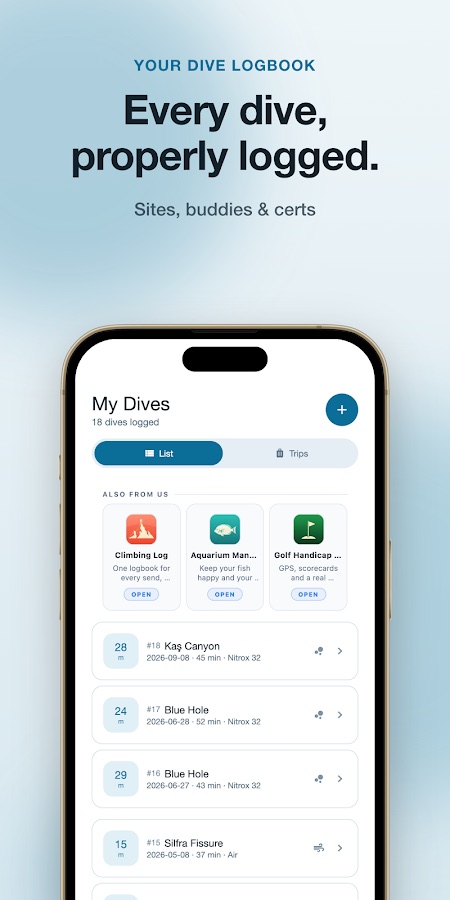
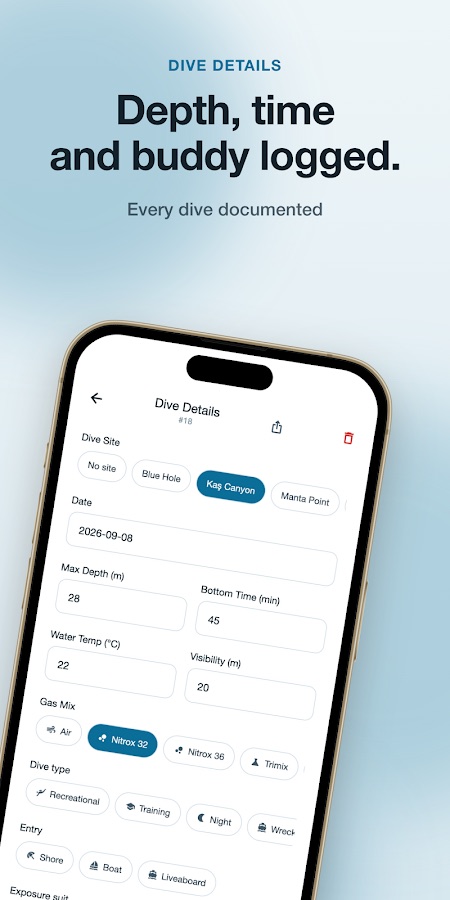
Depth, bottom time and visibility are easiest to write down while you are still wet and the boat is still moving. The app is designed so an entry takes under a minute to record, with the details you would put in a paper logbook, and it keeps working when there is no signal.
What it is
Dive Log: Scuba Logbook is a free Android scuba diving log book for certified recreational divers. It records max depth, bottom time, gas mix (air, Nitrox 32, Nitrox 36, trimix or other), water temperature, visibility, weight, buddy, cert level, notes and a photo for each entry. It also remembers sites, tracks certifications from Open Water to Instructor, and works offline with no account. It does not calculate no-decompression limits, safety stops or ascent rates, and it makes no medical claim.
Inside the app
What it looks like
Background
What belongs in a dive logbook, and what can a logbook not do?
A log is the record of what you did underwater: where, how deep, for how long, on which gas, with whom and in what conditions. Divers keep one to remember sites and to show their experience to operators and instructors. A logbook cannot plan your diving or keep you within safe limits. That job belongs to your training, your agency's guidelines and your own dive computer, and a logbook should never be used in their place.
Depth and bottom timethe two core numbers
Maximum depth and the time spent at depth describe the descent. They are normally copied from your dive computer afterwards, which is why a logbook app only has to store them quickly and correctly.
Gas mixair, nitrox, trimix
Recording the gas you breathed matters because mixes differ: air is about 21 percent oxygen, while Nitrox 32 and Nitrox 36 are enriched with more. Diving a mix other than air needs the right training, and the plan itself comes from your computer or tables.
Conditions and site memorywhy repeat dives help
Water temperature, visibility and weight change from day to day and from site to site. After a few dives at one site, your own history shows what to expect there, such as typical visibility, depth and the gas you usually take.
Sign-offs and certificationsproof and progress
Paper logbooks carry a buddy or instructor signature. A typed sign-off is a lightweight substitute, and keeping certification level, agency and date together shows your progress. Official requirements still come from your certifying agency.
How it works
How logging works
Everything is stored on the phone, so logging works on a boat with no signal and the first launch needs no sign-up.
Log it in under a minute
Enter max depth, bottom time, gas mix, water temperature, visibility, weight, your buddy's name, cert level and notes, and attach a photo. A typed buddy or instructor sign-off stands in for a paper signature.
Save the site once and return to it
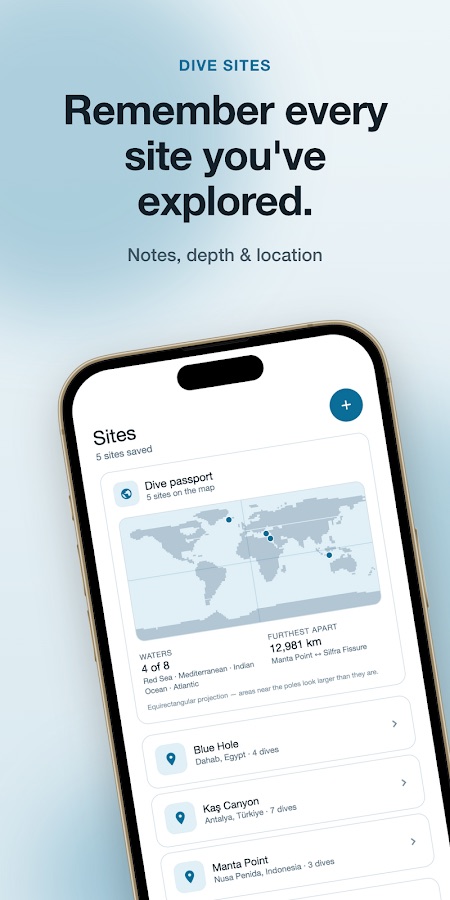
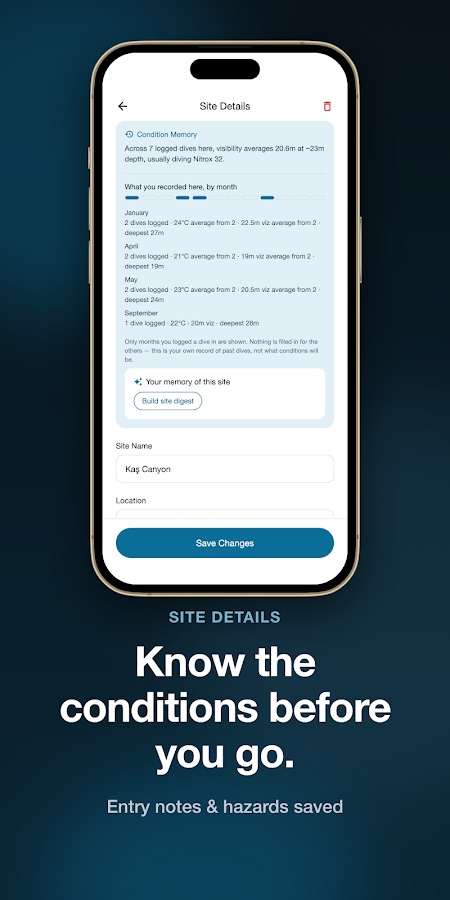
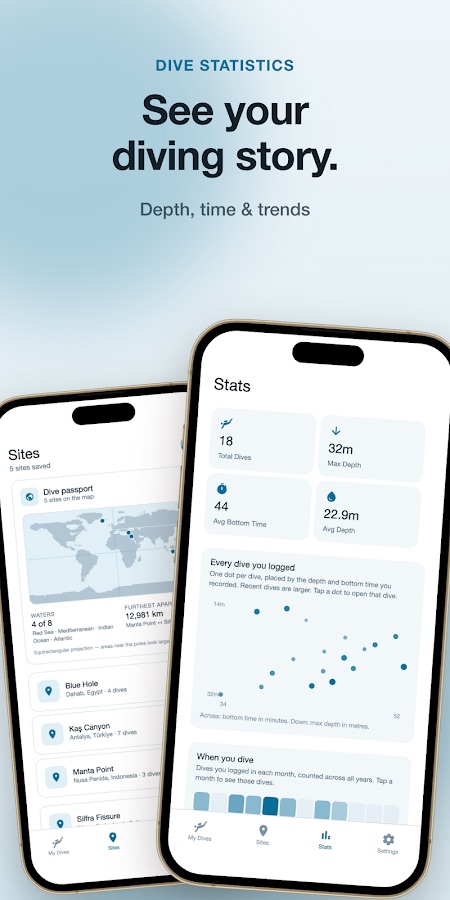
Save each site with its location and your own notes on entry points, hazards or conditions. Return to it and a condition-memory card shows average visibility, average depth and your usual gas mix, built from your own entries.
Watch the totals and certifications grow
The stats screen totals your dives, max depth, average bottom time and average depth. Track certifications by agency, level and date, with an informal progress bar based on your dive count.
What's inside
What comes with the app
<1 min
Fast capture
Depth, bottom time, gas mix, water temperature, visibility, weight, buddy, cert level, notes and a photo, in under a minute.
Sites
Sites that remember
Each site keeps its location and your notes. Repeat dives build a condition-memory card of average visibility, depth and usual gas mix.
Certs
Certification tracking
Record certifications by agency, level and date, from Open Water through Instructor, with a progress bar toward the next informal milestone. It is informational only, never an official requirement.
Offline
Works with no signal
Your logbook lives on the device. Without signal, even on first launch, you can set up, log dives and browse dives, sites, stats and certifications. Only AI summaries, subscribing and sign-in need a connection.
AI
Retrospective AI summaries
On demand, get a trend read of your depth and bottom time, a note on your nitrox use, and where your cert count sits, plus an AI-written summary and topic tags for a single entry's notes. They read only dives you have already logged.
Export
Share your logbook, in Pro
Export the whole logbook to share or hand to an instructor. Pro also lifts the limit on AI summaries and note tagging and removes ads.
Fit
Who it's for — and who it isn't
A good fit if you
- Are a certified recreational diver who wants a digital logbook that works on the boat
- Return to the same sites repeatedly and want your own average visibility, depth and gas mix remembered
- Track certifications from Open Water onward in the same place as your dives
- Want an instructor or buddy sign-off without carrying a paper logbook
- Prefer to start logging straight after install, with no account
Not the right tool if you
- Need a dive computer or planner; the app calculates no no-decompression limits, safety stops, ascent rates or gas plans
- Want medical or fitness-to-dive guidance, which the app does not give
- Expect unlimited AI: the free plan includes 2 AI summaries and 1 AI note tagging, and Pro removes that limit
Safety and limits
A logbook, not a dive computer
Scuba diving carries real risks, including decompression illness, running low on gas and problems with equipment or conditions. Dive Log: Scuba Logbook is a personal journal. It does not calculate no-decompression limits, safety stops or ascent rates, and it makes no medical or fitness-to-dive claim.
Always rely on your training, your certifying agency's guidelines and your own dive computer for planning and safety decisions. The AI summaries read only dives you have already logged, look backward, and carry the same safety disclaimer as the rest of the app.
If you have a heart or lung condition, ear or sinus problems, or any doubt about your fitness to dive, talk to a doctor trained in dive medicine before you dive. Nothing in the app is medical advice.
Privacy
What stays on your phone
Your logbook lives on your device, and no account is needed to start logging. Only AI summaries, subscribing and sign-in need a connection. The AI features read only dives you have already logged, and the free version shows ads.
Full details are in the CoddyKit privacy policy.
Questions
Frequently asked questions
What is Dive Log: Scuba Logbook?
Dive Log: Scuba Logbook is a free Android logbook for certified recreational divers. It records each entry's depth, bottom time, gas mix, conditions, buddy and notes, remembers your sites, and tracks certifications. It works offline and needs no account, and it is a logbook rather than a dive computer.
Can it replace my dive computer?
No. The app is a personal journal and does not calculate no-decompression limits, safety stops or ascent rates, and it makes no medical or fitness-to-dive claim. Use your dive computer, your training and your agency's guidelines for planning and safety, and use the app to record the outing afterward.
What gas mixes can I record?
You can record air, Nitrox 32, Nitrox 36, trimix or another mix for each entry. The app stores what you breathed so your history and your usual gas at each site are accurate, but it does not plan gas or check that a mix is suitable.
Does it work without internet on a boat?
Yes. The logbook lives on the device, and without signal, even on first launch, you can set up the app, log dives and browse your dives, sites, stats and certifications. Only AI summaries, subscribing and sign-in need a connection.
How does the site memory work?
Save a site with its location and your notes on entry points, hazards or conditions. When you return to it, a condition-memory card shows the average visibility, average depth and the gas mix you usually use there, calculated from your own logged dives rather than from outside data.
How do certifications work in the app?
You record each certification by agency, level and date, from Open Water through Instructor. A progress bar shows where you sit toward the next informal milestone based on your dive count. It is informational only and is never an official agency requirement or a guarantee of eligibility.
What do the AI summaries do?
On demand, the AI can write a retrospective read of your logbook, covering depth and bottom time trends, a note on nitrox use and your progress toward the next milestone. It can also summarise and tag the notes of a single entry. It reads only dives you have already logged and gives no planning, decompression or medical advice.
What is free and what does Pro add?
Free: unlimited logging of every entry, site and certification, every stat, the cert-progress bar and site condition memory, plus 2 free AI summaries and 1 free AI note tagging. Pro, an optional auto-renewing subscription, adds unlimited AI summaries and note tagging, export of the whole logbook, and no ads.
Which devices and languages does it support?
The app is for Android devices through Google Play. The app offers a language picker covering 10 languages, plus light, dark and system themes.
Get started
Log your next dive before the numbers fade
Free to start on Android, in 10 languages.
More from CoddyKit
Available on Android.