
Simple Machines: Gears Lab
Simple Machines: Gears Lab — Learn levers, pulleys and mechanical advantage in 3D
Simple Machines: Gears Lab is a free Android app, and a 3D physics simulator for learning simple machines: levers, gears, pulleys, ramps, screws and wedges, each a scene you orbit, zoom and run. A live force meter shows the effort needed and the mechanical advantage, calculated from the textbook relation for that exact setup rather than a number made up for show.


- Price
- Free, Pro upgrade
- Platforms
- Android now, coming to iPhone
- Languages
- 10
You never get something for nothing.
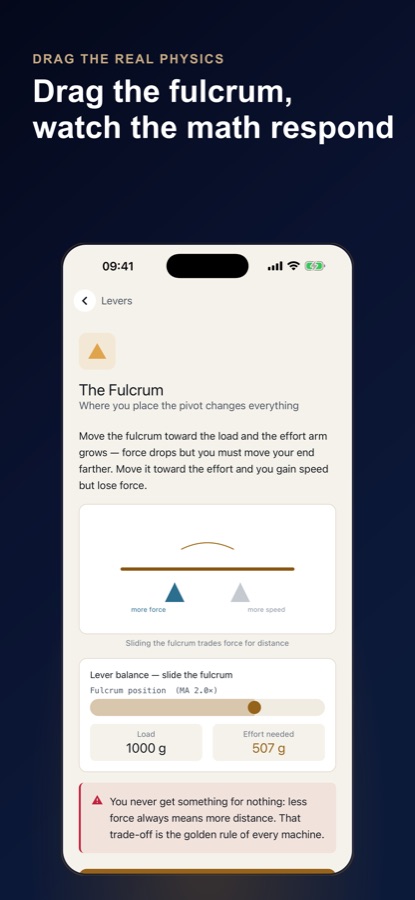
Drag the fulcrum of a lever closer to the load and the force you need drops, but your end of the bar has to travel farther. The lab makes that trade between force and distance something you can feel and read off a meter, not a sentence to memorise.
What it is
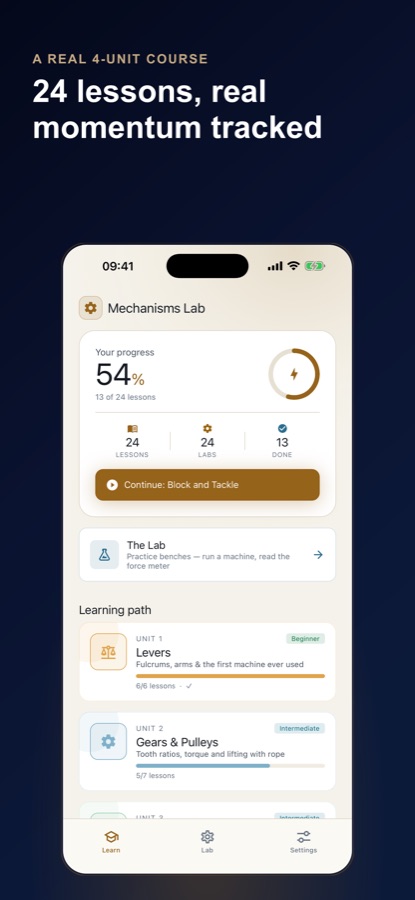
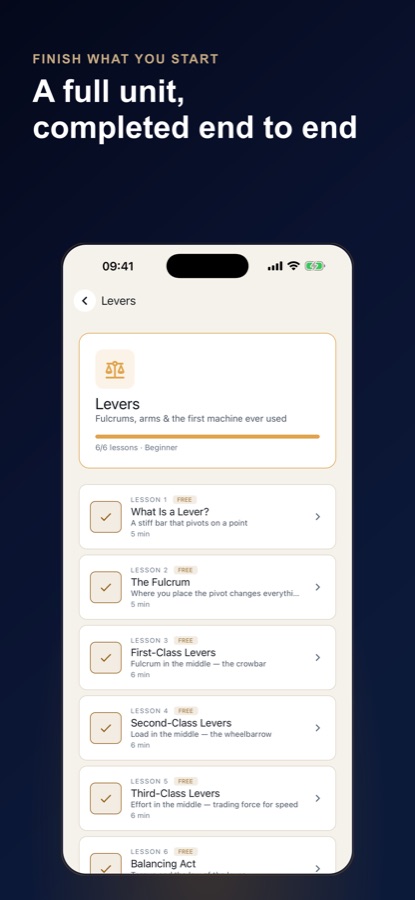
Simple Machines: Gears Lab is a free Android app that teaches how levers, gears, pulleys, inclined planes, screws and wedges work, using 3D scenes you can orbit and run. It has 31 lessons in five units, a force meter and mechanical advantage readout driven by a solver for eight textbook relations, a Lab with puzzle benches and a Workshop for building your own machine. An iPhone version is planned.
Inside the app
What it looks like
Background
What are simple machines, and what does mechanical advantage mean?
Simple machines are basic devices that change the size or direction of a force, so that a small effort can move a larger load. Mechanical advantage is the ratio of the load a machine moves to the effort you apply. A ratio of 3 means you push with a third of the load's weight. The catch is that machines do not create energy: gaining force means moving your end farther, which is the idea underneath every lever, pulley and ramp.
Leverseffort arm over load arm
A lever is a rigid bar that turns around a fulcrum. In the ideal case, mechanical advantage is the length of the effort arm divided by the length of the load arm, so moving the pivot changes how hard a job feels. First-, second- and third-class levers differ in where the fulcrum, load and effort sit.
Gearsratios of teeth
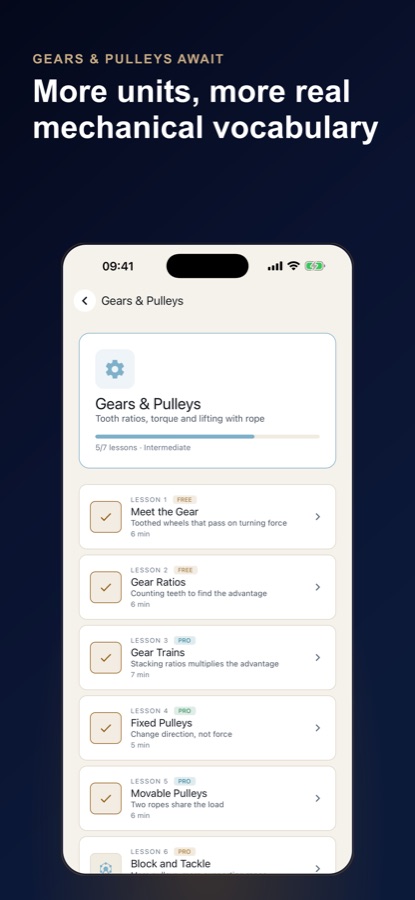
Meshing toothed wheels pass on turning force. Counting teeth gives the gear ratio: one gear turning a larger one trades speed for torque, and a gear train multiplies the ratios of each pair.
Pulleysrope and direction
A fixed pulley only changes the direction of the pull. A movable pulley shares the load between rope segments, which cuts the force you pull with but lengthens the rope you pull through. A block and tackle combines several.
Ramps, screws and wedgesthe inclined plane family
A longer, gentler ramp needs less force over a greater distance. A screw is a ramp wrapped around a cylinder, and a wedge is a moving ramp that splits or lifts material.
How it works
How a lesson works
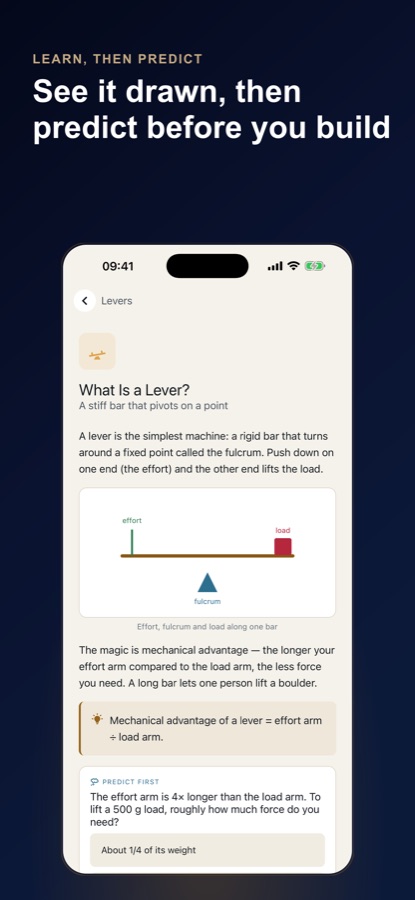
Every lesson follows the same loop, so the number on the force meter is always something you set up yourself.
Read a short explanation
Each lesson is a plain-English explanation with a diagram, covering one idea at a time, from what a lever is to how stacked machines multiply their advantages.
Predict, then check
A quiz or a real-world scenario with a worked explanation asks what you expect before the lab shows the answer, for example how much effort a longer lever arm saves.
Run the 3D lab
Open the scene for that machine, orbit and pinch to zoom, tap Run and watch the force meter and mechanical advantage update. Slider mini-labs recalculate the moment you move them.
What's inside
What is inside the app
31
Lessons in five units
Levers, Gears and Pulleys, Ramps, Screws and Wedges, Compound Machines and Advanced Compound Machines, with four Job Order capstones.
3D
A physics lab in every lesson
Orbit, pinch to zoom, Run and Reset in a scene for the machine you are studying, with a live force meter.
8
Mechanical advantage relations
A solver for lever, wheel and axle, gear, fixed pulley, movable pulley, inclined plane, screw and wedge, chained stage by stage for compound machines.
Lab
Puzzle benches
A lever warm-up bench and six puzzle benches where you lift the load within a force budget.
Workshop
Build your own
Pick one of eight machine types, tune its geometry and goal, run it and see whether it solves.
AI
AI hints
A hint for when a lab has you stuck. It runs only after you agree to it, and free users can unlock up to 3 a day by watching a short video ad.
Fit
Who it's for — and who it isn't
A good fit if you
- Meet simple machines in a physics or STEM class and want to see them work
- Half-remember effort arm over load arm and want the intuition back
- Are a maker who wants to reason about a pulley or gear setup before building it
- Are a parent or teacher looking for a hands-on lab rather than another flashcard app
- Want a friendly refresher on levers, gears and pulleys for a mechanical aptitude test
Not the right tool if you
- Need an engineering qualification or a full test-prep course — the app is neither
- Want to design real structures — the physics is idealised and ignores friction in most scenes
- Expect everything free: the first unit, the Lab and the Workshop are free, and Pro unlocks the remaining lessons
- Need the iPhone app today — it is planned but not yet available
Privacy
A guest profile, no sign-up
The app starts you on a guest profile, and the lessons and 3D labs are built into the app. An AI hint is sent only after you agree to it, and carries the bench, its task text and the force values on screen to the developer's server, which passes them to a third-party AI service.
Full details are in the CoddyKit privacy policy.
Questions
Frequently asked questions
What is the best way to learn simple machines?
Seeing a machine work beats reading about it. Simple Machines: Gears Lab gives each lever, gear, pulley, ramp, screw and wedge a 3D scene you can orbit and run, with a force meter that updates as you change the setup. A short explanation and a prediction question come first, so you commit to an answer before the lab shows the result.
What is mechanical advantage?
Mechanical advantage is the load a machine moves divided by the effort you apply. For an ideal lever it equals the effort arm divided by the load arm. A ratio of 3 means you push with a third of the load's weight, at the cost of moving your end three times as far.
How are the numbers in the lab calculated?
Simple Machines: Gears Lab uses a solver for eight textbook mechanical advantage relations: lever, wheel and axle, gear, fixed pulley, movable pulley, inclined plane, screw and wedge. For compound machines the same maths is chained stage by stage, so the force meter reflects the relation behind that scene rather than a figure invented for effect.
What does the app teach about levers, gears and pulleys?
First-, second- and third-class levers and where the fulcrum goes; gear ratios, torque and speed, and gear trains; fixed and movable pulleys and the block and tackle; why a longer ramp needs less force; the screw as a ramp wrapped around a cylinder; and the wedge. Compound machines then show how stacked advantages multiply.
Is there a way to build my own machine?
Yes. The Workshop lets you pick one of eight machine types, tune its geometry and goal, run it and see whether it solves the task. The Lab tab adds a lever warm-up bench and six puzzle benches where you lift a load within a force budget.
Is Simple Machines: Gears Lab free?
It is free to download. All of Unit 1 with its capstone, the first two Gears and Pulleys lessons, the whole Lab tab and the Workshop are free. The free version shows a small banner for other apps and occasional full-screen video ads. Pro, a monthly or yearly subscription, unlocks every lesson in all five units, unlimited AI hints and no ads.
Does it work offline?
Lessons and 3D labs are bundled with Simple Machines: Gears Lab, so they work without a connection. Only the optional AI hint needs one.
Who is it for, and is it an engineering course?
It suits students meeting simple machines in physics or STEM class, makers, and parents or teachers who want a physics lab. It can refresh levers, gears and pulleys before a mechanical aptitude test, but it is not a test-prep course and not an engineering qualification.
Is there an iPhone version?
Not yet. Simple Machines: Gears Lab is available on Android through Google Play, and an iPhone version is planned. The page links to the App Store listing, which will switch on when the app is live there.
Is Simple Machines: Gears Lab the same app as Mechanisms Lab?
Yes. Simple Machines: Gears Lab is the Google Play title, and the app's own description calls it Mechanisms Lab. The planned iPhone listing is named Mechanical Advantage: 3D Lab. The app is available in 10 languages with light and dark themes, and starts on a guest profile with no account.
Get started
Run your first lever today
Free to start on Android, in 10 languages. iPhone coming.
More from CoddyKit
Available on Android.