

Learn Ruby & Rails: Code & Run
Learn Ruby & Rails: Code & Run — Ruby programming from your first puts to Rails
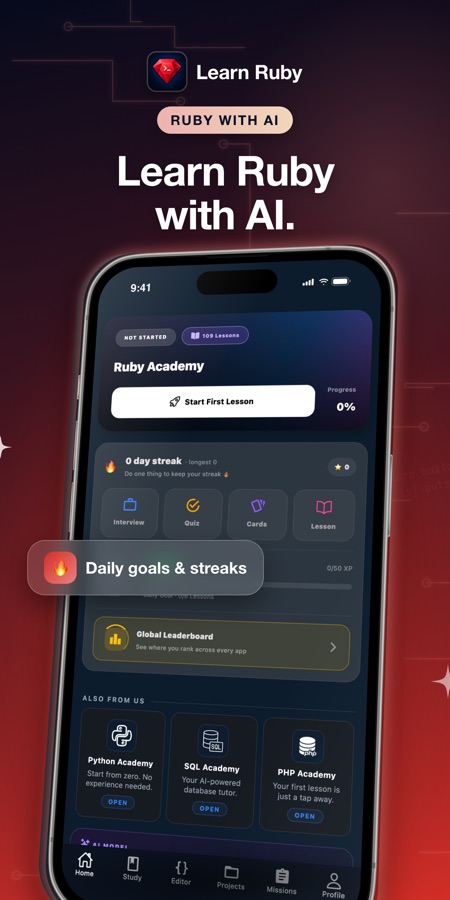
Learn Ruby & Rails: Code & Run is a free iOS and Android app for Ruby programming from scratch. A built-in Ruby editor and compiler runs the code you write, 29 courses and 109 short lessons run from variables to metaprogramming, and an AI Mentor explains any error or method that does not make sense.

- Price
- Free, Pro upgrade
- Platforms
- iOS and Android
- Languages
- 22
- Age rating
- 4+
- Requires
- iOS 15.1 or later
Ruby is the language, Rails is one thing built with it.
Beginners often start with Rails and get lost, because a web framework hides the language underneath it. The course teaches plain Ruby first: strings, hashes, blocks, classes and modules. Rails and Sinatra come late, as lessons that build on what the editor has already let you run.
What it is
Learn Ruby & Rails: Code & Run is a free iOS and Android app that teaches Ruby programming step by step, from the first puts to metaprogramming, with an introduction to Ruby on Rails. It has 29 courses and 109 lessons levelled from A1 to C1, an editor that runs your scripts, 60 coding missions, 20 guided projects and an AI Mentor for error messages and concepts. Your first course is free, and Pro unlocks the rest.
The editor runs plain Ruby on the app's server, so running code needs an internet connection. Rails and Sinatra are taught through lessons and code examples rather than run in the editor. Ruby on Rails is a trademark of David Heinemeier Hansson, and this app is independent of the Rails project..
Inside the app
What it looks like
The course
What the Ruby course covers
29 courses and 109 lessons. The course names below come from the Ruby course list on CoddyKit, from first steps to the web and beyond.
Introduction, Strings and Numbers
What Ruby is, setting up and writing a first program, then strings and text manipulation, interpolation and formatting, integers, floats and operators.
Symbols, Hashes and Control Flow
Symbols compared with strings, creating and reading hashes, then if, unless, the ternary and case/when, plus loops and logical operators.
Methods, Blocks and Collections
Defining methods and passing blocks, working with arrays and hashes, ranges and the Enumerable module.
Object-Oriented Ruby, Modules and Mixins
Classes, objects and core object-oriented principles, then defining modules and using include and extend to share behaviour.
Procs, Lambdas, Iterators and Pattern Matching
Closures with procs and lambdas, writing a custom each and including Enumerable, and case/in pattern matching on arrays and hashes.
Regex, Dates, Files and Errors
Regular expression literals, matching and capturing, time and date classes, reading and writing files, JSON, CSV and YAML, and exception handling and debugging.
Gems, Building a Gem and Testing
Finding and installing gems with Bundler, building and packaging your own gem, then testing and test-driven development.
Rails, Sinatra and Advanced Ruby
Rails basics, Active Record models and controllers with routing, small web APIs with Sinatra, then metaprogramming, concurrency and performance profiling.
How it works
How you learn Ruby in the app
A lesson is a little theory and a snippet you change and run, followed by practice that checks it.
Take a short lesson
Pick a course and work through a lesson of a few minutes. Each one mixes plain-language explanation with a code snippet in the editor that you can edit and run.
Practise straight away
Quizzes and coding missions follow each topic, and each mission is checked against what your code prints. Bigger guided projects, such as a todo list or a log parser, are built one step at a time.
Ask when you are stuck
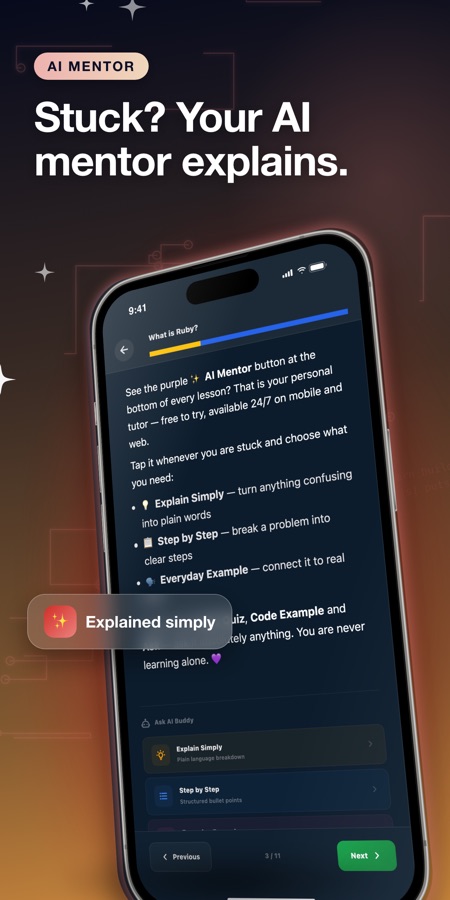
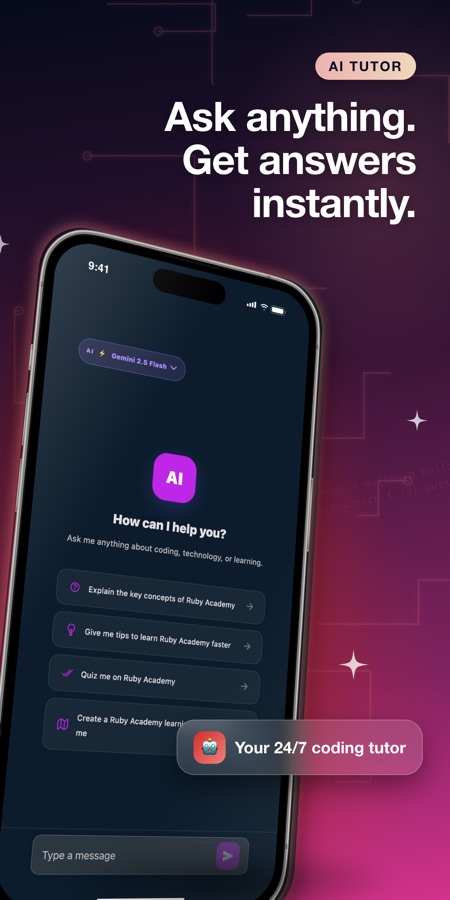
Paste an error message or ask about a method and the AI Mentor explains it. When you finish the path, the question bank and cheat sheet help with interview preparation and a certificate exam is available in Pro.
What's inside
What comes with the app
29
Courses, A1 to C1
109 lessons that start with an introduction to Ruby and strings and finish with metaprogramming, concurrency and performance profiling, with Rails models, controllers and routing along the way.
60
Coding missions
Twenty easy, twenty medium and twenty hard exercises, each checked against what your code prints, plus 20 guided projects such as a JSON round trip, an Enumerable mixin and pattern matching.
Editor
Ruby editor and compiler
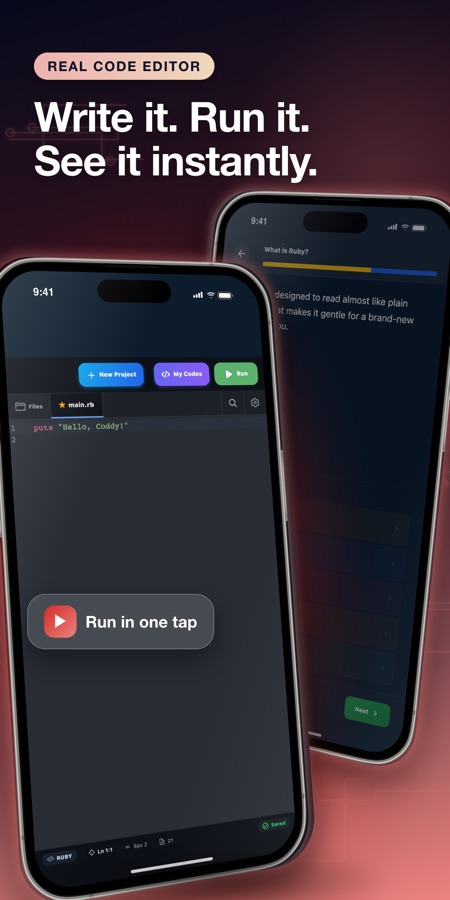
Write a script, run it and see its real output on the same screen. Scripts run on the app's server, so a connection is needed to run them.
AI
AI Mentor
Ask about an error message, a method or a concept and get a clear explanation. A daily allowance is free, and Pro makes it unlimited.
50+50
Quiz and interview questions
Fifty quiz questions with explanations and fifty Ruby interview questions, backed by a 73-entry cheat sheet for quick reference.
3
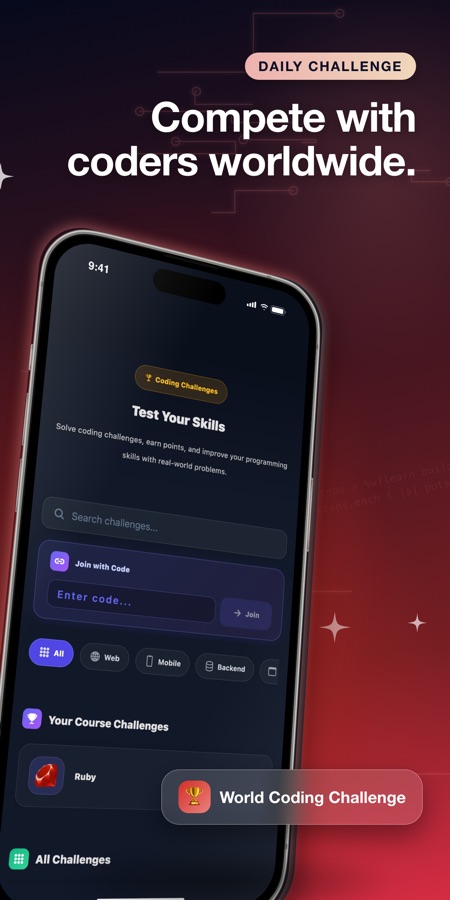
Global rounds every day
The World Coding Challenge sets three rounds a day to solve in Ruby and climb a leaderboard. A skill tree, streaks, reminders, notes and saved code keep practice regular.
Background
What is Ruby used for, and do you need to learn Rails?
Ruby is a general-purpose language created by Yukihiro Matsumoto and first released in 1995, designed to read cleanly and to make small programs pleasant to write. It is used for web back ends, scripting and automation, and command-line tools. You do not need Rails to learn Ruby, but many people meet Ruby because of Rails, the web framework written in it, so a solid grounding in the language makes the framework far easier to follow.
Everything is an objectthe idea behind the syntax
In Ruby even numbers and strings are objects with methods you can call, so a line such as 5.times or name.upcase reads almost like a sentence. Once that clicks, the object-oriented lessons feel like a continuation rather than a new subject.
Blocks and iteratorshow Ruby loops
Instead of counting with an index, Ruby code usually hands a block to a method such as each, map or select. Procs, lambdas and custom iterators build on the same idea, and it is one of the habits that makes Ruby code look different from other languages.
Gems and Bundlerreusable libraries
A gem is a packaged Ruby library, and Bundler keeps a project's gems at the versions it needs. Rails itself is distributed as a gem, which is why finding, installing and eventually building one is part of a complete Ruby course.
Rails and Sinatratwo ways to build for the web
Rails is a full-featured framework with models, controllers and routing included, while Sinatra is a small library for building a web API with a few routes. Both are built on plain Ruby, so a student who understands classes, modules and hashes can read either.
Fit
Who it's for — and who it isn't
A good fit if you
- Want a readable first language and are starting programming from zero
- Are a developer adding Ruby or a first look at Rails to your skills
- Study with a class and want extra practice with missions between lessons
- Are changing careers towards backend web development and want guided projects
- Are preparing for a Ruby interview and want a question bank and a cheat sheet
Not the right tool if you
- Need to run Ruby offline — the editor runs scripts on the app's server and needs a connection
- Expect to run a Rails app inside the app — Rails and Sinatra are taught through lessons and examples, and the editor runs plain Ruby
- Want everything free: the first course and a few missions are free, and Pro unlocks every course and mission
- Already ship Ruby professionally and want reference documentation rather than a course
Privacy
What the app sends
Because the editor runs your scripts on the app's server, the code you choose to run is sent there to be executed. Questions for the AI Mentor are sent to an AI service to produce an answer.
Full details are in the CoddyKit privacy policy.
Questions
Frequently asked questions
What is the best way to learn Ruby programming on a phone?
Short lessons that you can run immediately work well, because the idea and the output stay together. Learn Ruby & Rails: Code & Run pairs a few minutes of theory with an editor where you change and run a snippet, followed by quizzes and missions checked against your output. You can learn in gaps such as a commute, then practise on a bigger screen later.
Do I need to learn Rails to learn Ruby?
No. Ruby is a language in its own right, and Rails is a web framework written in it. The app teaches plain Ruby first, covering strings, hashes, blocks, classes and modules, and introduces Rails models, controllers and routing near the end of the 29 courses, along with Sinatra for small web APIs.
Does the app have a Ruby compiler and editor?
Yes. The built-in Ruby editor lets you write a script, run it and read the real output inside the lesson. The code runs on the app's server, so you need an internet connection to run it, and the editor runs plain Ruby rather than a Rails application.
How many courses, lessons and missions are there?
Learn Ruby & Rails: Code & Run has 29 courses and 109 lessons, levelled from A1 beginner to C1 advanced. Practice includes 60 coding missions split evenly across easy, medium and hard, 20 guided projects, 50 quiz questions and 50 interview questions.
Do I need programming experience to start?
No. The course assumes you are new, starts with what Ruby is and how to write a first program, and explains each concept in plain language. Beginners, students who want extra practice and people switching careers are the audience it is written for.
What does the AI Mentor do in the Ruby app?
When you hit an error message, an unfamiliar method or a concept that will not click, you can ask the AI Mentor and receive a clear explanation. The free version includes a daily allowance of questions, and Pro makes the AI Mentor unlimited.
Does the app help with Ruby interview preparation?
It includes a bank of 50 Ruby interview questions and a 73-entry cheat sheet, and the missions and guided projects give you code to talk through. A certificate exam is available in Pro when you finish the tutorial path.
Is Learn Ruby & Rails: Code & Run free?
It is free to download and start. The first course, two coding missions, the first guided project and a daily AI Mentor allowance are free, and the free version shows ads. Pro unlocks every course, mission and project, the certificate exam and unlimited AI Mentor, and removes ads.
Is Learn Ruby & Rails: Code & Run on iPhone and Android, and why does the App Store name differ?
Yes. The app is on the App Store (iOS 15.1 or later, rated 4+) and on Google Play, and the interface is available in 22 languages. Google Play lists it as "Learn Ruby & Rails: Code & Run" and the App Store lists it as "Learn Ruby: Code & Build"; it is the same Ruby course on both.
Get started
Write your first line of Ruby
Free to start on iOS and Android, in 22 languages.
More from CoddyKit
Available on iOS and Android.