
Education · Free · iOS & Android
By CoddyKit
Learn Cryptography: Encryption — an app to learn cryptography on your phone
Learn Cryptography: Encryption is a free iOS and Android app for complete beginners, students and career switchers. It turns cryptography into 100+ bite-sized lessons of five to ten minutes each, with a real code editor on your phone and an AI Mentor that answers your questions in seconds.
- Price
- Free, Pro optional
- Platforms
- iOS and Android
- Languages
- 22
- Age rating
- 4+
- App Store
- 5.0 (1)
Built for real life, not lecture halls.
A five-to-ten-minute lesson is a size that survives a normal week. It fits a bus ride or a queue, which is the only reason most people ever reach lesson forty.
What it is
Learn Cryptography: Encryption is a free education app for iOS and Android that teaches cryptography from scratch, assuming no prior experience. It divides the subject into more than 100 lessons of five to ten minutes, each pairing short plain-language theory with hands-on practice, and includes a code editor for writing and running code on the phone itself. Quizzes and coding challenges follow every topic, and an AI Mentor answers questions as they come up.
Background
What is cryptography?
Cryptography is the study of protecting information so that only the intended reader can use it. It covers encryption, which scrambles a message so it is unreadable without the right key; hashing, which turns data into a fixed-length fingerprint; and the key exchange and signature schemes that let strangers trust each other online. It is ordinary applied mathematics, taught openly in universities and used by every website you visit.
Encryptionthe core idea
Turning readable data into ciphertext using a key, so that anyone without the key sees noise. The same process run in reverse, with the right key, gives the original message back.
Symmetric keyAES and friends
One shared secret both encrypts and decrypts. It is fast and used for bulk data, but the two sides have to agree on that secret without anyone else overhearing it.
Public-key cryptographyRSA and friends
Each person has a public key others encrypt to and a private key only they hold. It solves the sharing problem, and the same maths lets you sign something so others can verify it.
Hash functionnot encryption
A one-way fingerprint of data, always the same length. There is no key and no way back, which is why hashes suit password storage and integrity checks rather than sending secrets.
How it works
How a session works
The app is shaped around short sittings rather than long study blocks: one lesson, one piece of practice, one check that it stuck.
Take one lesson
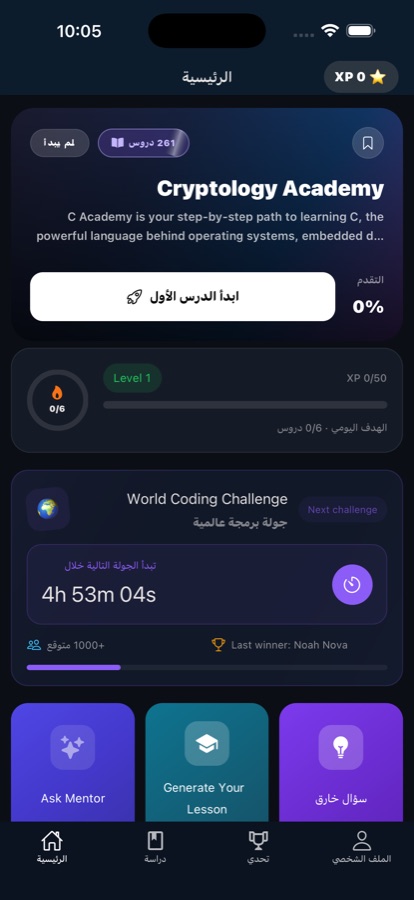
Open a topic and take a single lesson at a time. Each runs five to ten minutes and mixes short plain-language theory with something to do, so a session fits a bus ride, a coffee queue, or the gap before a lecture starts.
Write the code on the phone
The built-in editor lets you write and run cryptography code without a laptop. Practice follows the theory inside the same lesson, so the idea you just read gets typed out and executed while it is still fresh in your head.
Check it stuck, and ask when it did not
Quizzes and coding challenges close every topic. When something does not make sense — a concept or an error message — the AI Mentor answers in seconds, and streaks, progress tracking and reminders keep the next session from slipping.
What’s inside
What comes with the app
100+
Bite-sized lessons
More than a hundred lessons covering cryptography fundamentals step by step, the building blocks used in real work, common mistakes, and advanced topics for afterwards.
5–10
Minutes per lesson
Every lesson is sized for a real day rather than a study session, which is what makes daily progress on a phone possible at all.
AI
AI Mentor
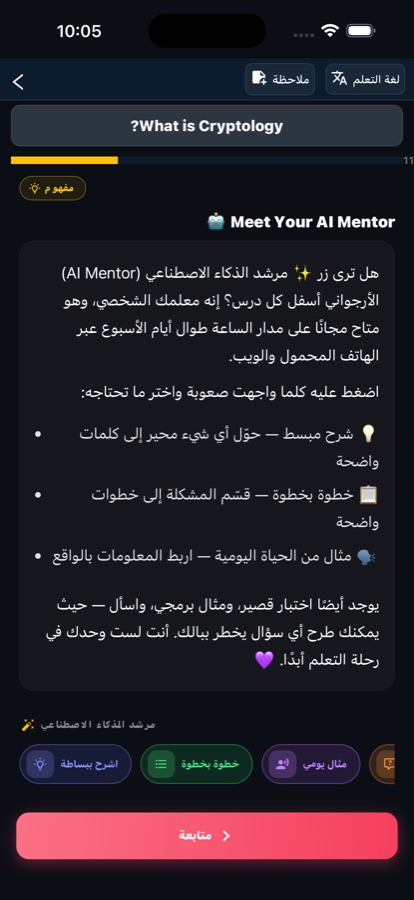
Stuck on a concept or an error message? Ask anything and get a clear answer in seconds, instead of losing the evening to a search engine.
</>
Real code editor
Write and run cryptography code directly on your phone. The practice after each topic happens in the editor, not as a multiple-choice guess about code.
1/wk
Weekly Code Challenge
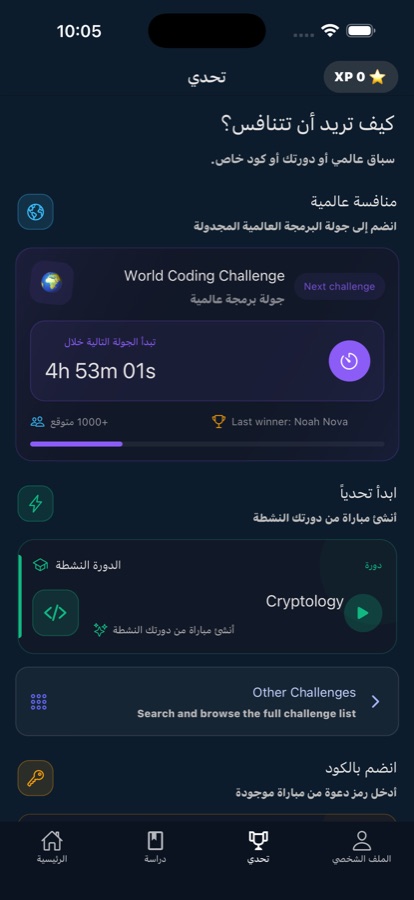
A challenge each week, competing with learners around the world — a reason to come back that is not just a streak counter.
Cert
Certificate of completion
Pass the final exam and get a certificate of completion, alongside the quizzes and coding challenges that follow every topic.
Inside the app
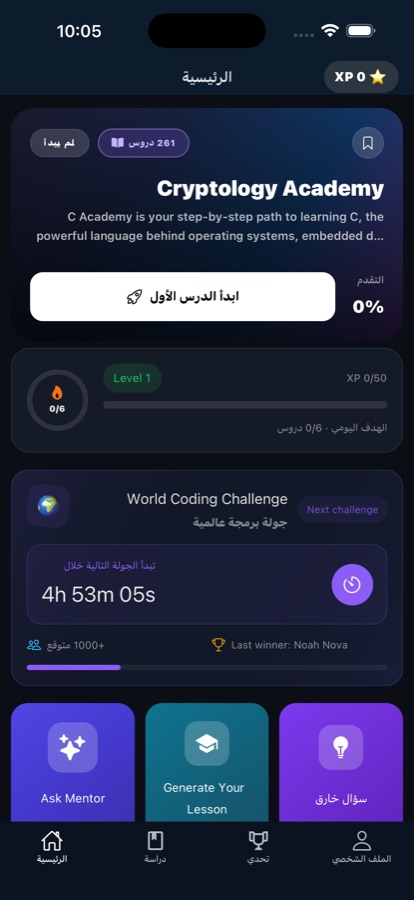
What it looks like
Fit
Who it’s for — and who it isn’t
A good fit if you
- Are starting cryptography from zero and want it explained in plain language
- Learn on a phone, in short sessions, rather than at a desk for an hour
- Want to type and run real code instead of only reading about ciphers and keys
- Are a student wanting extra practice alongside classes, or a career switcher building job-ready skills
- Get stuck often and want an AI Mentor to answer rather than trawling forums
Not the right tool if you
- Want a full offline app — lessons are built to survive flaky connections, but the AI Mentor needs one
- Are looking for a tool that attacks or breaks real encryption: this teaches how the maths works and how to use it correctly
- Expect everything free: the first course is free with a daily AI Mentor allowance, and Pro unlocks the rest
- Need an accredited qualification — the certificate is a completion certificate, not a degree
Questions
Frequently asked questions
What is the best app to learn cryptography on a phone?
On a phone, what matters is lesson length, whether you can actually run code, and how fast you get unstuck — desktop-length modules rarely get finished on a commute. Learn Cryptography: Encryption is built around those constraints: over 100 lessons of five to ten minutes, a code editor that runs code on the device, and an AI Mentor that answers concept and error questions in seconds. It is free to start on iOS and Android, in 22 languages.
Can you learn cryptography without a maths degree?
Yes, for the working level most people need. You can understand what encryption does, why a key has to stay secret, how hashing differs from encryption, and where systems usually go wrong without any advanced maths. Modular arithmetic and prime numbers turn up once you look inside RSA, and they are learnable on their own terms. Learn Cryptography: Encryption assumes no experience and explains every concept in plain language from zero.
What is the difference between encryption and hashing?
Encryption is two-way: it scrambles data with a key, and the right key turns it back into the original message. Hashing is one-way: it produces a fixed-length fingerprint of the input with no key and no route back. So you encrypt a message you intend someone to read later, and you hash a password or a file when you only ever need to check whether something matches.
What is the difference between symmetric and public-key encryption?
Symmetric encryption, such as AES, uses one shared secret for both locking and unlocking. It is fast, which is why it protects the bulk of real traffic, but both sides must somehow agree on that secret first. Public-key encryption, such as RSA, gives each person a public key anyone may encrypt to and a private key they never share. In practice the two are combined: public-key maths agrees on a key, symmetric encryption carries the data.
Is cryptography worth learning in 2026?
It stays useful because it underpins everything else: HTTPS, messaging, payments, authentication, signed software updates. Even developers who never implement a cipher need to know which primitive fits a problem and which habits leak secrets. It is also a recognised skill on a resume. The realistic goal for most learners is confident correct use of existing libraries, rather than designing new algorithms, and that is reachable from a standing start.
Does this app teach you how to break encryption?
No. Learn Cryptography: Encryption is a course app: it explains how ciphers, keys, hashes and signatures work, and includes a section on common mistakes and how to avoid them, which is the defensive side of the subject. It does not provide tooling to attack systems or recover other people's data. Understanding why a scheme fails is standard material in any cryptography class, and it is taught here to help you build things correctly.
Is Learn Cryptography: Encryption free?
The app is free to download on the App Store and Google Play. The first course is free, with a daily allowance of AI Mentor questions, so you can work through real lessons before deciding anything. Pro is the paid upgrade: it unlocks every course, removes ads, and makes the AI Mentor unlimited. There is no requirement to upgrade in order to finish the free course.
Does it work offline, on the underground or on a plane?
It is designed for patchy conditions rather than for having no connection at all. Lessons load fast and keep working on flaky connections, which covers most commuting. The AI Mentor is the part that genuinely needs a connection, since it answers your questions live. If a guaranteed fully offline app is what you need, that is worth knowing before you install.
What platforms and languages does it support?
Learn Cryptography: Encryption runs on iOS through the App Store and on Android through Google Play, and the app is available in 22 languages. It is rated 4+ for content, so there is nothing age-restricted in the material. It is one of the CoddyKit coding apps, which share the same lesson format, code editor and AI Mentor across different subjects.
Do you get a certificate at the end?
Yes. Pass the final exam and the app issues a certificate of completion for the course. It is a completion certificate rather than an accredited qualification, so treat it as evidence of the work you did — useful on a CV or in an interview alongside the exercises and challenges you can actually talk through, not as a formal credential.
Start logging
Learn cryptography in the gaps in your day
Free to start on iOS and Android, in 22 languages.
More from CoddyKit
Available on iOS and Android.