
AP Physics Simulator: HS Lab
AP Physics Simulator: HS Lab — Predict the result, run a 3D physics simulation, see how close you were
AP Physics Simulator: HS Lab, called Physics Sandbox inside the app, is a physics simulator and physics lab for high school and AP Physics students on Android, with an iPhone version on the way. You commit to a number first, run a real rigid-body simulation in 3D, then see your guess next to what the engine measured.


- Price
- Free, Pro upgrade
- Platforms
- Android now, coming to iPhone
- Languages
- 10
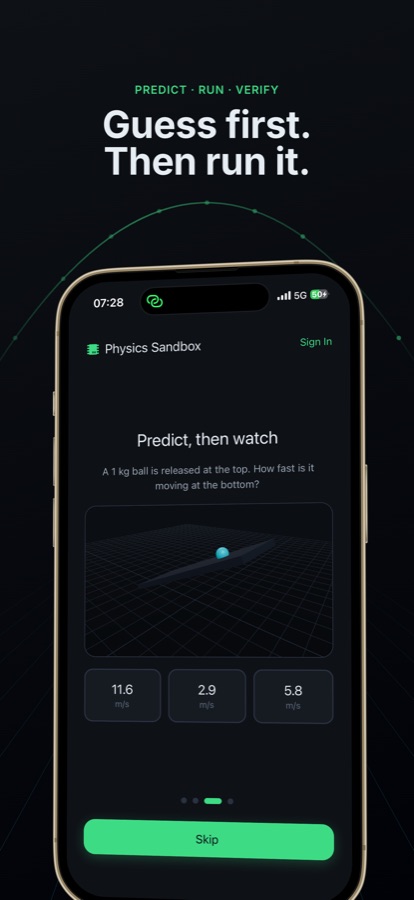
Being able to do the algebra is not the same as knowing what the number will be.
Each lesson asks you to predict a result before the experiment runs: how far the ball lands, how fast the block reaches the bottom of the ramp, how long the pendulum takes to swing. Verify then shows your guess against the measured value, with an honest Off by X percent when you were wrong.
What it is
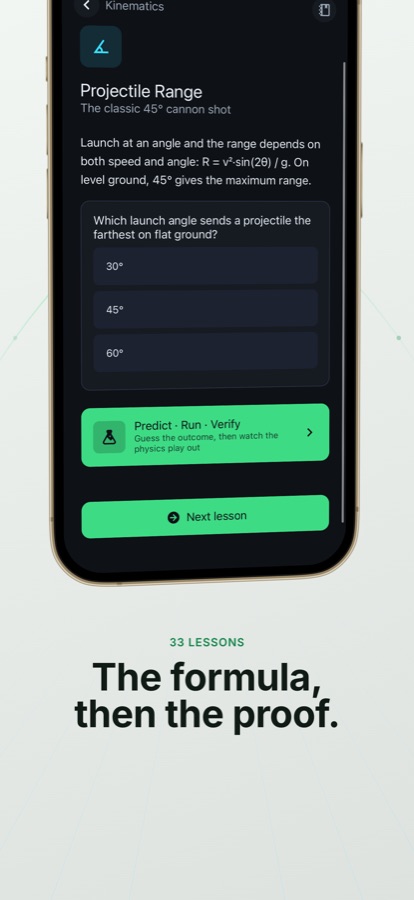
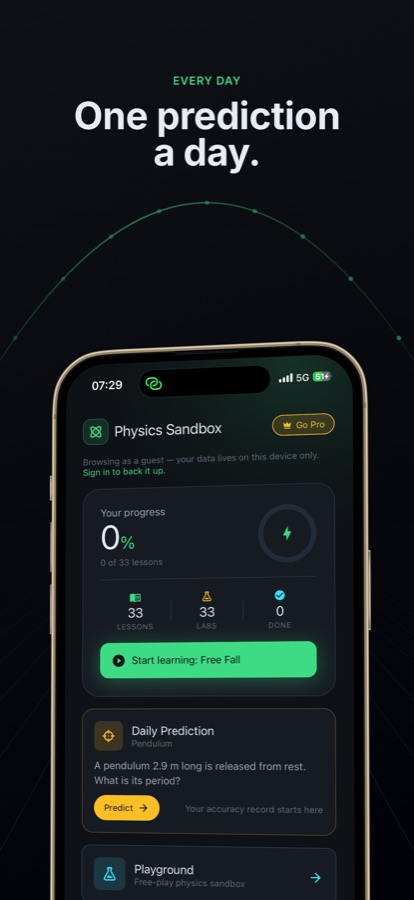
AP Physics Simulator: HS Lab (Physics Sandbox in the app) is a physics practice app for high school and AP Physics students with 33 lessons in four units: kinematics, Newton's laws and friction, energy and momentum, and simple harmonic motion and springs. Each lesson uses a predict, run, verify loop on a real rigid-body physics engine in 3D, and a playground with five adjustable rigs lets you change sliders and run your own experiments.
Inside the app
What it looks like
Background
How do you build physics intuition for kinematics and Newton's laws?
Intuition in mechanics comes from being wrong in a useful way. When you estimate an outcome first, such as the speed of a ball at the bottom of a ramp, then see the real result, the gap between the two tells you which idea you misunderstood. Working from the formula alone hides that gap, because a correct substitution can hide a poor sense of what the answer should be. That is why simulation with a prior guess is a good complement to textbook problems in a first physics course or in AP Physics 1.
Kinematicsdescribing motion without asking why
Free fall, projectile motion, horizontal launch and velocity-time graphs describe where something is and how fast it moves. A classic result is that on level ground a projectile travels farthest when launched at 45 degrees, from R = v squared times sin of 2 theta, divided by g.
Newton's laws and frictionforce explains the change in motion
Inertia, F = m a and action and reaction connect force to acceleration. Ramps add components of weight, and friction adds a force that opposes sliding or rolling. Changing the angle, the mass or the friction coefficient and re-running shows which of them actually matters.
Energy and momentumwhat is conserved in a collision
Momentum is conserved in collisions, and kinetic energy is conserved only in elastic ones. Restitution describes how bouncy a collision is, which is why the same two carts can end up moving very differently.
Simple harmonic motionsprings and pendulums
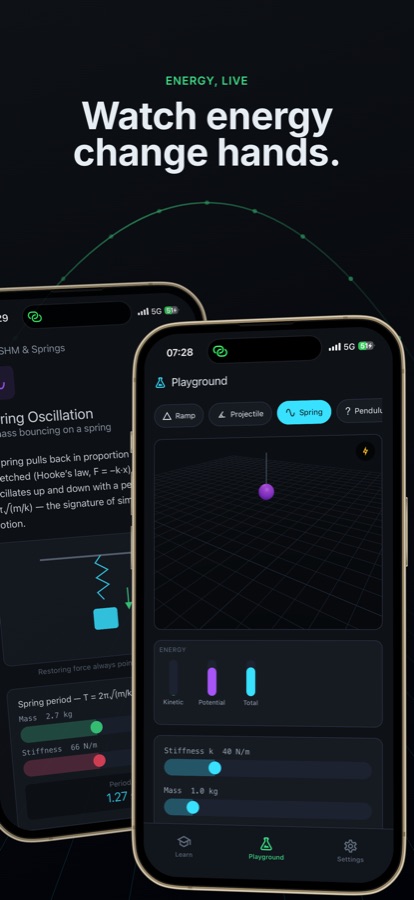
A spring pulls back in proportion to how far it is stretched, which is Hooke's law, and a mass on it oscillates with a period set by the mass and the stiffness. A pendulum's period depends on its length rather than its mass, which is not what everyday intuition suggests.
How it works
The predict, run, verify loop
Every lesson and every daily challenge follows the same three beats.
Predict
Read a short explanation, then commit to an answer: pick a value, choose a launch angle or estimate a period. The answer is locked before anything moves.
Run
Press Run and watch gravity, friction and collisions play out frame by frame in a 3D scene driven by a rigid-body engine, not a pre-made animation. You can orbit the camera while it runs.
Verify
The result screen sets your prediction beside the measured value and says how far off you were. Ask Why for a short AI explanation of the physics behind what you just watched.
What's inside
What is in the lab
33
Lessons in four units
Kinematics has 8 lessons, Newton's laws and friction 9, energy and momentum 9, and simple harmonic motion and springs 7.
5
Adjustable rigs
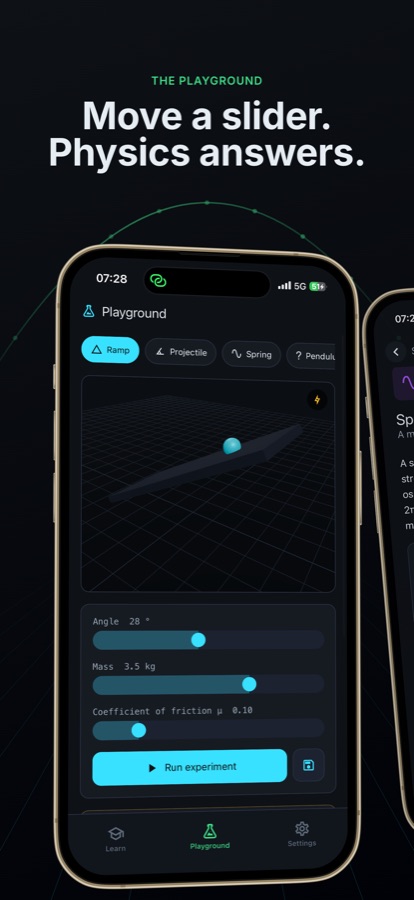
A ramp, projectile motion, springs, pendulums and collisions, each with sliders such as angle, mass and the friction coefficient, run by the same engine as the lessons.
Daily
Daily prediction
One graded prediction each day, sampled from the rigs, with an accuracy record split by unit and a streak for correct calls. It works offline and has an optional reminder that is off by default.
Off by %
Honest feedback
Verify compares your guess to the measured result and states how far off you were, so being wrong tells you something.
Why?
AI explanations
Ask Why after a run to get a short explanation of the physics behind the result.
10
Languages and themes
The app comes in 10 languages with light and dark themes, and tracks lessons completed, prediction accuracy and streak, unit by unit.
Fit
Who it's for — and who it isn't
A good fit if you
- Are studying AP Physics 1 or a first high school physics course
- Can solve the algebra but are unsure what the answer should look like
- Want to see what happens when a ramp angle or a spring stiffness changes
- Like a short daily challenge with a running accuracy record
- Are an adult relearning mechanics
Not the right tool if you
- Need a complete textbook or exam-board syllabus; the app covers four mechanics units
- Want an iPhone version today; it has not been released
- Expect all 33 lessons to be free; 12 are, and Pro adds the other 21
- Want an official AP practice exam; this is a simulator and practice tool
Questions
Frequently asked questions
What is AP Physics Simulator: HS Lab?
AP Physics Simulator: HS Lab, named Physics Sandbox in the app, is a 3D physics simulator and lab for high school and AP Physics students. It has 33 lessons in four mechanics units, a playground with five rigs, a daily prediction and AI explanations. It is on Android now, and an iPhone version is coming.
How is it different from a physics video or a worksheet?
You make a prediction before the experiment runs, and a real rigid-body engine then plays out the result. The app shows your guess beside the measured number, so feedback is specific. It is a practice tool built around that loop, not a video lecture or a canned animation.
Which topics does the app cover?
Four units: kinematics, with free fall, projectile motion, horizontal launch and velocity-time graphs; Newton's laws and friction; energy and momentum, including elastic and inelastic collisions and restitution; and simple harmonic motion and springs, including Hooke's law and pendulum period.
Is it useful for AP Physics 1?
It can support your study of mechanics, which is a large part of a first physics course, by building a feel for how forces, energy and oscillations behave. It does not replace a textbook or official practice exams, and it makes no claim to match any exam syllabus.
What can I do in the playground?
Choose one of five rigs, a ramp, projectile motion, springs, pendulums or collisions, drag the sliders and run the experiment. Because the playground uses the same engine as the lessons, a changed slider is a genuine experiment. The whole playground, including all five rigs, is free.
What is the daily prediction?
A new challenge each day that asks you to predict a result drawn from the rigs, graded by the same simulator. The app keeps an accuracy record split by unit and a streak of correct predictions. It is free, works offline and has an optional reminder that you can switch on in Settings.
What is free and what does Pro add?
Free: all 8 kinematics lessons, the first two Newton and friction lessons, one sampler lesson from each of energy and momentum and SHM and springs, the entire playground, the daily prediction and 3 AI Why explanations a day. Pro adds the remaining 21 lessons, unlimited Why explanations and no ads.
Can I use it without signing in?
Yes. The home screen says you are browsing as a guest and that your data lives on the device, with an option to sign in later to back it up.
When will the iPhone version arrive?
No date is announced. The Android version is available on Google Play now. This page will show the App Store link as coming soon until the iPhone app is released.
Get started
Make your first prediction
Free to start on Android, iPhone coming, in 10 languages.
More from CoddyKit
Available on Android.