
Plate Tectonics: Volcano Lab
Plate Tectonics: Volcano Lab — Learn geology by setting the conditions and watching the Earth respond
Plate Tectonics: Volcano Lab is a free Android app for learning geology by experiment. In the 3D Plate Lab you choose how two plates move, and in the Volcano Lab you dial in magma chemistry, then watch the landform, the eruption style and the earthquake severity follow, with a 44-lesson course behind both.

- Price
- Free, Pro upgrade
- Platforms
- Android, on Google Play
- Languages
- 10
- Account
- Guest start, no account needed
Set it, run it, then read what happened.
A plate diagram is easy to nod at and hard to remember. Here you pick a plate motion and a pairing of oceanic and continental plates, run the boundary, and a readout names the landform, says whether it is volcanic and gives a real example. The same geology tables write the lessons and drive the labs, so what you read is what you see.
What it is
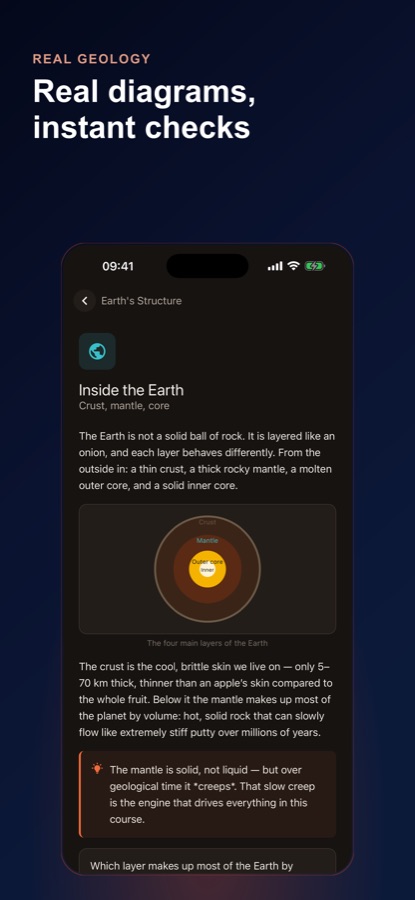
Plate Tectonics: Volcano Lab is a free Android app on Google Play that teaches plate tectonics, volcanoes and earthquakes through two 3D labs and a 44-lesson course. The Plate Lab lets you set plate motion and plate type and watch a ridge, a subduction zone or a mountain belt form, while the Volcano Lab lets you slide silica and dissolved gas to see an eruption change from a lava flow to an ash column. Four units, 44 quizzes, 20 real-world case studies and fault-slip mini-labs round it out.
This is a teaching model built on standard geology classifications. It is not a live seismic feed and never forecasts when or where a real earthquake or eruption will happen. For real hazards, follow your local emergency authorities..
Inside the app
What it looks like
Background
How do moving plates produce earthquakes, volcanoes and mountains?
The Earth's rigid outer shell is broken into plates that creep over the softer, slowly flowing mantle at a few centimetres a year. Most earthquakes, volcanoes and mountain belts sit along plate boundaries, because that is where plates pull apart, collide or grind past one another. What happens at a boundary depends on which way the plates move and on whether each one is thin oceanic crust or thick continental crust.
Three kinds of plate boundarypull apart, push together, slide past
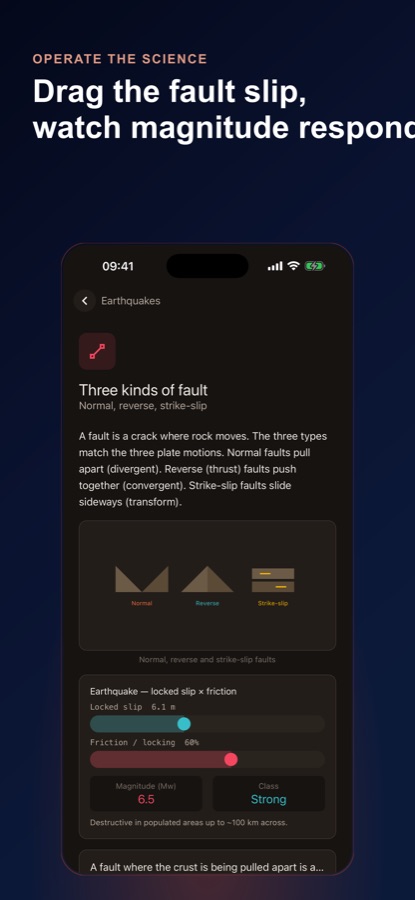
At a divergent boundary plates separate and new crust forms, as along a mid-ocean ridge. At a convergent boundary they push together, building mountain belts or sinking one plate beneath another, and at a transform boundary they slide sideways, which produces strike-slip faults.
Subduction and volcanic arcswhere one plate sinks
When dense oceanic crust meets another plate it can sink into the mantle in a subduction zone. Water released from the sinking slab helps melt rock above it, which is why a chain of volcanoes often lines the coast beside a deep ocean trench.
Silica, gas and eruption stylewhy some volcanoes ooze and others explode
Magma rich in silica is sticky and traps dissolved gas, so pressure builds until it erupts violently as an ash column, as at Pinatubo. Runny, low-silica magma lets gas escape and tends to flow as lava, as at Kilauea. Changing those two settings in the Volcano Lab shows the shift.
Fault slip and earthquake sizemagnitude from slip and friction
An earthquake happens when a locked fault slips. A bigger slip across a larger locked area releases more energy, and each whole step up in moment magnitude is roughly 32 times more energy, which is why a magnitude 7 is far stronger than a 6.
How it works
How you learn in the app
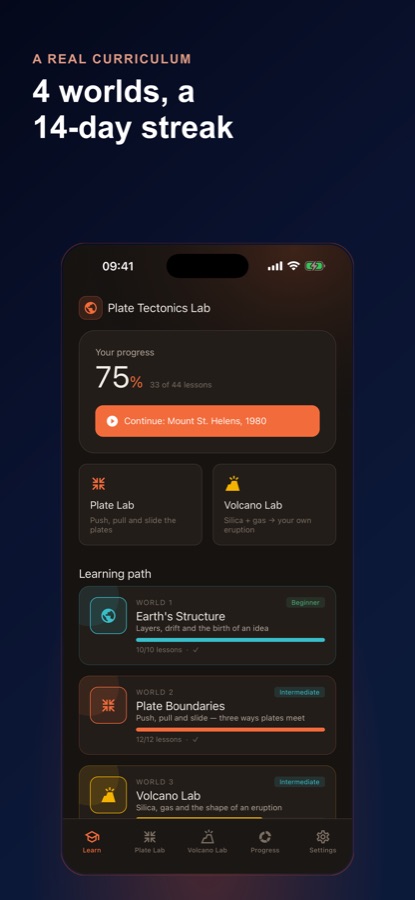
The course is organised into four worlds, and each one unlocks a lab you can experiment in.
Work through a world
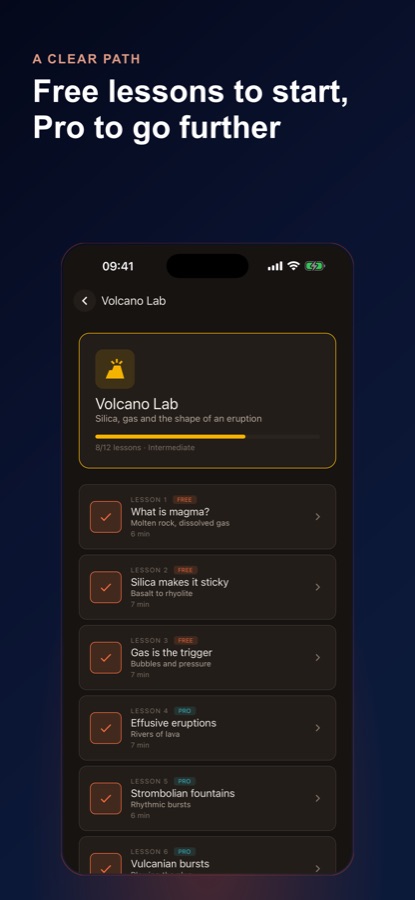
Take short lessons across four units: Earth's Structure, Plate Boundaries, the Volcano Lab and Earthquakes. Hand-drawn diagrams explain each major idea, and a quiz with worked explanations closes each lesson.
Experiment in a lab
In the Plate Lab choose a motion and a plate pairing and run it; in the Volcano Lab move the silica and gas sliders. Inside lessons, mini-labs let you drag sliders for fault slip, plate motion, magma chemistry and isostasy and watch the result recompute.
Connect it to a real place
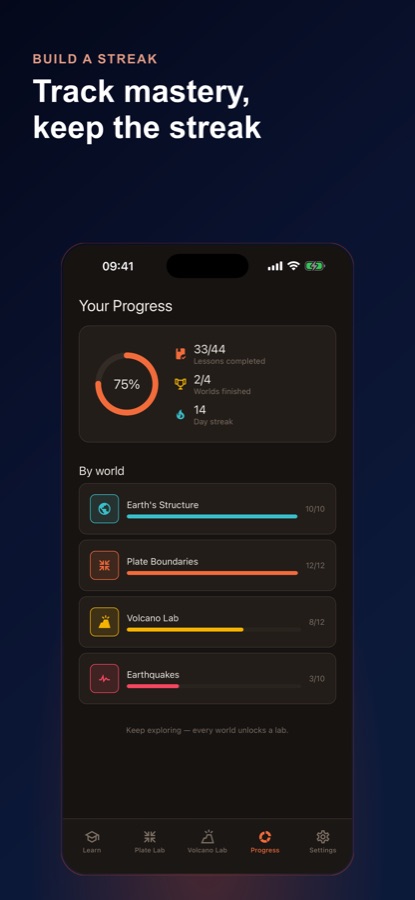
Case studies drawn from real plate boundaries and volcanoes, from the East African Rift to Mount St. Helens, tie each result to somewhere on the map. A day streak tracks your habit.
What's inside
What is in the app
44
Lessons in four units
Earth's Structure, Plate Boundaries, the Volcano Lab and Earthquakes, each with quizzes that explain the answers. The first three lessons of every unit, 12 in all, are free.
3D
Plate Lab and Volcano Lab
Set plate motion and plate type and watch a boundary form, or dial silica and gas and watch the eruption style change. A readout gives the landform, whether it is volcanic, typical earthquake severity and a real-world example.
20
Real-world case studies
Cases taken from actual plate boundaries and volcanoes, such as the Mid-Atlantic Ridge, the Himalayas, Kilauea and Pinatubo. Free lessons unlock three of them, and Pro opens all 20.
Sliders
Mini-labs inside lessons
Drag fault slip and friction and watch the magnitude class recalculate on the spot, or move plate motion, magma chemistry and isostasy sliders in other lessons.
1
One source of geology
The course and both labs read from the same geology tables, so a lesson never teaches one outcome while a lab shows another.
Free
Labs free, depth in Pro
Both labs are free with unlimited plate configurations. Pro adds the remaining 32 lessons, the full case library, unlimited eruption animations, AI explanations of any result and no ad banner.
Fit
Who it's for — and who it isn't
A good fit if you
- Are meeting plate tectonics for the first time and want to see it, not just memorise a diagram
- Are a curious adult who wants to know why some volcanoes ooze while others explode
- Like to change one setting and see the result immediately
- Want short lessons with quizzes that explain why an answer is right
- Want real examples, from the East African Rift to Mount St. Helens, attached to each idea
Not the right tool if you
- Use an iPhone — the app is only on Google Play
- Want a live earthquake or volcano alert; this is a teaching model, not a monitoring tool
- Need university-level geophysics with full mathematics
- Expect every lesson free — 12 of 44 lessons are free, and Pro unlocks the remaining 32
Privacy
Accounts and data
You can start the first lesson as a guest with no account. The optional AI explanations in Pro send the result you ask about to an AI service so it can explain it.
Full details are in the CoddyKit privacy policy.
Questions
Frequently asked questions
What is the best app to learn plate tectonics?
One where you can change something and see the result. Plate Tectonics: Volcano Lab pairs a 44-lesson course with two 3D labs: choose how two plates move and watch the landform appear, or set magma chemistry and watch an eruption change. Each lesson ends with a quiz that explains the answers. It is free to start on Android.
How does the Plate Lab work?
You pick a motion, either plates pulling apart, pushing together or sliding past, and a pairing of oceanic and continental plates, then run it. A mid-ocean ridge rises, a slab sinks under a chain of volcanoes, or two continents crumple into a mountain belt, and a readout names the landform, says whether it is volcanic, rates typical earthquake severity and gives a real example.
Why do some volcanoes erupt gently and others explosively?
It comes down mainly to the magma's silica content and dissolved gas. Sticky, high-silica magma traps gas and can erupt as an ash column, as at Pinatubo, while runny, low-silica magma lets gas escape and flows as lava, as at Kilauea. The Volcano Lab lets you move both sliders and watch the eruption style change.
Can the app predict earthquakes or eruptions?
No. Plate Tectonics: Volcano Lab is a teaching model built on standard geology classifications. It is not a seismic feed and never predicts when or where a real earthquake or eruption will happen. For real hazards, follow your local emergency authorities.
What topics does the course cover?
The course has 44 lessons in four units: Earth's Structure with 10 lessons, Plate Boundaries with 12, the Volcano Lab with 12 and Earthquakes with 10. There are also 44 quizzes with worked explanations, hand-drawn diagrams for each major concept and 20 case studies.
What is the fault-slip mini-lab?
Inside an earthquake lesson you drag two sliders, locked slip and friction, and the app recalculates the earthquake's magnitude and class on the spot. It is a quick way to see how slip and locking combine to set an earthquake's size.
Is Plate Tectonics: Volcano Lab free?
It is free to download. Free learners get the first three lessons of each unit, 12 of 44, both 3D labs with unlimited plate configurations and full readouts, and three real-world cases. The Volcano Lab's eruption animation has a daily cap on the free tier. Pro, a monthly or annual subscription, adds the remaining 32 lessons, all 20 cases, unlimited eruption animations, AI explanations and no ad banner.
Do I need a science background?
No. The first unit starts with the structure of the Earth, and every idea is something you set and watch rather than memorise. It is aimed at students meeting the topic for the first time and at curious adults.
Is there an iPhone version, and what languages does it support?
Plate Tectonics: Volcano Lab is an Android app on Google Play and has no iPhone version. The interface is available in 10 languages with light and dark themes.
Get started
Set the plates in motion
Free on Android, with a Pro upgrade for the full course and case library.
More from CoddyKit
Available on Android.