
Optics Light Lab: Ray Tracing
Optics Light Lab: Ray Tracing — An optics simulator where mirrors, lenses and prisms trace every beam
Optics Light Lab: Ray Tracing is a free Android optics simulator that makes geometric optics something you can touch. Place mirrors, lenses and prisms on a 3D optical bench and a ray-tracing engine recomputes every reflection and refraction as you move them. 38 lessons, 18 labs and a 50-level laser puzzle ladder are all graded by that same engine, and the whole app works offline.

- Price
- Free, Pro upgrade
- Platforms
- Android
- Languages
- 10
The rainbow is computed, not drawn.
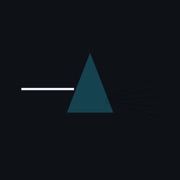
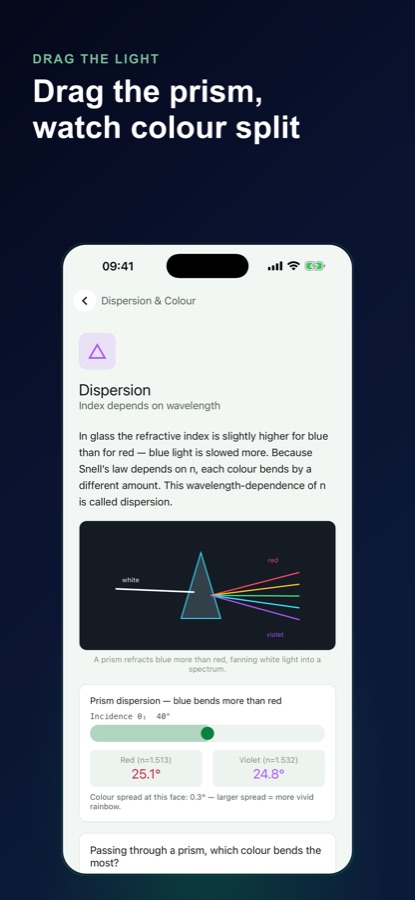
Switch the laser to white light and aim it at a prism, and one beam fans into seven separately traced wavelengths, each bent by its own refractive index. There is no pre-rendered path underneath, so when you get an angle wrong you can see by exactly how much.
What it is
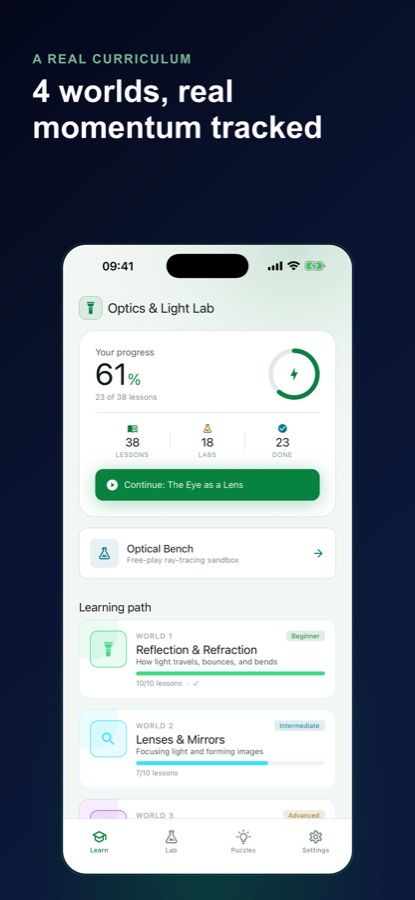
Optics Light Lab: Ray Tracing is a free Android app for learning geometric optics with a live ray-tracing simulator. It has 38 lessons in four worlds (Reflection and Refraction, Lenses and Mirrors, Dispersion and Color, Deep Optics), 18 optical-bench labs, 4 interactive simulations, a sandbox with 9 element types and 15 optical materials, and 50 laser puzzles. Every lesson, diagram, lab and puzzle is bundled on the device, so it works offline.
Inside the app
What it looks like
Background
How do mirrors, lenses and prisms bend light, and what is ray tracing?
Geometric optics treats light as rays that travel in straight lines until they meet a surface. At a mirror a ray reflects so that the angle in equals the angle out, and at the boundary of two materials such as air and glass it bends according to Snell's law. Ray tracing is the method of following each ray through every surface it hits, which is how a computer can show where a lens focuses a beam or how a prism splits white light into colours. Because the rules are exact, a simulator can check your answer by tracing the beam and seeing whether it lands on the target.
Law of reflectionangle in equals angle out
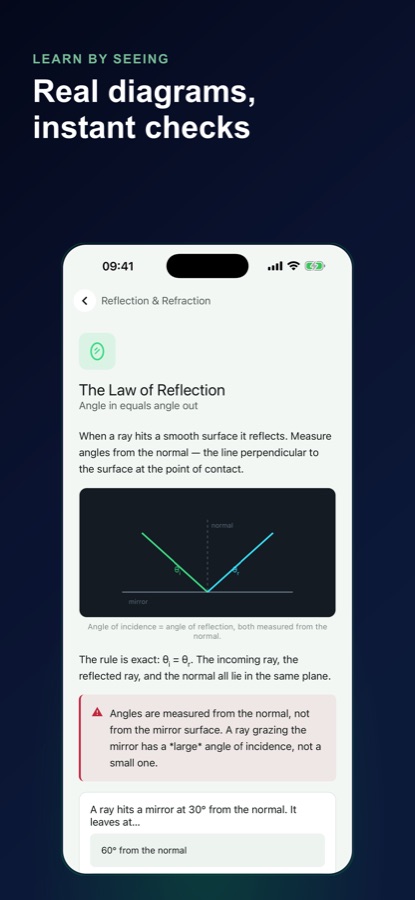
A ray hitting a smooth surface leaves at the same angle it arrived, measured from the normal, the line perpendicular to the surface. A common mistake is measuring from the mirror surface itself instead.
Snell's law and refractive indexhow light bends entering glass
When light passes from one material into another it changes speed and direction. The refractive index of each material, from ice to diamond, sets how much it bends, and a larger index bends the ray more.
Thin-lens equationwhere a lens makes an image
For a thin lens, 1/f equals 1/do plus 1/di, linking the focal length f to the object distance and the image distance. It explains why a converging lens can form a larger, smaller, upright or inverted image depending on where the object sits.
Dispersion and total internal reflectioncolour spreading and trapped light
Dispersion happens because the refractive index differs slightly for each colour, so a prism bends blue more than red. Beyond a critical angle inside a denser material, light cannot escape and reflects fully, which is the idea behind optical fibres.
How it works
How a lesson and a lab fit together
Every lesson pairs a short explanation with a live optical bench, so the rule and the picture arrive together.
Read the rule with a diagram
Each lesson explains one idea, for example the law of reflection, with a hand-drawn diagram and an instant check question. Warnings point out the usual slips, such as measuring from the wrong line.
Move the optics on the bench
Rotate a mirror, swap a lens or drop a prism into the beam. The ray tracer recomputes the path in real time, and sliders for Snell's law, the thin lens, the critical angle and prism dispersion show their own readouts as you drag.
Prove it with a lab or a puzzle
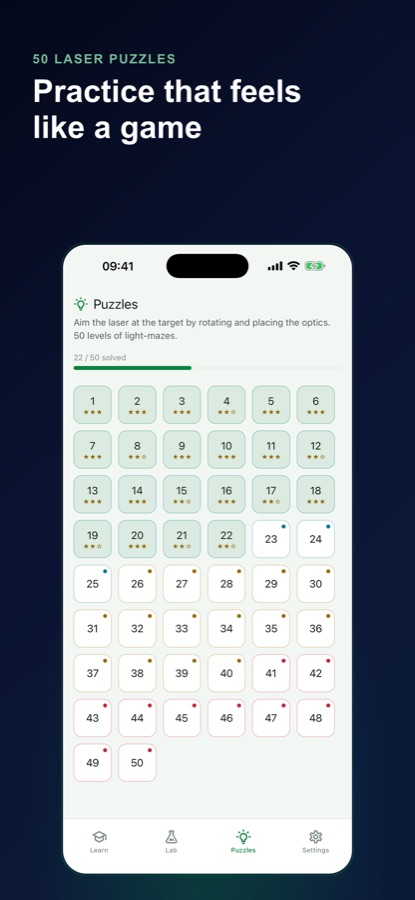
Labs inside the lessons are graded by the same engine that draws the beam. Puzzles ask you to aim the laser at a target by rotating and placing optics, from single-mirror shots to three-mirror staircases with decoy prisms and blockers.
What's inside
What is in the app
38
Lessons in 4 worlds
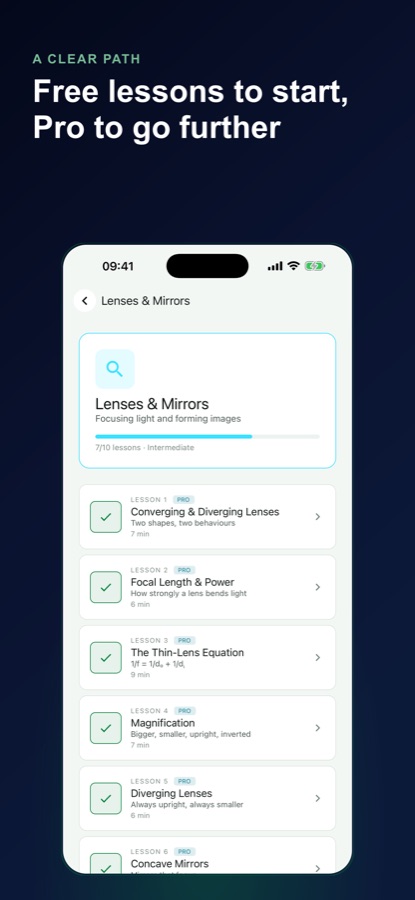
Reflection and Refraction, Lenses and Mirrors, Dispersion and Color, and Deep Optics, covering Snell's law, curved mirrors, the thin-lens equation and total internal reflection.
50
Laser puzzles
A ladder of light mazes, every level checked by the engine to be solvable before it shipped.
18
Optical-bench labs
Hands-on tasks built into the lessons and graded by the ray-tracing engine that draws the beam.
9
Sandbox element types
Flat, concave and convex mirrors, converging and diverging lenses, prisms, blockers, targets and the laser. Drag to orbit, pinch to zoom, and save builds to reopen later.
15
Real optical materials
From ice to diamond, each with its own refractive index. Swap the glass in a prism and watch the spectrum widen or narrow.
AI
AI tutor
Ask for an explanation of what your bench is doing, or a hint when a puzzle has you stuck. Free accounts get 2 explanations and 1 hint a day.
Fit
Who it's for — and who it isn't
A good fit if you
- Study physics and want to see how a lens bends light, not only memorise a formula
- Teach or tutor optics and want a bench students can change and test themselves
- Like puzzle games and enjoy aiming a laser with mirrors
- Are curious why a prism makes a rainbow or how total internal reflection works
- Need to study without a connection, since the content is bundled offline
Not the right tool if you
- Need an iPhone app, because the app is on Android only for now
- Want wave optics, such as interference and diffraction, since the app covers geometric optics
- Expect all four worlds and all 50 puzzles free: World 1 and the first 10 levels are free and Pro unlocks the rest
- Dislike ads, as the free version shows ads between screens
Questions
Frequently asked questions
What is the best app to learn optics and ray tracing on a phone?
An optics simulator lets you change the setup and watch the light respond. Optics Light Lab: Ray Tracing pairs 38 short lessons with a live 3D optical bench, where a ray-tracing engine recomputes each reflection and refraction as you move mirrors, lenses and prisms. It is free to start on Android and works offline.
What is geometric optics?
Geometric optics models light as rays that travel in straight lines and change direction only at surfaces, through reflection and refraction. It explains mirrors, lenses, prisms and simple optical instruments. Optics Light Lab: Ray Tracing teaches it through four worlds, from Reflection and Refraction to Deep Optics.
How does a prism split white light into colours?
The refractive index of glass is slightly higher for blue light than for red, so each colour bends by a different amount at the surface. This is called dispersion. In Optics Light Lab: Ray Tracing you can switch the laser to white light and watch one beam fan into seven separately traced wavelengths.
Do I need to know Snell's law before I start?
No. World 1 builds up from the law of reflection to Snell's law, with diagrams and instant checks, so a formula you have only memorised becomes something you can test. Optics Light Lab: Ray Tracing also includes a Snell's-law slider that computes its own readout as you drag.
What are the laser puzzles?
There are 50 levels in which you aim a laser at a target by rotating and placing optics. Early levels use a single mirror, later ones use two or three mirrors with decoy prisms and blockers. Optics Light Lab: Ray Tracing grades each one with the same ray-tracing engine and has checked that every level can be solved.
Does Optics Light Lab: Ray Tracing work offline?
Yes. Every lesson, diagram, lab and puzzle is bundled on the device, so a flight or a dead signal does not interrupt a session. The AI tutor is the one feature that needs a connection to answer.
What does the AI tutor do?
It explains what your bench is doing and gives a hint when a puzzle has you stuck. In Optics Light Lab: Ray Tracing the free version includes 2 AI explanations and 1 puzzle hint a day, and Pro removes those limits.
Is Optics Light Lab: Ray Tracing free?
The app is free on Google Play and runs with ads between screens. Free includes all of World 1 (10 lessons and 5 labs), puzzle levels 1 to 10, a 5-element sandbox with 3 saved benches, 2 AI explanations and 1 hint a day. Pro unlocks Worlds 2 to 4 (28 more lessons and 13 more labs), levels 11 to 50, an unlimited sandbox and unlimited AI help, and removes ads.
Is there an iPhone version?
Not at the moment. Optics Light Lab: Ray Tracing is available on Android phones and tablets through Google Play, and this page links only to that listing.
Which languages does it support?
The app and this page are available in 10 languages, and the app has a light and a dark theme throughout.
Get started
Put a mirror in the beam and see what happens
Free to start on Android, in 10 languages.
More from CoddyKit
Available on Android.