

Genetics Lab: DNA & Heredity
Genetics Lab: DNA & Heredity — Breed a 3D creature to see Mendelian genetics work
Genetics Lab is a free interactive heredity lab for iPhone and Android. Instead of memorising vocabulary, you breed a fictional creature, the Glimmerbeast, across 15 traits and run real Punnett squares on its alleles — every cross resolves to a calculable, non-random outcome you can check by hand.


- Price
- Free, Pro upgrade
- Platforms
- iOS and Android
- Languages
- 10
- Age rating
- 4+
- Version
- 1.2.0
- Requires
- iOS 15.1 or later
A Punnett square only convinces you once you've filled one in yourself.
Reading that a cross gives a 3:1 ratio is one thing. Picking two genotypes, running the cross, and watching the offspring land in exactly that ratio — in a creature whose coat, ears and wings visibly change — is what makes the rule stick.
What it is
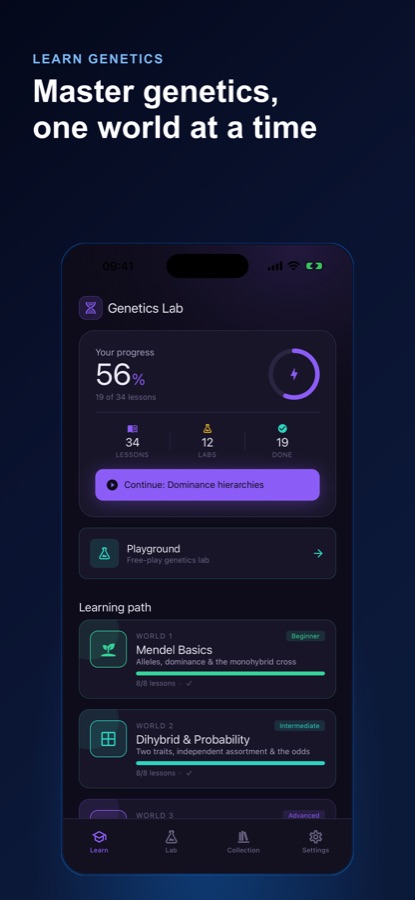
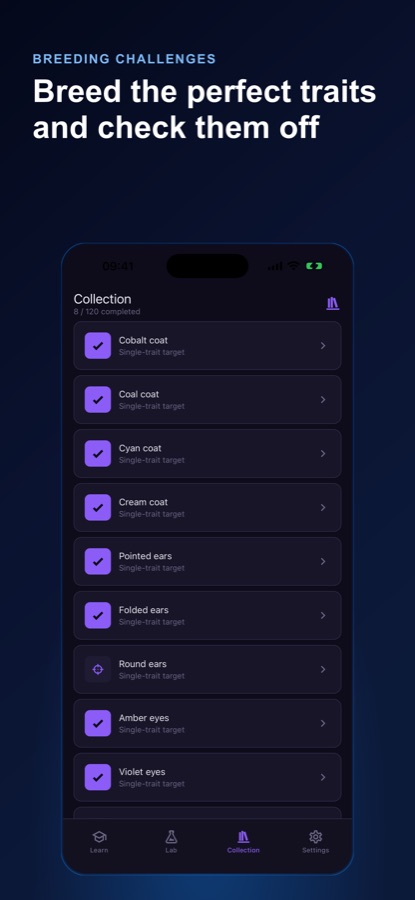
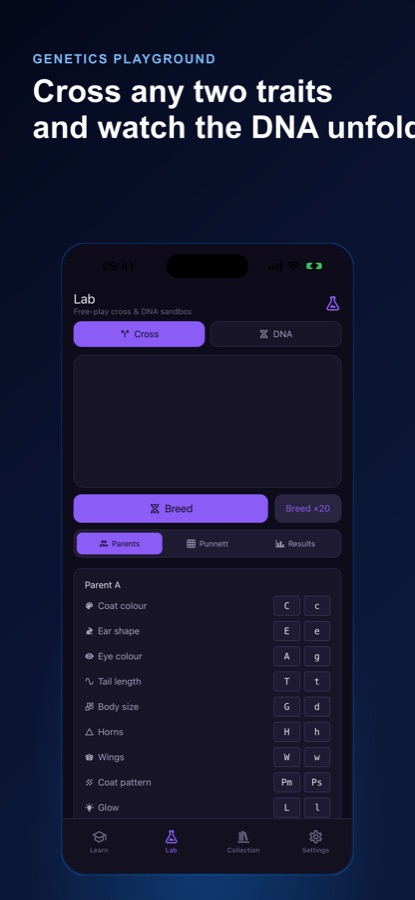
Genetics Lab is a free iOS and Android app that teaches Mendelian genetics and heredity through an invented creature called the Glimmerbeast. You cross parent genotypes across 15 traits and roughly 40 alleles in a Cross Lab, and every result is a real, mathematically computed Punnett square outcome — never a random roll. A 3D DNA Lab lets you build and rotate the double helix, a 120-challenge Collection asks you to hit specific genotype and phenotype targets, and a four-world, 34-lesson course walks from the monohybrid cross through dihybrid ratios, non-Mendelian inheritance and population genetics.
Inside the app
What it looks like
Background
What is a Punnett square, and how does Mendelian inheritance actually work?
A Punnett square is a grid that lays out every possible combination of alleles two parents can pass to an offspring, so you can read off the probability of each resulting genotype and phenotype. The method rests on a small number of rules Gregor Mendel worked out from pea plants: each parent carries two copies of a gene (alleles), passes on only one copy at random, and a dominant allele masks a recessive one when both are present. Real biology adds patterns Mendel's basic model doesn't cover — incomplete dominance, codominance, multiple alleles, sex-linked genes and linked genes that don't assort independently — which is why a genetics course moves from the monohybrid cross to these exceptions rather than stopping at the first rule.
Genotype vs phenotypethe pair that confuses everyone at first
A genotype is the pair of alleles an organism carries for a gene, written like Bb or bb. A phenotype is the trait you actually observe — brown fur versus white fur. Two different genotypes, Bb and BB, can produce the identical phenotype when one allele is dominant, which is exactly what a Punnett square is built to track.
Monohybrid vs dihybrid crossone trait, then two at once
A monohybrid cross follows a single gene and typically produces offspring in a 3:1 phenotype ratio when both parents are heterozygous. A dihybrid cross follows two genes at once, assuming independent assortment, and produces the classic 9:3:3:1 ratio across four phenotype combinations — the standard next step after the basic cross.
Incomplete dominance and codominancewhen dominant doesn't mean 'wins outright'
Not every gene follows strict dominant-recessive rules. Incomplete dominance blends two phenotypes into an intermediate one, the way red and white can produce pink. Codominance instead expresses both alleles fully and simultaneously, as in a coat pattern showing both parent colours side by side rather than blended.
Hardy-Weinberg and allele frequencygenetics at the population level
Once you move past a single cross, population genetics asks how common an allele is across an entire group rather than in one family. The Hardy-Weinberg equation predicts how allele and genotype frequencies should stay stable generation to generation in an idealised population — and how real forces like mutation shift them away from that baseline.
How it works
How the app is used
Lessons build the theory world by world; the Cross Lab, DNA Lab and Collection are where you actually run genetics rather than read about it.
Work through a world
Each of the four worlds — Mendel Basics, Dihybrid & Probability, Beyond Mendel, Population Genetics — breaks a concept into short interactive steps with instant feedback, so a lesson ends with you solving a Punnett square rather than picking a multiple-choice answer.
Run a cross in the lab
Pick genotypes for Parent A and Parent B across traits like coat colour, ear shape, eye colour and wings, each shown as a pair of allele letters. Tap Breed and the Punnett square, genotype and resulting 3D Glimmerbeast all update from the same calculation — the DNA Lab does the same for base pairing and mutation on a rotatable double helix.
Hit a target in the Collection
The Collection lists 120 breeding challenges, from a single-trait coat colour target to a rare recessive combination or a sex-linked pattern. Each checked-off target is a cross you actually solved, not a creature unlocked by a timer or a purchase.
What's inside
What is actually in the app
15
Fifteen breeding traits
Coat colour, ear shape, eye colour, tail length, body size, horns, wings, coat pattern and glow are among the loci you can set for each parent, each with its own dominant and recessive alleles.
120
Breeding challenges
The Collection sets a specific genotype or phenotype target for each of 120 challenges — single-trait coats, dihybrid combinations and sex-linked patterns among them — and checks off only when you actually produce it.
34
Lessons across 4 worlds
Mendel Basics, Dihybrid & Probability, Beyond Mendel and Population Genetics cover the monohybrid cross through the Hardy-Weinberg equation, each lesson built as short interactive steps rather than a slideshow.
3D
DNA Lab
An interactive 3D DNA builder and visualiser turns the double helix and base pairing into a model you rotate and explore, rather than a flat textbook diagram.
AI
AI genetics tutor
Ask the built-in tutor to explain a specific genotype, cross or ratio in plain language when a result — like a 3:1 ratio you expected to be 1:1 — doesn't match your intuition.
0
No randomness in the math
Every cross is a real Punnett square with a calculable outcome. The app never rolls a hidden die to decide an offspring's traits — what the grid predicts is exactly what the lab produces.
Fit
Who it's for — and who it isn't
A good fit if you
- Are taking a first biology course and want Punnett squares to make sense, not just come out right
- Learn better by running a cross yourself than by reading a worked example
- Want dihybrid ratios, incomplete dominance and sex-linked inheritance explained past the basic monohybrid cross
- Like a collection-style goal (120 breeding targets) alongside a structured course
- Are homeschooling genetics and want a hands-on lab without lab equipment
Not the right tool if you
- Want to analyse real human genetics or a real DNA sample — Genetics Lab uses an invented creature and makes no medical or ancestry claims
- Want the full course and all 15 breeding traits for free — Pro unlocks the remaining worlds, traits and the full Collection
- Need a reference for a specific real species' inheritance patterns rather than general Mendelian mechanics
- Want multiplayer or a social breeding feature — this is a single-player lab
Questions
Frequently asked questions
What's a good app for learning Punnett squares and Mendelian genetics?
The useful test is whether an app makes you run the cross yourself rather than just show you a finished example. Genetics Lab does that: you pick parent genotypes across 15 traits, tap Breed, and watch a real Punnett square resolve into a 3D creature's actual coat, eyes and wings. It covers the monohybrid cross through dihybrid ratios, non-Mendelian patterns and population genetics in 34 lessons, free on iOS and Android.
How do you read a Punnett square?
A Punnett square lines up one parent's possible alleles across the top and the other's down the side, then fills each cell with the combination that lands there. Each cell represents one equally likely outcome, so counting how many cells show a given genotype or phenotype gives you its probability directly. Genetics Lab's Cross Lab builds this grid from whatever genotypes you choose, so the square you see always matches the cross you actually set up.
What is the difference between genotype and phenotype?
A genotype is the pair of alleles an organism carries for a gene — for example Bb, one dominant and one recessive copy. A phenotype is the trait you can actually observe, such as a particular coat colour. Two different genotypes can share one phenotype whenever a dominant allele masks a recessive one, which is why a Punnett square tracks genotypes first and phenotypes second.
Why does a dihybrid cross give a 9:3:3:1 ratio?
A dihybrid cross follows two genes at once, and the 9:3:3:1 ratio comes from the independent assortment of those genes — each gene's alleles sort into gametes without affecting the other gene's alleles. Multiplying the probabilities for each gene separately across sixteen total possible offspring combinations produces exactly that split. Genetics Lab's World 2 walks through the product rule and the sum rule that explain the arithmetic behind the ratio, with the Cross Lab letting you verify it on an actual two-trait cross.
What is incomplete dominance, and how is it different from codominance?
Incomplete dominance blends two phenotypes into an intermediate form, the classic example being red and white flowers producing pink offspring. Codominance instead expresses both alleles fully at once, so a heterozygous organism shows both parent traits side by side rather than a blend — a spotted coat pattern showing both colours is a typical example. Genetics Lab's Beyond Mendel world covers both patterns, along with multiple alleles and sex-linked inheritance, as the cases that go past the basic dominant-recessive rule.
What does the Hardy-Weinberg equation describe?
The Hardy-Weinberg equation predicts how allele and genotype frequencies should remain stable across generations in an idealised population — one with no mutation, migration, selection or genetic drift. It gives biologists a baseline to compare real populations against, since a population's frequencies drifting away from that prediction signals one of those real forces at work. Genetics Lab's Population Genetics world introduces the equation alongside allele frequencies, DNA structure and mutation.
What is the Glimmerbeast in Genetics Lab?
The Glimmerbeast is the fictional creature every cross in the app is run on, with 15 breeding traits — coat colour, ear shape, eye colour, tail length, body size, horns, wings, coat pattern and glow among them — controlled by roughly 40 alleles. Using an invented creature keeps every lesson in a safe sandbox for learning heredity mechanics, with no human genetics and no medical framing anywhere in the app.
Is Genetics Lab free?
Yes. It is free to download on the App Store and Google Play, with the first world, a limited set of breeding traits, part of the Collection and the Daily Cross available at no cost, and ads shown to support the free content. A Pro subscription unlocks the remaining worlds and lessons, all 15 breeding traits, the full 120-challenge Collection, the AI genetics tutor and an ad-free experience.
What does the AI genetics tutor do?
It explains a specific genotype, cross or ratio in plain language when a result doesn't match what you expected — for instance, why a cross produced a 3:1 ratio instead of 1:1. It answers the problem actually in front of you rather than giving a generic genetics lecture, and the app asks for your permission before the first AI request goes out.
Do I need a biology background to use Genetics Lab?
No. The course starts at the definition of a trait and builds up one Punnett square at a time toward dihybrid crosses, non-Mendelian inheritance and population genetics. It's built for high school and college students working through Mendelian genetics, homeschool learners without lab equipment, and anyone who wants alleles and probability to click.
Get started
Run your first cross
Free on iOS and Android — breed a 3D creature and watch real Punnett squares resolve.
More from CoddyKit
Available on iOS and Android.