
Coding Interview Prep: DSA/SQL
Coding Interview Prep: DSA/SQL — Practise the questions interviewers really ask
Coding Interview Prep: DSA/SQL is a free iOS and Android app for the coding interview: 90 short courses and 360 lessons across data structures and algorithms, SQL and competitive programming, plus 60 Python problems you solve and run in a built-in editor. It opens by letting you watch two correct Two Sum solutions race — so the reason one beats the other is something you have seen, not memorised.


- Price
- Free, Pro upgrade
- Platforms
- iOS and Android
- Languages
- 22
- Age rating
- 4+
- Version
- 82.6.0
- Requires
- iOS 15.1 or later
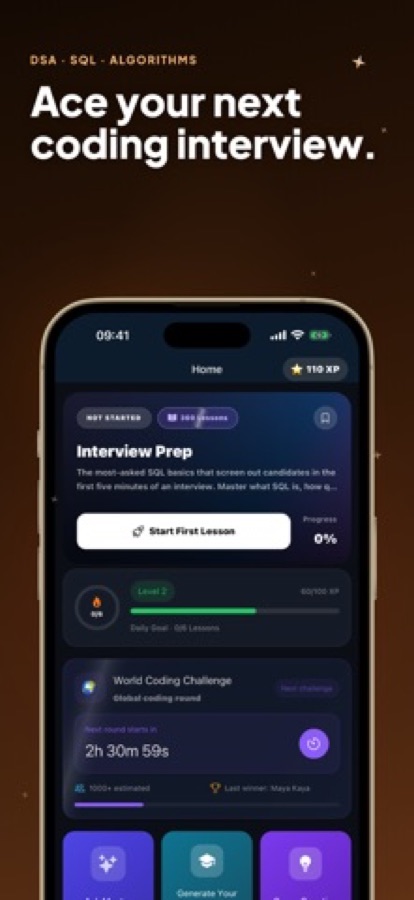
Same answer. Sixteen times the work.
The first lesson runs Two Sum two ways on the same 64 numbers — check every pair, or remember what you have already seen — and counts each comparison and lookup as it happens. That count is the whole idea behind big O notation, and it is what an interviewer is listening for when they ask why.
What it is
Coding Interview Prep: DSA/SQL is a free iOS and Android app for people preparing for technical interviews. It teaches data structures and algorithms, SQL interview questions and competitive programming in three tracks of short lessons, then has you write the solution in Python and run it. The app treats a coding interview as a test of explanation rather than recall: it shows what an approach costs by running it, and an AI mentor explains any concept that refuses to click.
Inside the app
What it looks like
The course
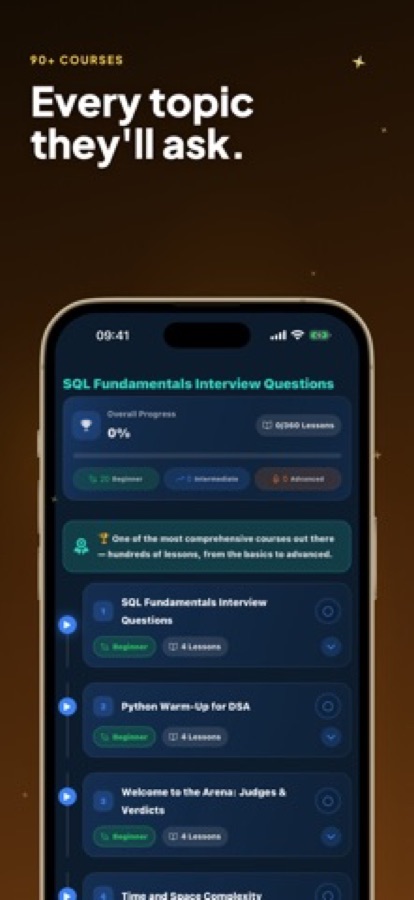
What the interview prep course covers
90 courses and 360 lessons in the app's own course list, running from SQL basics and complexity through to dynamic programming, graphs and contest-style problems.
SQL Fundamentals and Filtering Gotchas
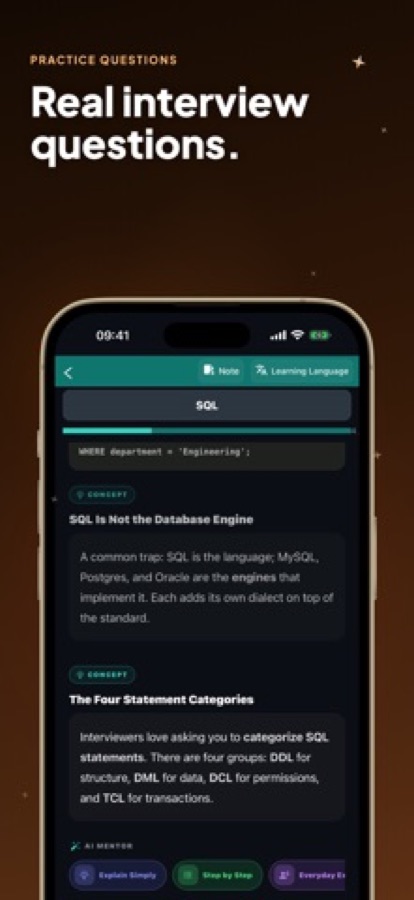
SQL Fundamentals Interview Questions, SELECT expressions, WHERE filtering traps and ORDER BY with LIMIT for top-N questions.
Time and Space Complexity
Time and Space Complexity and Big-O on the Clock: working out whether a solution will pass before you submit it.
Arrays, Strings and Hashing
Arrays and the Two-Pointer Technique, Sliding Window Mastery, Prefix Sums, Strings and Pattern Matching, and Hash Maps and Sets.
Lists, Stacks, Queues and Searching
Linked Lists from Scratch, Stacks and Queues in Action, Sorting Algorithms and Binary Search Mastery.
Trees, Heaps and Graphs
Tree traversals and paths, binary search trees, heaps and priority queues, and BFS and DFS on graphs.
Recursion, Backtracking and Dynamic Programming
Recursion and the Call Stack, Backtracking, Dynamic Programming Foundations, 1D and 2D grid DP patterns and knapsack variants.
Joins, Window Functions and Analysis SQL
INNER, LEFT and FULL OUTER joins, ROW_NUMBER, RANK, LAG and LEAD, top-N per group, gaps and islands, and cohort and funnel analysis.
Competitive Programming Toolkit
Judges and verdicts, fast input and output, number theory, Dijkstra, union-find and tries for contest-style problems.
How it works
How a practice session works
Sessions are built for the commute, the queue or the ten minutes before a meeting: one question at a time, then a reason attached to it.
Start with the daily question
Read a real interview question, think, then reveal the answer. It is free every day, and keeping the streak alive gives the habit a reason to survive a busy week.
Learn a pattern in a short lesson
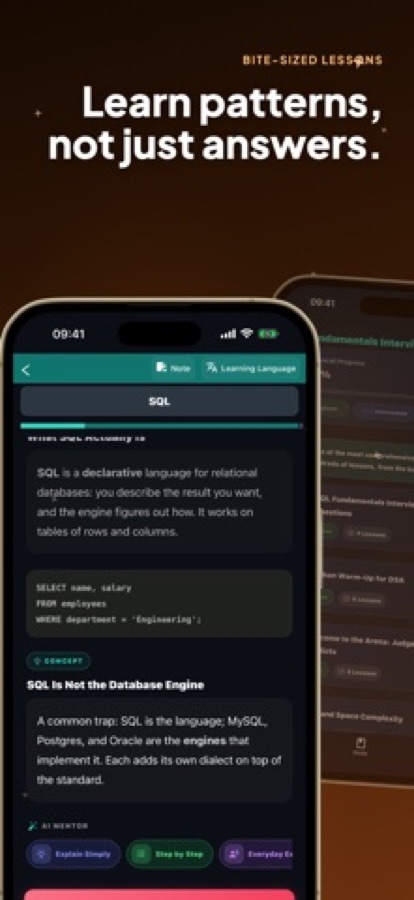
Pick a lesson in one of the three tracks — each one is a few minutes of explanation with a concept card, a code snippet and an AI mentor row for "explain simply" or "step by step" when the first read does not land.
Write the solution and run it
Open one of the 60 coding problems, write the answer in Python in the built-in editor and run it against the checks. Quizzes and flip cards then turn "I read it" into "I can recall it".
What's inside
What is inside the app
90
Courses in three tracks
360 lessons across data structures and algorithms, SQL for interviews and competitive programming, each track starting with a free first course.
60
Python problems
20 easy, 20 medium and 20 hard challenges, from Two Sum and Valid Parentheses to Merge Intervals, Coin Change, Trapping Rain Water and Edit Distance, grouped by pattern.
Counted
Complexity shown by running it
Where the app says an approach costs more, the number comes from executing both and counting the steps side by side.
20
Guided pattern projects
Build one pattern step by step — two pointers, sliding window, binary search, BFS on a grid, heap top-k, tries and more — choosing the right code block at each step and seeing why it works.
50 + 50
Flip cards and quiz questions
50 interview questions as think-first flip cards, 50 quiz questions with review sessions, and a cheat sheet of 67 entries on data structures, algorithms and SQL.
AI
AI mentor
Ask anything in plain language when a concept does not click. Free users get a few mentor answers a day; Pro removes the limit.
Background
What does a coding interview actually test, and how do you prepare for it?
A coding interview checks whether you can take an unfamiliar problem, pick a sensible approach, say out loud why it works and what it costs, and then write it cleanly. Most questions are variations on a small set of patterns, so preparation that groups problems by pattern tends to transfer further than collecting answers one question at a time. The part candidates underestimate is the explanation: two working solutions can both be correct, and the interviewer is usually listening for why you chose one.
Time and space complexitythe vocabulary of the conversation
Big O notation describes how the work an algorithm does grows as the input grows. Interviewers use it as shared language: saying a solution is O(n²) and then finding an O(n) version with a hash map is often the exact moment a question is won or lost.
Patterns over problemswhy lists of questions plateau
Two pointers, sliding windows, binary search, hash maps, BFS and DFS and dynamic programming cover a large share of what gets asked. Learning to recognise which pattern a problem belongs to lets you solve a question you have never seen.
SQL in the hiring loopnot only for database roles
Analysts, data engineers and many backend candidates meet SQL questions: joins, GROUP BY and HAVING, NULL handling, window functions, top-N per group. The traps are usually in the details, such as how a WHERE filter changes the result of a LEFT JOIN.
Thinking aloudthe communication half
A silent correct answer scores lower than a spoken, slightly rough one. Practising with a question in front of you, trying an idea, then checking it against an explanation is closer to the real room than reading finished solutions.
Fit
Who it's for — and who it isn't
A good fit if you
- Are heading into a first internship or graduate interview and want a structured route through the common topics
- Are a working developer who needs to refresh algorithms before a technical loop
- Expect SQL questions in a data analyst or data engineer hiring process
- Want to understand why one correct solution beats another, not only reproduce a memorised answer
- Prefer short daily sessions on a phone to long evening study blocks
Not the right tool if you
- Need a full simulation of a whiteboard interview with a live person — the app practises the material, not the room
- Expect everything free: the first course of each track and a few problems are free, Pro unlocks the full library
- Want to prepare in a language other than Python for the coding problems
- Are a complete beginner who has never written code — a beginner Python course is a better first step
Questions
Frequently asked questions
What is the best way to prepare for a coding interview on a phone?
Short, repeated practice beats long cramming, and a phone suits that. Coding Interview Prep: DSA/SQL gives you one interview question a day, bite-sized lessons grouped by pattern, and 60 Python problems you can write and run in a built-in editor. Quizzes and flip cards then test recall so what you read is still there when the interview arrives.
Does Coding Interview Prep: DSA/SQL cover SQL interview questions as well as algorithms?
Yes. SQL is one of the three tracks, alongside data structures and algorithms and competitive programming. It covers WHERE and NULL gotchas, GROUP BY and HAVING, every kind of JOIN, subqueries and CTEs, window functions such as ROW_NUMBER, RANK, LAG and LEAD, gaps and islands, and cohort and funnel analysis.
What is the difference between learning algorithms and memorising answers?
Memorised answers fail the moment a question is changed slightly, while a pattern carries across many questions. Coding Interview Prep: DSA/SQL teaches the pattern first — two pointers, sliding window, binary search, hash maps, BFS and DFS, dynamic programming — and then has you solve problems that use it. Its first lesson shows the idea directly by running two Two Sum solutions side by side and counting the work each does.
Which programming language do the coding problems use?
The 60 coding problems in Coding Interview Prep: DSA/SQL are solved in Python in the app's built-in editor, where you write the solution, run it and get it checked. The lessons explain the underlying algorithm rather than Python syntax, so the patterns apply in whatever language an interview lets you choose.
How many questions and lessons are there?
The app has 90 short courses and 360 lessons in three tracks, plus 60 Python coding problems, 20 guided pattern projects, 50 interview flip cards, 50 quiz questions and a 67-entry cheat sheet. The first course of each track — SQL Fundamentals Interview Questions, Python Warm-Up for DSA and Welcome to the Arena — is free.
Is Coding Interview Prep: DSA/SQL free?
It is free to download and use. The daily interview question, the first course of each track, two coding problems, one guided project, the flip cards, the quiz, the cheat sheet and a few AI mentor answers a day are free. Pro unlocks all 90 courses, all 60 problems, all 20 projects, course certificates and unlimited AI mentor answers. The app is listed as Coding Interview Prep: DSA/SQL on Google Play and as Job Interview Prep & Coding on the App Store.
Does the app show ads?
No. The App Store listing states that Coding Interview Prep: DSA/SQL never shows a banner, an interstitial or a rewarded video, in the free version either. Income comes from the optional Pro subscription.
Can the AI mentor help when a concept does not make sense?
Yes. Inside any lesson you can ask the AI mentor in plain language, or tap a shortcut such as Explain Simply or Step by Step. It is meant for the moment a concept refuses to click, and free users get a few answers every day.
Can I use it for competitive programming as well as job interviews?
Yes. Competitive Programming is a full track in Coding Interview Prep: DSA/SQL, covering online judges and verdicts, fast input and output, estimating whether a solution will pass in time, prefix sums, number theory, Dijkstra, Fenwick and segment trees, string algorithms and game theory.
What platforms and languages does it support?
Coding Interview Prep: DSA/SQL is available for iPhone and iPad on the App Store and on Android through Google Play, and the interface is available in 22 languages. It is rated 4+ on the App Store.
Get started
Come to your next interview with the reasons
Free to start on iOS and Android, in 22 languages.
More from CoddyKit
Available on iOS.