Games · Free · iOS & Android
By CoddyKit
HackLab: a hacker simulator game with a real terminal
HackLab is a free hacking simulator game for iPhone and Android. You type real commands — nmap, sqlmap, curl — into a terminal and work missions inside a closed simulation: no real systems, no real targets. It exists to show how attacks work so you can recognise and defend against them.
- Price
- Free, with optional Pro
- Platforms
- iOS and Android
- Experience needed
- None
- Age rating
- 4+
- App Store
- 4.6 (5)
A real terminal, not a cutscene.
Most hacking games play an animation while a progress bar fills. Here you type the command yourself, it gets parsed, and the output comes back the way the tool would print it — against a target that does not exist.
What it is
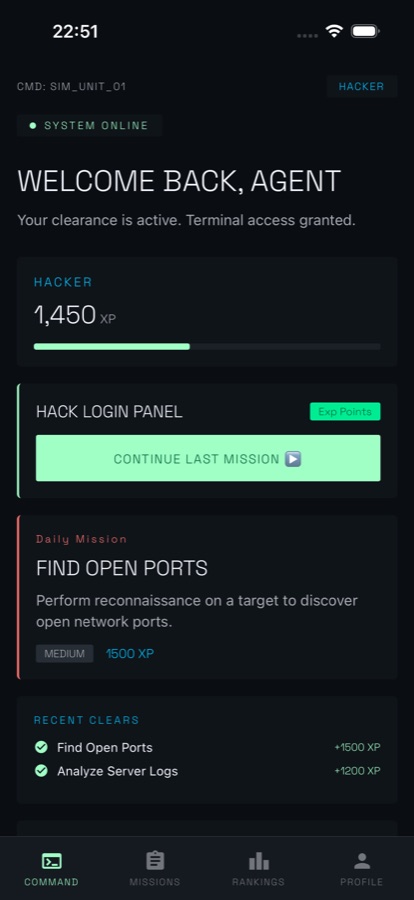
HackLab is a free hacking simulator game for iOS and Android. Missions run inside a fictional sandbox: you type commands like nmap, sqlmap and curl into a terminal that parses them, then take each simulated target through three phases — scan, analyze, exploit. Nothing touches a real system or network. XP, five ranks, daily missions, badges and live CTF tournaments carry the progression.
Everything in HackLab is simulated. Attack techniques are shown so you can understand and defend against them, never to use against systems you do not own or have written permission to test.Read the white-hat note.
Background
What is ethical hacking, and why do defenders study attacks?
Ethical hacking is testing a system the way an attacker would, with the owner's permission, so weaknesses get found and fixed before someone hostile finds them. The techniques are the same either way — what changes is authorisation and intent. Defenders study them because you cannot spot an injection flaw, a stray open port or a stolen credential in your own systems if you have never watched one being used.
Penetration testingauthorised attack
A scoped, written-permission engagement where a tester tries to break into a system and then reports exactly how they did it. The permission is the whole difference between a pen test and a crime.
Port scanningreconnaissance
Probing a host to see which network ports answer and what software sits behind them. Tools like nmap report ports as open or closed with a service and version — the first map an attacker or a defender draws.
SQL injectiona web flaw
When user input is pasted straight into a database query, an attacker can append their own SQL and make the database return or change data it should not. It stays common because one unescaped parameter is enough.
Capture the FlagCTF
A legal competition format where deliberately vulnerable machines are set up for players to break into, and proof of success is a hidden string called a flag. It is how most security people practise without touching real infrastructure.
How it works
How a mission runs
Every mission ends in the same place: a terminal, an objective, and you typing the next command. A run is short enough to finish on a commute.
Pick a mission off the board
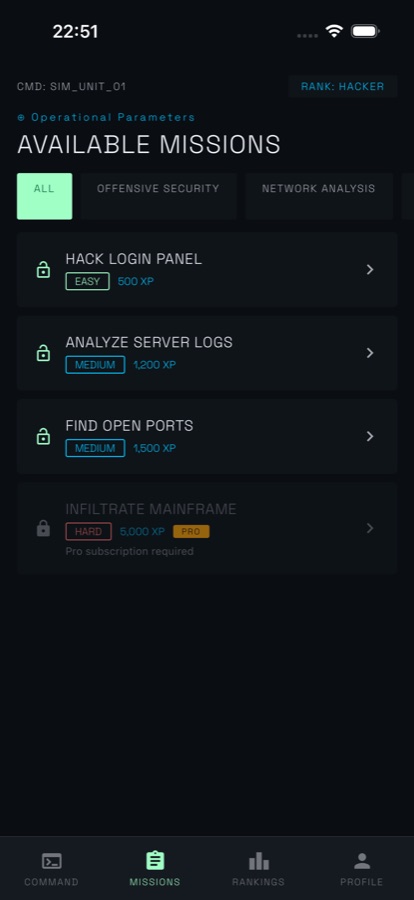
The mission list shows each operation with a difficulty and an XP reward — easy jobs like Hack Login Panel, harder ones like Analyze Server Logs. A fresh mission drops daily, and an Experience Level setting tailors the hints and pacing from your first run.
Work the three phases in the terminal
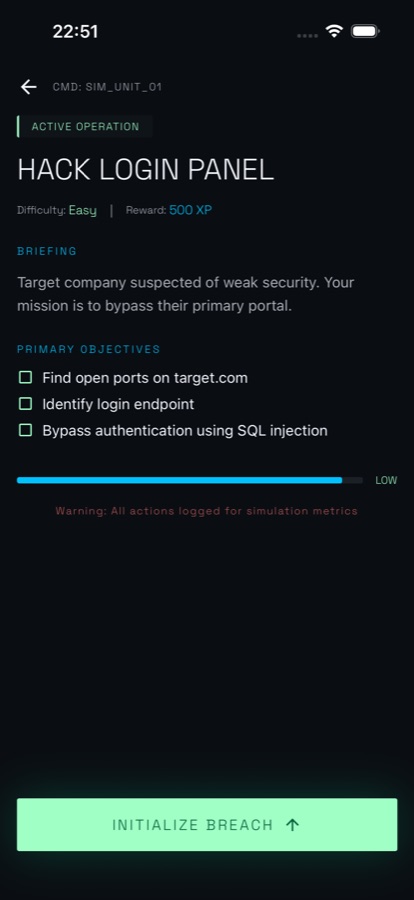
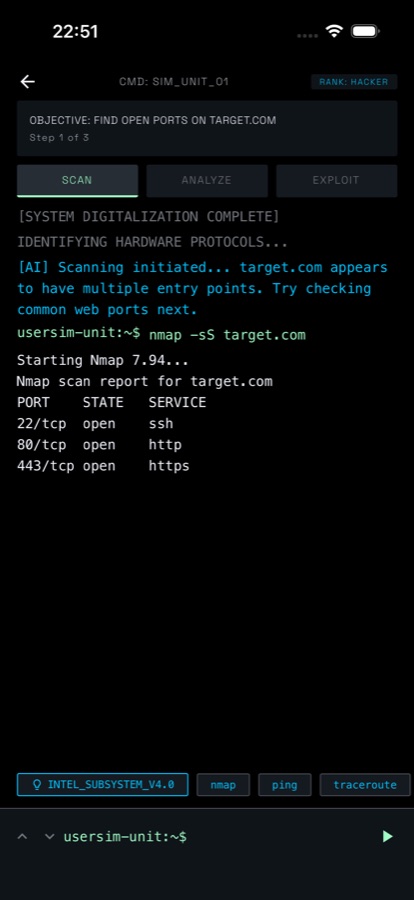
The mission opens with a briefing and a checklist of objectives, then hands you the terminal. Scan the fictional host, analyze what came back for weaknesses like SQL injection or XSS, then exploit it. Tap a suggested command chip to learn the syntax, or type your own.
Bank the XP and keep the streak
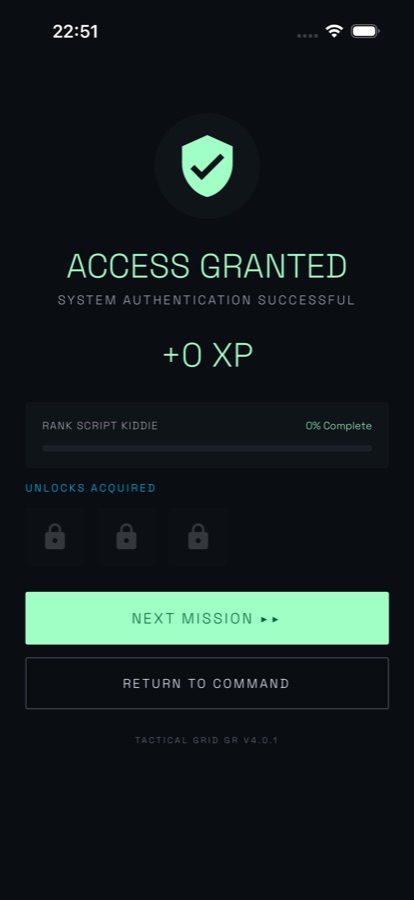
A cleared mission returns ACCESS GRANTED, pays XP toward the next of five ranks, and unlocks harder work. Streaks, badges like Ghost for a zero-error run, the global leaderboard, duels and live CTF tournaments are what pull you back the next day.
What’s inside
What is actually in the app
nmap
A terminal that parses commands
Type nmap, sqlmap, curl and more. Commands are parsed rather than faked: a scan lists open ports with services and versions, curl prints the headers back.
3
Scan, analyze, exploit
Every mission runs the same three phases against its simulated target — map the host, look for weaknesses like SQL injection or XSS, then use what you found.
5
Five ranks and XP
Missions pay XP toward five ranks — Script Kiddie, Hacker, Elite, Root, Legend. Higher ranks unlock harder grid nodes, rarer cosmetics, and a place on the global leaderboard.
AI
An AI Mentor that nudges
Stuck on a step, ask the AI Mentor. It is built to point at the technique rather than hand over the answer, with a limited number of free questions each day.
CTF
Tournaments, duels and ghosts
Enter scheduled live Capture-the-Flag tournaments, challenge a friend or a random rival to an async duel with invite codes and rematches, or race a recorded best time.
Sim
A closed environment
Every mission, contract, duel and operation runs against a simulated target. No real systems, no real networks — the app produces no tooling pointed at anything live.
Inside the app
What it looks like
Fit
Who it’s for — and who it isn’t
A good fit if you
- Are curious how attacks like port scanning and SQL injection actually work, and want to try them somewhere harmless
- Prefer typing commands in a terminal to tapping through multiple-choice questions
- Are building toward CompTIA Security+ or OSCP-style knowledge and want the hands-on side to stick
- Play in short sessions on a phone — a commute, a queue, a daily mission before bed
- Like competition: streaks, badges, a global leaderboard, duels and live CTF tournaments
Not the right tool if you
- Want working attack tools — every target here is fictional and the app produces nothing that runs against a real system
- Need real tooling on real hosts; that belongs in your own lab, a legal CTF platform, or an authorised engagement
- Are looking for accredited coursework or an official certification exam bank
- Want defensive blue-team incident response practice rather than the attacker's side of the story
Safety and limits
White-hat only
HackLab is a game and a simulator. Every mission, contract, duel and operation runs against a fictional target inside the app. Nothing here scans, connects to, or attacks a real system or network, and completing a mission does not leave you holding a working exploit.
Attack techniques are shown for the same reason defenders study them: you cannot recognise an injection flaw, a stray open port or a credential leak in your own systems if you have never seen one used. Testing systems you do not own or have written permission to test is illegal in most countries regardless of intent. Take what you learn to a legal CTF, your own lab, or a sanctioned penetration test — nowhere else.
Questions
Frequently asked questions
What's the best app for practising ethical hacking on a phone?
The useful test for a phone app is whether you type commands or tap answers, because recall of syntax and order is most of the skill. HackLab works that way: missions hand you a terminal where nmap, sqlmap and curl are parsed and answered with realistic output, and every target is fictional. It is free on iOS and Android and needs no prior experience. Real tooling on real hosts still belongs in a lab or a sanctioned CTF.
Is it legal to learn hacking?
Learning is legal. Reading about attacks, studying tools, and practising in an environment built for it breaks no law anywhere. What is illegal in most countries is accessing or testing a system you do not own without written permission, and intent is not a defence — curiosity and a good motive do not make an unauthorised scan lawful. That is why simulators, Capture-the-Flag competitions, and home labs exist: they give you the same practice with the permission question already settled.
What does a tool like nmap actually do?
nmap is a network scanner. It sends packets to a host and reports which ports answer, whether they are open, filtered or closed, and often which software and version is listening — ssh on 22, http on 80, https on 443. Attackers use it to find a way in; defenders use it to find services nobody meant to expose. In HackLab, the scan phase of a mission runs against a simulated host so the reading of that output is what you practise.
What is SQL injection, and why is it still so common?
SQL injection happens when user input is dropped straight into a database query instead of being passed as a parameter. An attacker types SQL into a form field or a URL and the database runs it, returning or altering data it should never expose. It persists because a single unescaped parameter anywhere in a large application is enough, and because the fix — prepared statements and parameterised queries — has to be applied consistently rather than once.
What is a CTF competition?
Capture the Flag is the standard legal practice format in security. Organisers stand up deliberately vulnerable machines or challenges, and players prove they broke in by finding a hidden string called a flag. Scoring is by difficulty, often against a clock. It matters because it gives you a target you are explicitly allowed to attack. HackLab runs scheduled live CTF tournaments inside its own simulation, alongside duels against other players and races against a recorded best time.
Does HackLab give you tools that work against real systems?
No. HackLab is a simulator and a game. The terminal parses commands and returns realistic output, but the hosts, networks and vulnerabilities are fictional and live entirely inside the app. Nothing it produces can be pointed at real infrastructure, and finishing a mission leaves you with understanding rather than an exploit. That is the point: you can see how port scanning, SQL injection and XSS probing behave without touching anything you are not allowed to touch.
Is HackLab free, and what does Pro add?
HackLab is free to download on the App Store and Google Play, with an optional Pro subscription. Pro adds unlimited daily missions, every CTF challenge, a 1.5x XP multiplier, two automatic streak freezes per renewal, a second gear loadout, and every advanced Learn lesson. A free trial lets you try Pro before committing. The app is rated 4+ and links to its terms of use and privacy policy from the store listing.
Do I need any experience to start?
No prior experience is required. Missions start at easy — find the open ports on a host, read a server log — and there are Beginner, Intermediate and Advanced tracks, plus an Experience Level setting that tailors hints and pacing from the first run. If a step stalls you, the AI Mentor gives a limited number of free contextual nudges each day, written to point at the technique rather than hand over the answer.
Do you need certifications like Security+ or OSCP to work in security?
Certifications open doors, especially for a first role or a government contract, but they test knowledge you still have to acquire somewhere. Most people build that through labs, CTFs and reading, then sit the exam to prove it. HackLab is practice, not coursework: it is not an accredited course or an exam question bank, but working missions gives you familiarity with scanning, injection and log analysis that makes the study material read as things you have already seen.
Can I compete against other players?
Yes. A global leaderboard ranks players worldwide, and scheduled live Capture-the-Flag tournaments run against the clock with final standings posted afterwards. You can also challenge a friend or a random rival to an async duel using invite codes, with ratings and rematches, or race a Ghost — the recorded best time on a mission. Daily missions, a five-question daily trivia round, and streaks with a streak freeze keep the day-to-day scoring going.
Start logging
Open the terminal, clear the mission
Free on iOS and Android. Every target is simulated.
More from CoddyKit
Not a medical device. Does not diagnose or treat any condition.