

Dog Training: Puppy Commands
Dog Training: a tiered command curriculum and potty schedule for a new puppy
Dog Training replaces a scattered list of commands with a real tiered curriculum — Foundation, Intermediate, Advanced and Problem-Solving — so you always know what to teach after "sit". A potty schedule that adapts to your puppy's own accidents and successes, and a built-in clicker, round out the daily routine.


- Price
- Free, Pro upgrade
- Platforms
- iOS and Android
- Languages
- 10
- Age rating
- 4+
- Version
- 1.2.0
- Requires
- iOS 15.1 or later
A list of commands is not a curriculum.
Most puppy training advice hands a new owner thirty commands in no particular order. What actually builds a reliable, well-behaved dog is sequence: which command depends on which other one already being solid, and when a behavior problem needs a referral instead of a tip.
What it is
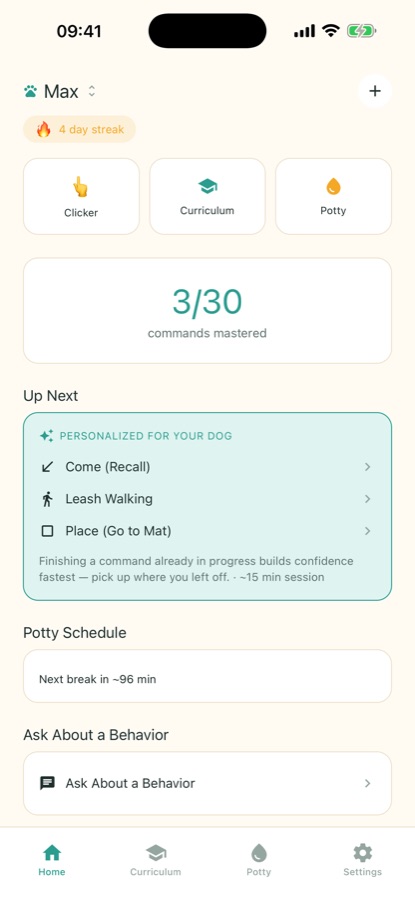
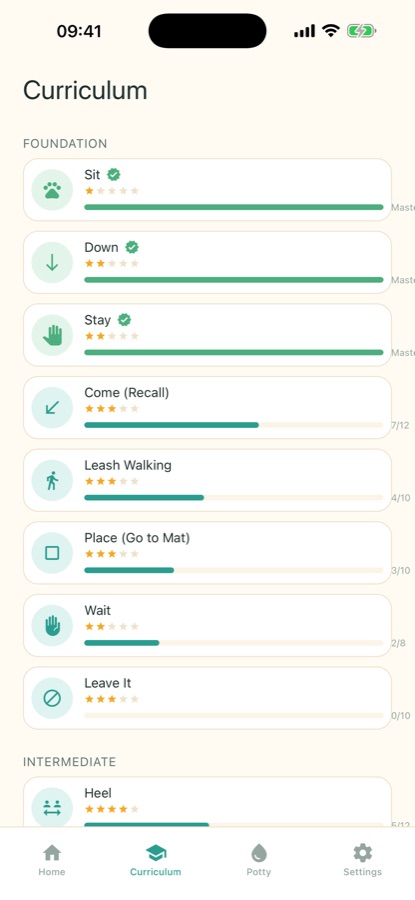
Dog Training: Puppy Commands is a free iOS and Android app that organizes 30 obedience commands into four tiers — Foundation, Intermediate, Advanced and Problem-Solving — each with step-by-step instructions, common mistakes and a rep counter. It includes an age-based puppy potty schedule that tightens after accidents and loosens after successes, a built-in clicker, breed-specific training notes for 160 breeds, and guidance for five everyday behavior issues. Aggression, fear and resource-guarding questions are routed to a referral for a certified trainer or veterinary behaviorist rather than answered in-app.
Inside the app
What it looks like
Background
What does a structured puppy training plan actually look like?
Puppy obedience training generally progresses in a deliberate order rather than a random list, because later commands lean on earlier ones being reliable — recall is far easier to teach once sit and stay are solid. Running in parallel, house training follows its own age-based timeline tied to a puppy's bladder control, which develops gradually over the first several months rather than on a fixed schedule that applies to every dog.
Foundation before everything elsesit, down, stay, come
Commands like sit, down, stay and come form the base that later, harder commands depend on. A puppy that reliably holds a stay has an easier time learning heel or place, because the underlying skill of holding a position under distraction is already there.
Potty training by age, not by a fixed rulebladder control develops over months
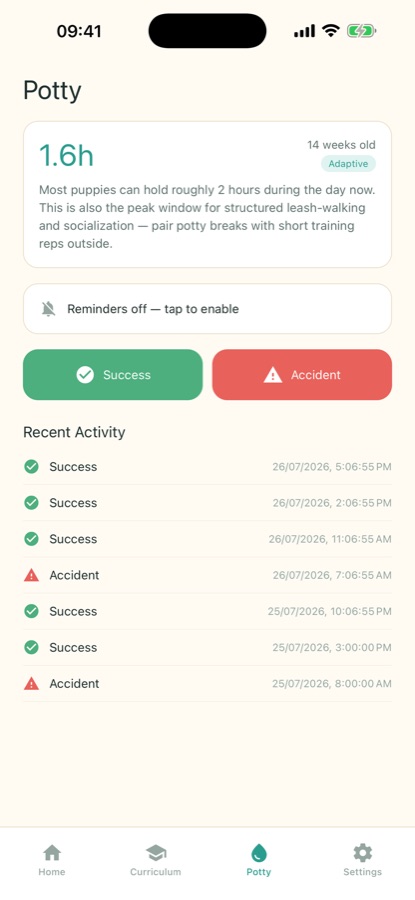
A young puppy's bladder control develops gradually, so a realistic potty schedule is based on age in weeks rather than a single number that applies at every stage. A schedule that adjusts after an accident — tightening the interval — and after a run of successes — loosening it — tracks what is actually happening with that puppy.
Breed shapes training, not just temperamentwhat comes easily versus what takes longer
Different breeds tend to find different commands easier or harder for reasons rooted in what they were originally bred to do — a herding breed often picks up recall quickly but can struggle with impulse control around movement, for example. Knowing a breed's tendencies ahead of time changes how patient to be with a specific command.
When a behavior needs a professionalnot every issue is a training tip away
Everyday nuisance behaviors — jumping on guests, leash pulling, mouthing, barking, counter-surfing — generally respond to consistent, scoped guidance. Aggression, fear-based reactions and resource guarding are a different category: they can escalate and are not reliably solved by generic tips, which is why responsible guidance routes them to a certified trainer or veterinary behaviorist instead.
How it works
How the app is used
The curriculum sets the order; the daily habit is a short session plus logging each potty break as it happens.
Start the curriculum in order
Work through 30+ commands across four tiers — Foundation, Intermediate, Advanced and Problem-Solving — each with clear steps, common mistakes to avoid, and a rep counter that logs practice and shows mastery building. Earn a shareable certificate when a tier is completed.
Follow the adaptive potty schedule
An age-based schedule, calculated from your puppy's age in weeks, suggests when the next break is likely due. Log every success and accident in seconds; the schedule tightens after an accident and loosens after a streak of successes, so it stays realistic for that specific puppy.
Use the clicker and ask about everyday behaviors
Mark the exact moment a behavior is right with a built-in clicker that gives instant audio feedback, with sessions feeding into the same streak as command practice. For everyday issues like jumping or leash pulling, ask the behavior guidance for a scoped answer — questions involving aggression or fear are referred to a professional instead.
What's inside
What the app teaches and tracks
30+
Tiered command curriculum
Foundation, Intermediate, Advanced and Problem-Solving tiers, each command with step-by-step instructions, common mistakes to avoid and a rep counter to log practice over time.
AI
Personalized sequencing
After every session, a 'what's next' suggestion is built from your dog's breed and current mastery rather than a generic fixed order. Part of Pro.
160
Breed-specific notes
Training notes for 160 breeds flag temperament quirks worth knowing before starting a new command, so expectations match what that breed tends to find easy or hard.
Age
Adaptive potty schedule
An age-aware schedule calculated from your puppy's age in weeks, with developmental-stage tips, that tightens after an accident and loosens after a streak of successes with Pro.
Click
Built-in clicker
Instant audio feedback for the exact moment you want to mark and reward a behavior, with session tracking that counts clicks and feeds into the dog's overall streak.
5
Behavior guidance
Scoped guidance for five everyday issues — jumping on guests, leash pulling, mouthing, barking, counter-surfing. Aggression, fear and resource-guarding questions are referred to a certified trainer or veterinary behaviorist instead of answered directly.
Fit
Who it's for — and who it isn't
A good fit if you
- Are raising a new puppy and want commands taught in a deliberate order instead of a random list
- Are house training and want a schedule that adjusts to your own puppy's accidents and successes
- Have more than one dog and want each one's progress and potty schedule kept separate
- Want everyday nuisance behaviors — jumping, pulling, barking — addressed with scoped guidance
- Understand that aggression, fear or resource-guarding issues need a certified trainer or vet behaviorist, not an app
Not the right tool if you
- Have a dog showing aggression, fear-based reactivity or resource guarding — the app refers these to a professional rather than offering guidance
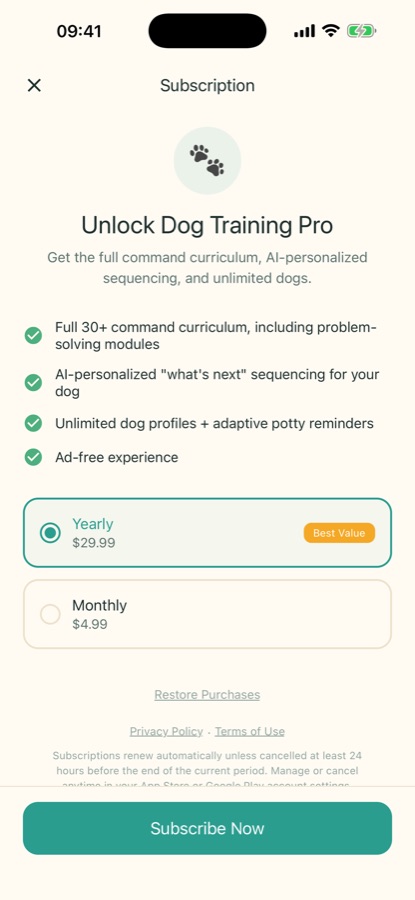
- Want the full curriculum, AI sequencing and adaptive reminders for free — these are Pro
- Want veterinary or medical guidance for your dog — this app covers obedience and behavior training only
- Want to train more than one dog for free — multiple dog profiles are Pro
Questions
Frequently asked questions
What's a good app for training a new puppy?
The useful feature is a real order to teach commands in, not just a list — later commands like recall or heel are easier once foundation skills like sit and stay are solid. Dog Training: Puppy Commands organizes 30 commands into four tiers with step-by-step instructions and a rep counter, alongside an age-based potty schedule and a built-in clicker. It is free to start on iOS and Android.
How does the potty training schedule work?
The schedule is calculated from your puppy's age in weeks, since bladder control develops gradually rather than on a fixed timeline every dog follows at the same pace. With Pro, it also adapts: the interval tightens after you log an accident and loosens after a run of logged successes, so the suggested next break stays realistic for that specific puppy rather than a generic number.
In what order should I teach my dog commands?
Dog Training's curriculum follows four tiers: Foundation (sit, down, stay, come, leash walking, place), then Intermediate, Advanced and Problem-Solving. The idea is that later, harder commands depend on foundation skills being reliable first — a solid stay, for instance, makes heel and place considerably easier to teach.
Does the app help with aggressive or fearful behavior?
No, and deliberately so. The app's behavior guidance covers five everyday nuisance issues — jumping on guests, leash pulling, mouthing, barking and counter-surfing. Questions involving aggression, fear-based reactions or resource guarding are routed to a referral for a certified trainer or veterinary behaviorist, because those issues are not reliably solved by generic in-app guidance.
What does the built-in clicker do?
It gives instant audio feedback at the exact moment you want to mark and reward a behavior, which is the core mechanic of clicker training. A guided first session explains what the click means to your dog, and clicker sessions feed into the same streak and progress tracking as command practice.
Does training advice change by breed?
Yes. The app includes training notes for 160 breeds that flag temperament quirks worth knowing before starting a new command — for example, a tendency that makes one breed pick up recall quickly but struggle more with impulse control. Pro also uses your dog's breed, alongside current mastery, to suggest what to train next.
Is Dog Training free?
Yes, to start. Free includes one dog profile, the six Foundation commands, guided sessions, the potty schedule and log, the clicker, breed notes, five behavior guides and a report card, and shows ads. Pro is a monthly or annual subscription that adds the full 30+ command curriculum including Intermediate, Advanced and Problem-Solving tiers, AI-personalized sequencing, the adaptive potty schedule, unlimited dog profiles and no ads.
Can I train more than one dog with the app?
The free version covers one dog profile. Pro removes that limit, so a household raising more than one puppy, or training an older dog alongside a new one, can keep each dog's curriculum progress, potty schedule and clicker history completely separate.
What counts as mastering a command?
Each command tracks reps logged through the app's rep counter, and progress toward mastery is shown against that command's target. Completing all the commands in a tier earns a shareable certificate, giving a concrete marker of progress through the Foundation, Intermediate, Advanced or Problem-Solving tier.
Does the app replace a professional dog trainer?
No. It structures everyday obedience training and house training, and scopes its behavior guidance to common nuisance issues. For anything involving aggression, fear or resource guarding, or for a dog with a behavior problem that is not improving, the app itself points you to a certified trainer or veterinary behaviorist rather than offering a substitute.
Get started
Give your puppy a real curriculum to follow
Free on iOS and Android, one command and one potty break at a time.
More from CoddyKit
Available on iOS and Android.