

Eye Contact: Social Anxiety
Eye Contact: Social Anxiety — A graded gaze-hold ladder and AI conversation practice
Eye Contact is a free graded exposure tool for the specific feeling of a gaze that drifts or a mind that goes blank mid-conversation. Hold a steady gaze for 10, 20 or 30 seconds against a rotating gallery of faces, then rehearse a full conversation — interview, first date, new coworker — with an AI roleplay partner.


- Price
- Free, Pro upgrade
- Platforms
- iOS and Android
- Languages
- 10
- Age rating
- 4+
- Version
- 1.0.0
- Requires
- iOS 15.1 or later
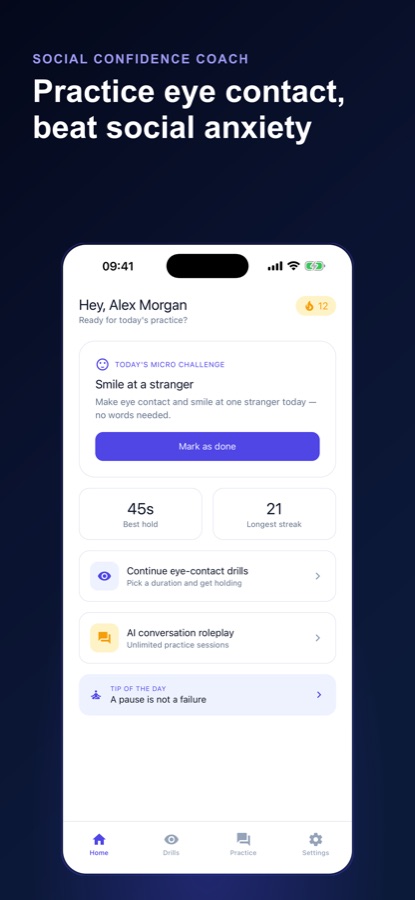
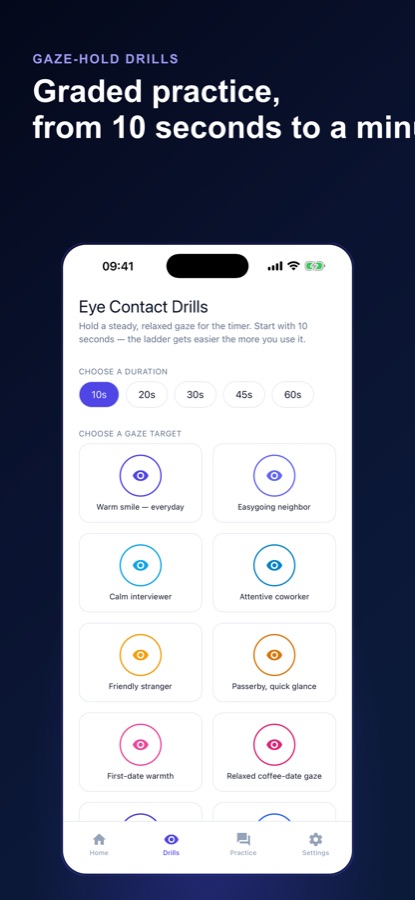
Start at the duration you can actually hold.
A 10-second hold against a warm, easygoing face is a different task than a 60-second hold against a skeptical hiring-manager stare. The ladder exists so the first rep is genuinely doable today, and the hard version is something you grow into, not something you fail at first.
What it is
Eye Contact: Social Anxiety is a free iOS and Android app for practicing comfortable eye contact and easing everyday social anxiety through graded exposure. A gaze-hold ladder runs 10, 20, 30, 45 and 60-second holds against 20 stimulus clips across four settings — friendly, professional, stranger and date — and an AI roleplay partner lets you rehearse a full conversation with a job interviewer, a first date, a new coworker or a stranger at a networking event. It is a self-help practice tool, not therapy or a diagnosis.
Eye Contact is a practice and coaching tool for a common feeling, not a substitute for professional mental health care. If social anxiety is getting in the way of your life, a licensed professional is the right next step — see Read this first.
Inside the app
What it looks like
Background
Why does eye contact feel hard, and can it be practiced?
For people with social anxiety, holding someone's gaze is often experienced as exposure to scrutiny rather than a neutral act, which is why the instinct is to look away rather than stare back longer. The standard non-clinical approach to easing this kind of discomfort is graded exposure: starting with a duration and a setting mild enough to tolerate, holding it repeatedly until it stops feeling intense, and only then stepping up — the same logic used for practicing any avoided situation, applied here to the length and intensity of a gaze.
Graded exposurethe mechanism, not a slogan
Instead of confronting the hardest version of a feared situation first, graded exposure breaks it into a ladder of increasing difficulty and works up one rung at a time. Applied to eye contact, that ladder is duration (10 seconds before 60) and setting intensity (a warm smile before a skeptical interviewer).
Soften, don't starethe usual correction
A common overcorrection is replacing a darting gaze with a locked, unblinking stare, which reads as intense rather than comfortable. Softening the gaze — a relaxed focus rather than a fixed one — is typically taught as the actual target, not simply holding longer.
The triangle techniquea conversational anchor
Shifting your gaze gently between a person's eyes and the lower part of their face during conversation, rather than fixing on one point, is a commonly taught technique for keeping eye contact natural across a longer exchange.
Rehearsal before the real momentwhy roleplay helps
Practicing a full conversation — not just the gaze — before a genuinely nerve-wracking moment like an interview or a first date is a standard technique: it lowers the number of things being handled for the first time when it actually counts.
How it works
How a practice session works
Each drill takes under a minute, so a rep fits into a short break rather than needing a scheduled block.
Pick a duration and a setting
Choose a hold length from the ladder — 10, 20 or 30 seconds free, 45 and 60 with Pro — then pick a stimulus setting: a warm smile, a calm interviewer, a friendly stranger, a first-date moment and more.
Hold the gaze, get a soften cue
A relaxed, steady gaze runs against the animated stimulus for the chosen duration, with a gentle midway cue reminding you to soften your gaze instead of staring.
Rehearse the real conversation
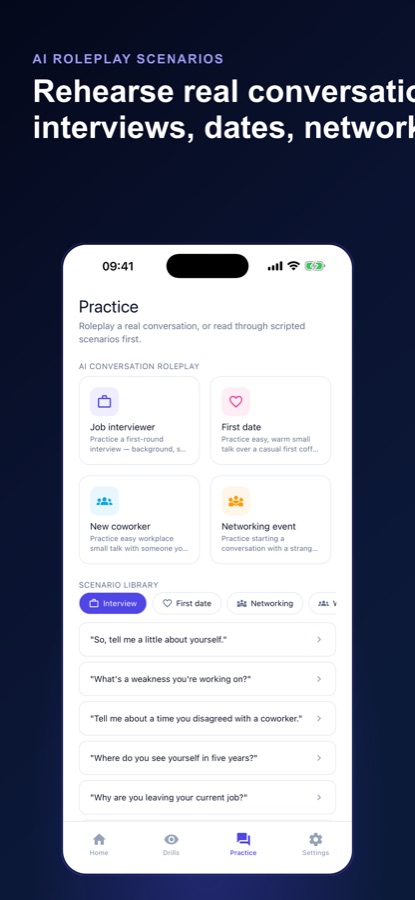
Open an AI roleplay partner — a job interviewer, a first date, a new coworker, or someone at a networking event — and practice the full exchange, or read through the scripted scenario library first if you'd rather prepare lines before improvising.
What's inside
What the app includes
10-60s
Graded gaze-hold ladder
Five hold durations from 10 to 60 seconds, each paired with a gentle midway cue to soften your gaze rather than stare, so the difficulty climbs gradually instead of all at once.
20
Stimulus gallery, 4 settings
Twenty animated gaze targets split across friendly, professional, stranger and date settings, each with its own gaze angle and intensity — from a warm smile to a skeptical hiring-manager stare.
AI
AI conversation roleplay
Practice a full conversation with a job interviewer, a first date, a new coworker or a stranger at a networking event; the partner stays in character so you rehearse the whole interaction, not only the gaze.
30
Scenario library
Five categories — interview, date, networking, workplace and casual small talk — of openers, good responses and follow-up questions you can study before you need them for real.
Daily
Micro-challenge
One small, doable real-world exposure goal each day — like smiling at a stranger or holding eye contact while saying thanks — that you mark done to keep a streak going.
Streak
Streak and best-hold tracking
Current and longest streak, plus your personal-best gaze-hold time, tracked over weeks rather than judged from a single session.
Fit
Who it's for — and who it isn't
A good fit if you
- Find your gaze drifts away or your mind goes blank the moment eye contact starts to feel like too much
- Are preparing for a specific moment — a job interview, a first date, a networking event, a first day with new coworkers
- Want to rehearse a whole conversation, not just practice staring at a screen
- Are shy or introverted and want a structured, low-pressure way to build the skill gradually
- Want a private space to practice a hard conversation before you have it for real
Not the right tool if you
- Are looking for therapy, a diagnosis, or treatment for clinical social anxiety — this is a practice and coaching tool, not a substitute for professional care
- Expect the gaze-hold ladder alone to fix social anxiety without also working on conversation and small talk
- Want the full 60-second ladder, all 20 gaze targets and unlimited roleplay sessions for free — these are part of Pro
- Want the app to diagnose or treat a condition rather than help you practice a specific skill
Safety and limits
Read this before you start
Eye Contact is a practice and coaching tool for a common feeling. It is not therapy, not a diagnosis, and not a substitute for professional mental health care. It helps you practice holding eye contact and rehearsing conversation; it does not treat social anxiety as a clinical condition.
If social anxiety is getting in the way of your daily life — work, relationships, or things you want to do — a licensed professional is the right next step, not an app alone. The in-app Crisis Resources screen lists free helplines if you need support beyond what practice drills can give.
Progress is gradual and personal. A broken streak or a rough roleplay session is data about where you are, not a failure — the ladder is built so you can step back down a rung and build up again rather than quitting.
Questions
Frequently asked questions
What's a good app for practicing eye contact and social anxiety?
Look for graded exposure — short, repeatable reps at an increasing duration — rather than being told to "just hold eye contact longer," plus a way to practice actual conversation, not only staring at a screen. Eye Contact: Social Anxiety covers both: a gaze-hold ladder from 10 to 60 seconds against 20 stimulus settings, and an AI roleplay partner for interviews, dates, new coworkers and networking events. It's free to start on iOS and Android, and it is a practice tool, not therapy.
How do I get better at holding eye contact?
Start with a short duration against a low-intensity setting — a warm, friendly face rather than a stern one — and build up gradually rather than forcing a long hold immediately. Soften your gaze instead of fixing a hard stare; the triangle technique, gently shifting focus between someone's eyes and the lower part of their face, is a common way to keep a gaze natural across a longer conversation. Eye Contact structures exactly this progression as a timed ladder with a built-in soften cue.
Is eye contact practice actually effective for social anxiety?
Graded exposure — gradually facing a milder version of an avoided situation and working up — is the general, well-supported principle behind most anxiety-reduction practice, and Eye Contact gamifies that principle into a duration ladder specifically for gaze-holding. It is a self-help practice tool built on that idea, not a clinical treatment, and results depend on consistent practice over weeks rather than a single session.
What does the AI conversation roleplay actually do?
You pick a partner — a job interviewer, a first date, a new coworker, or a stranger at a networking event — and have a full back-and-forth conversation with it, with the partner staying in character throughout. Afterward you get simple feedback: how many follow-up questions you asked, a note on filler words, what went well, and one thing to try next time. Free gives one roleplay session a week; Pro is unlimited.
Is Eye Contact free?
Yes. The free plan includes gaze-hold drills up to 30 seconds across 10 of the 20 focus targets, 15 of the 30 scenario-library entries, the daily real-world challenge, all short lessons, streak tracking, and one AI roleplay session a week; the free version shows ads. Eye Contact Pro adds the full 60-second ladder, all 20 focus targets, all 30 scenarios, unlimited roleplay, full session history and no ads.
Is this app the same as therapy for social anxiety?
No. Eye Contact is explicit that it is a self-help practice tool, not therapy, a diagnosis, or a substitute for professional mental health care. If social anxiety is affecting your daily life in a significant way, a licensed professional is the appropriate next step; the app's own Crisis Resources screen lists free helplines for anyone who needs more support than a practice tool can give.
What is the scenario library for?
It's a set of real-life openers and short exchanges across five categories — job interview, first date, networking, workplace and casual small talk — each with an opener, a good way to respond, and follow-up questions to keep the conversation going. You can study it before a real situation, rather than only improvising in the moment with the AI roleplay partner.
What is the daily micro-challenge?
Each day the app gives you one small, real-world exposure step — smiling at a stranger, holding eye contact while saying thanks, asking one follow-up question, starting a two-minute chat — designed to be doable in under a minute. Marking it done keeps your streak alive and moves the skill out of the app and into an actual interaction.
Does holding eye contact longer always mean more confident?
No — a fixed, unbroken stare usually reads as intense rather than confident, which is why Eye Contact's drills include a midway cue to soften your gaze rather than simply hold it longer. The goal taught in the app's short lessons is a relaxed, natural gaze that shifts occasionally, not an unblinking one.
Who is Eye Contact built for?
People whose gaze drifts, whose palms sweat, or whose mind goes blank the moment eye contact starts to feel like too much; people preparing for a specific nerve-wracking moment like an interview, a date or a first day with new coworkers; and shy or introverted people who want a structured, low-pressure way to build social confidence rather than generic advice to "just relax."
Get started
Start with a 10-second hold
Free on iOS and Android — a practice tool, not therapy.
More from CoddyKit
Not a medical device. Does not diagnose or treat any condition.