

Chemistry Lab: VSEPR Molecules
Chemistry Lab: VSEPR Molecules — A chemistry lab app to build molecules in 3D and run reactions yourself
Chemistry Lab: VSEPR Molecules is an Android app, with an iPhone version coming, for introductory through AP chemistry. Read a short illustrated lesson, answer a quiz that explains the right answer, then open the lab to build molecules atom by atom in 3D and mix two reagents to see a balanced reaction.


- Price
- Free, Pro upgrade
- Platforms
- Android now, coming to iPhone
- Languages
- 10
- Lessons
- 42 lessons, 51 quizzes
Water is bent, and now you can see why.
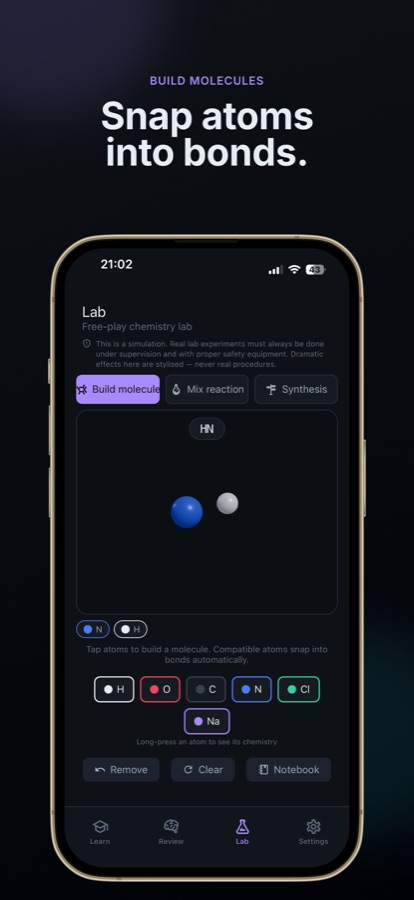
Many people can recite that a water molecule is bent and a methane molecule is a tetrahedron without ever picturing the reason. Here you place the atoms yourself, watch the molecule settle into its real geometry, and get a short note on why the lone pairs push it into that shape.
What it is
Chemistry Lab: VSEPR Molecules is an Android app, with an iPhone version on the way, that teaches introductory through AP chemistry in four worlds: Atoms & Bonds, Reactions, Balancing & Stoichiometry and AP Chemistry Deep. It has 42 lessons and 51 quizzes, a 3D molecule builder where you predict the VSEPR shape before the reveal, a reaction mixer built on 43 hand-checked balanced reactions, a stoichiometry bench, and a spaced review queue with a Daily Problem. It is free to start, and Pro adds the remaining lessons and the full lab.
Inside the app
What it looks like
Background
What is VSEPR theory, and how do you predict a molecule's shape?
VSEPR stands for valence shell electron pair repulsion. The idea is that the electron pairs around a central atom, both the bonding pairs and the lone pairs, repel each other and spread as far apart as they can. Counting those pairs gives you the molecule's shape and its bond angle, and the shape in turn helps decide whether the molecule is polar. It is a standard topic in high school and AP chemistry because one counting rule explains a lot of shapes.
Bonding pairs and lone pairswhat you count
Start from the central atom's valence electrons and ask how many are shared in bonds and how many stay as lone pairs. Lone pairs take up more room than bonds, which is why water ends up bent at about 104.5 degrees and not at the ideal tetrahedral angle.
Common shapeslinear, bent, trigonal, tetrahedral
Two pairs give a linear shape, three a trigonal planar one, and four a tetrahedron, as in methane. Replace one or two of those pairs with lone pairs and you get shapes such as trigonal pyramidal and bent from the same starting geometry.
Polarityshape plus electronegativity
A molecule is polar when its bond dipoles do not cancel. Carbon dioxide has polar bonds but a linear shape that cancels them, while water's bent shape leaves a net dipole, so shape decides the answer.
Balancing and the molethe other half of the course
A chemical equation must conserve atoms on both sides, and the mole lets you move from grams to counts of particles. Limiting reagent and percent yield are the usual next steps, and they are the focus of the stoichiometry part of the app.
How it works
How a study loop works
Each topic moves from reading to doing, so the idea is tested in the lab right after you meet it.
Read a short lesson
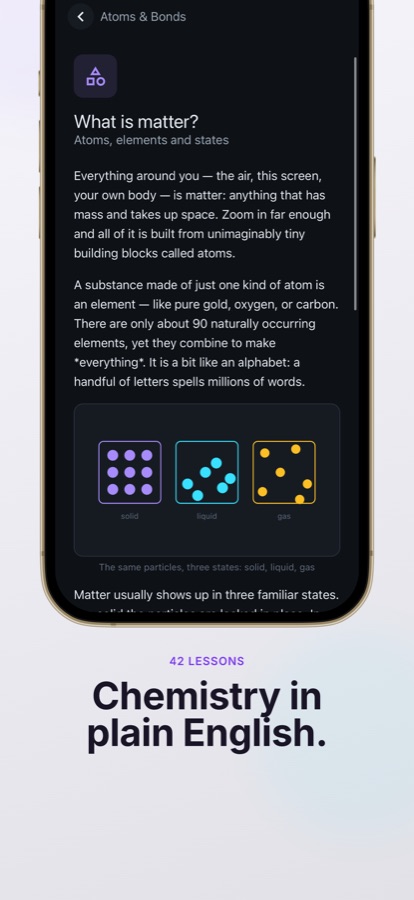
Lessons are brief and illustrated, written in plain English, with a diagram of the idea such as the same particles shown as a solid, a liquid and a gas.
Answer a quiz that explains itself
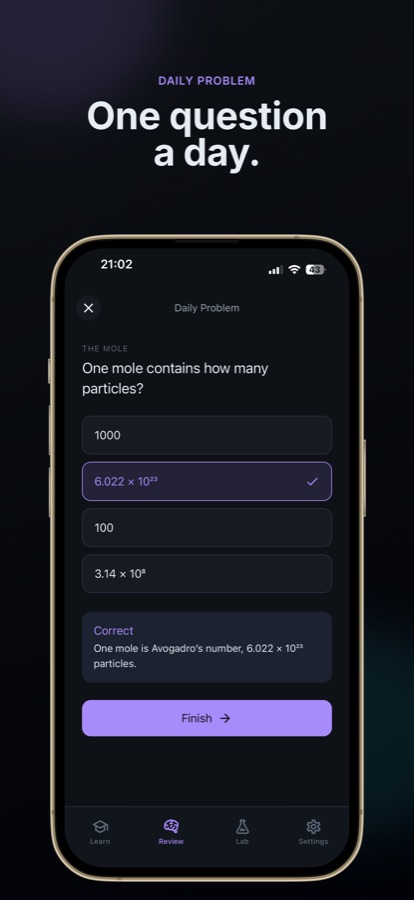
Each quiz explains in words why the correct option is correct, not just whether you were right or wrong.
Open the lab
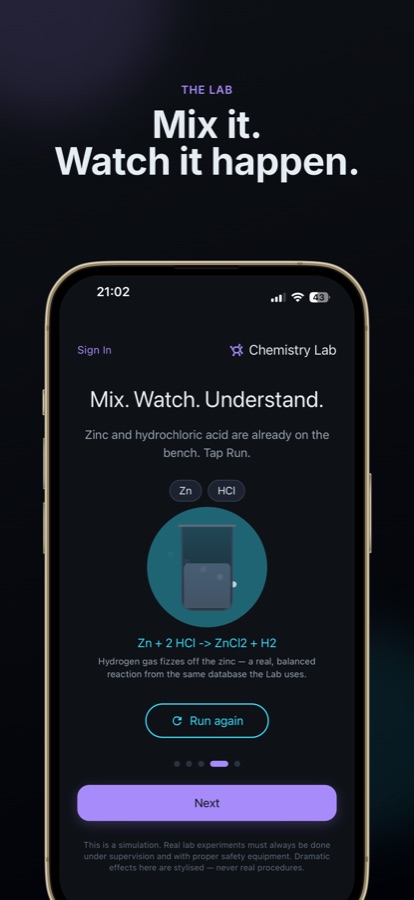
Build a molecule by tapping atoms onto the workbench and predict its VSEPR shape, bond angle and polarity before the answer is shown, or pick two reagents in the mixer and press Run.
Let review bring it back
Every quiz you answer joins a spaced review queue. Cards you got right return later and missed ones return sooner, and the Daily Problem gives one fresh question a day.
What's inside
What is inside
42
Lessons in four worlds
Atoms & Bonds, Reactions, Balancing & Stoichiometry, and AP Chemistry Deep, which covers organic chemistry, equilibrium, thermochemistry, titration and electrochemistry, with 51 quizzes across them.
3D
Molecule builder with VSEPR predictions
Atoms snap onto a workbench into their real geometry. Predict the shape, the bond angle and the polarity first, then see the answer with the lone-pair effect explained. Save builds to a notebook or share a molecule card.
43
Reaction mixer
Pick two reagents and press Run. Results come from 43 hand-checked chemical reactions, each balanced atom for atom, with a hazard note and an Explain why button. If a pair is not in the database, the app says so.
Bench
Stoichiometry bench
Enter grams or moles to get the limiting reagent, the excess and the theoretical yield, plus the percent yield once you add an actual mass.
Drills
Practice drills and puzzles
A balance-the-equation trainer, periodic trends and electron configuration drills, and synthesis puzzles where you reach a target compound in as few steps as you can.
Review
Mastery map and test date
A streak counts the days you clear your queue, and a mastery map shows which concepts are solid or shaky. Set a test date and your daily target leans toward your weakest topics.
Fit
Who it's for — and who it isn't
A good fit if you
- Are taking high school, introductory or AP Chemistry and want extra practice
- Are an adult who wants to finally picture why molecules have the shapes they do
- Learn better by building and mixing than by reading definitions
- Want quizzes that explain the reasoning and a review queue that returns what you forget
- Have a test date and want a daily target focused on your weak concepts
Not the right tool if you
- Need a lab procedure or a safety reference: the reaction database is a teaching tool
- Expect any combination of chemicals to produce a result: only the curated reactions are included
- Want every lesson free, because Pro unlocks the remaining ones
- Use an iPhone today, because the iOS version is not out yet
Safety and limits
A teaching tool, not a lab guide
The reaction mixer is a simulation built on a curated database of balanced equations. It is not a lab-procedure reference and it does not contain instructions for hazardous experiments. The app shows a safety note on first launch, in the Lab and in Settings.
Real chemistry needs supervision. Do not copy anything you see in the app at home. Real laboratory work should be done only with a teacher or supervisor, the proper protective equipment and the right ventilation, and the effects shown in the app are stylised.
Privacy
What stays on your phone
No account is needed to start. Review cards, your streak and your notes stay on your device, while daily usage counters and notebook saves are kept on the app's server and signing in syncs lesson progress. The Explain why and AI hint features send the reaction or lab goal to an AI service only after you agree.
Full details are in the CoddyKit privacy policy.
Questions
Frequently asked questions
What is the best app for learning VSEPR shapes?
Look for one where you build the molecule instead of looking at a chart. Chemistry Lab: VSEPR Molecules lets you tap atoms onto a 3D workbench, predict the shape, bond angle and polarity first, and then shows the answer with the lone-pair effect explained. It is free to start on Android, with an iPhone version coming.
Does the app cover AP Chemistry?
Yes. The fourth world, AP Chemistry Deep, covers organic chemistry, functional groups, equilibrium and Le Chatelier's principle, thermochemistry, reaction rates, titration and electrochemistry, and it ends with an AP-style problem set. These lessons are part of Pro.
Are the chemical reactions in the mixer real?
They come from a curated database of 43 hand-checked reactions, each balanced atom for atom, and the result is not a live simulation. If you pick a pair that is not in the database, Chemistry Lab: VSEPR Molecules tells you so instead of inventing an answer.
Can I use this to do experiments at home?
No. It is a teaching tool and a simulation, not a lab procedure, and it does not describe hazardous experiments. The app says on first launch and in Settings that real experiments must be supervised and use proper safety equipment.
How do I learn to balance chemical equations on a phone?
Balancing is about conserving atoms, and it helps to practise it a lot. Chemistry Lab: VSEPR Molecules has a lesson world on balancing and stoichiometry, a balance-the-equation trainer built from the mixer's reactions, and a stoichiometry bench for the limiting reagent and percent yield.
What is free and what is Pro?
Free includes 11 of the 42 lessons, a 6-element palette, 9 buildable molecules, 10 reactions, a set number of mixes and Explain why answers each day, and the whole review area. Pro adds all 42 lessons, all 14 elements, 19 buildable molecules, 43 reactions, unlimited mixes and an AI hint, and removes ads. Pro is an optional auto-renewing subscription; the price in your currency is shown in the app before you buy, and you can cancel any time in Google Play.
Do I need an account?
No. Chemistry Lab: VSEPR Molecules is guest-first, so you can start the first lesson straight away. Signing in is optional and syncs your lesson progress.
Is there an iPhone version?
Not yet. Chemistry Lab: VSEPR Molecules is available on Android now and the iPhone version is coming. The app is available in 10 languages.
Get started
Build your first molecule
Free to start on Android, in 10 languages. Coming to iPhone.
More from CoddyKit
Available on Android.