
Type Coercion: Safe Patterns to Avoid Surprises
Understand implicit vs explicit coercion; prefer clear casts with Number/String/Boolean; handle NaN safely.
Type Coercion: Safe Patterns to Avoid Surprises is a free JavaScript Academy lesson on CoddyKit. This is lesson 3 of 3. Any 3 lessons of this learning path are free to read in full — after that, CoddyKit PRO unlocks every lesson, plus hands-on practice with a built-in code editor and a 24/7 AI tutor. It is part of the JavaScript Academy learning path, and your progress syncs across the web and the CoddyKit app. The JavaScript Academy course includes 3 lessons in total.
Intro
Goal: See when JavaScript converts types, what results it produces, and how to use explicit casts to stay predictable.
- Implicit vs explicit
- Number/String/Boolean
- NaN safety
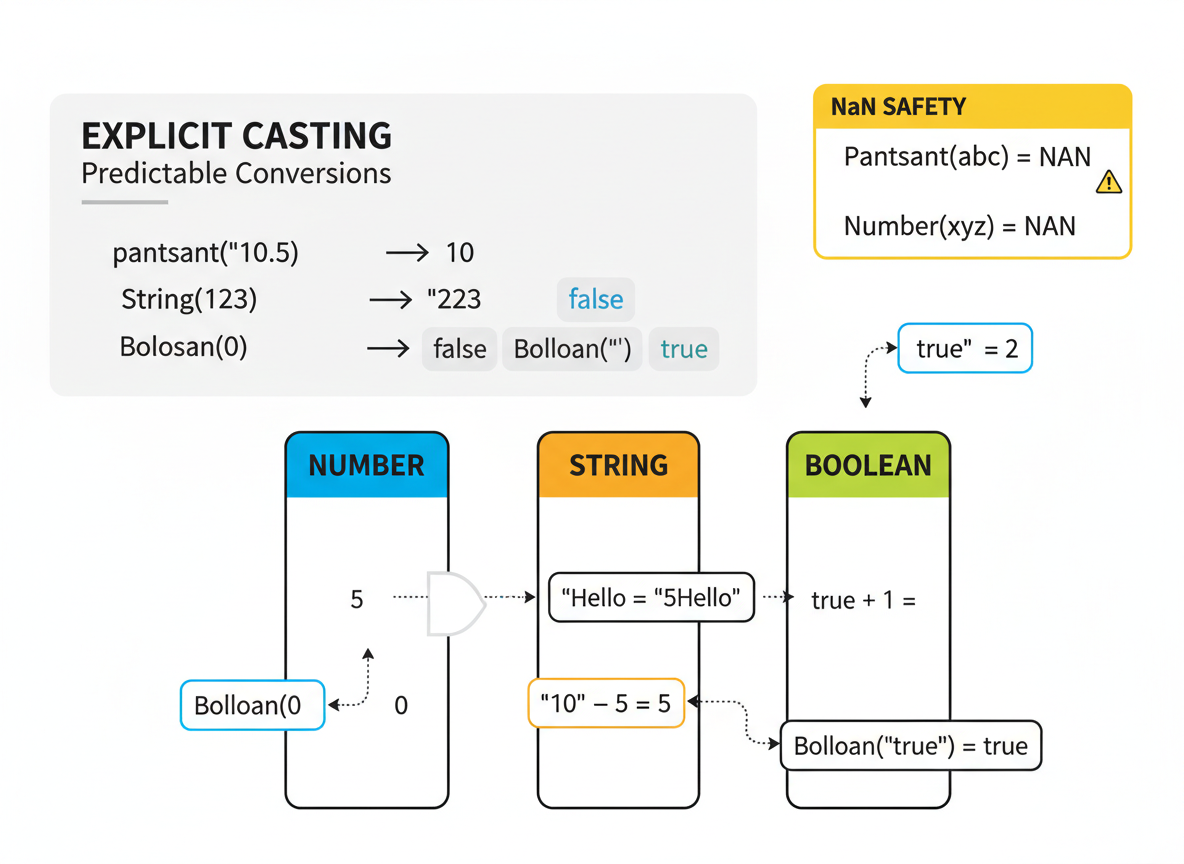
Implicit coercion demo
+ with a string triggers concatenation; - and * try numeric conversion.
// Implicit coercion can surprise beginners
console.log("5" + 1);
// "51"  (string concatenation)
console.log(5 + "1");
// "51"  (number -> string)
console.log("5" - 1);
// 4     (string -> number)
console.log("5" * 2);
// 10    (string -> number)

Explicit conversions
Use Number(x), String(x), and Boolean(x) for clarity.
// Prefer explicit, readable casts
const n = Number("42");
// 42
const s = String(42);
// "42"
const t = Boolean("hi");
// true (non-empty string)
const f = Boolean("");
// false (empty string)

console.log(n, s, t, f);

Number vs parseInt
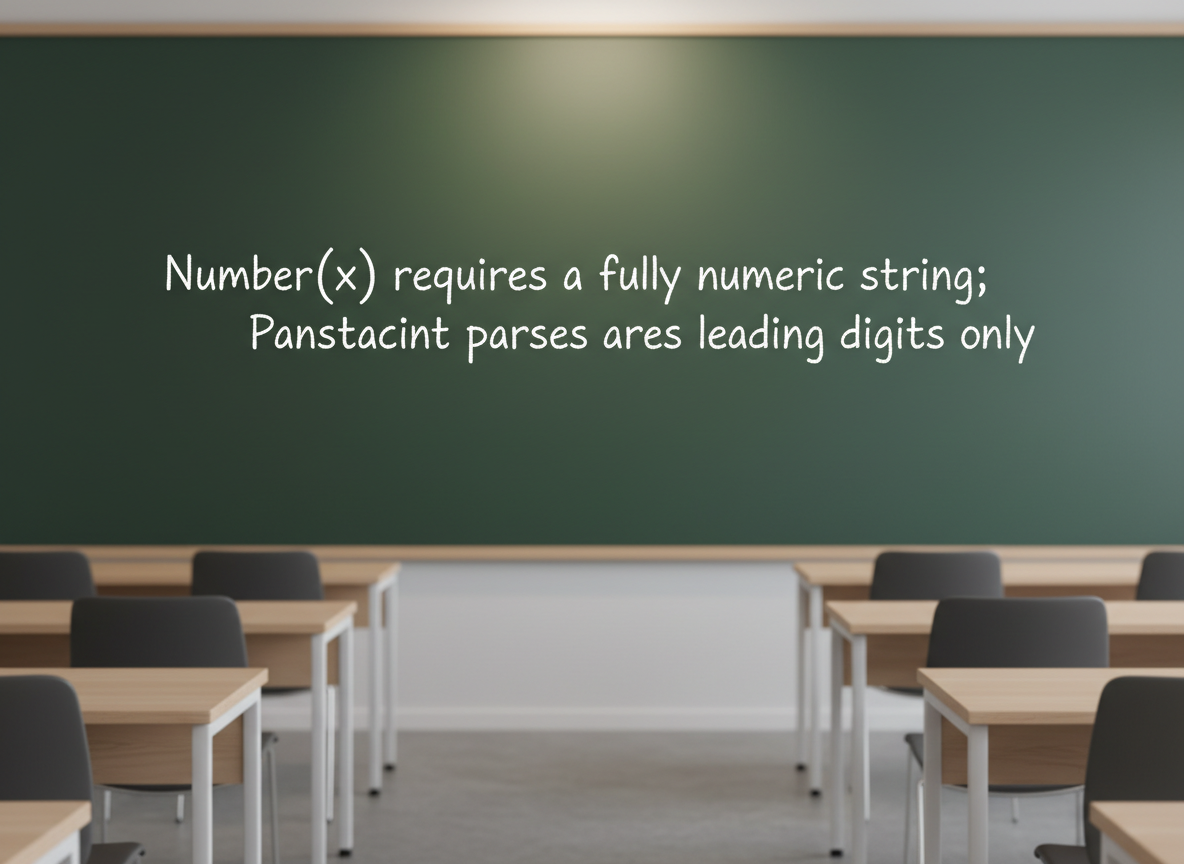
Number(x) requires a fully numeric string; parseInt parses leading digits only.
// Number vs parseInt with examples
console.log(Number("42"));
// 42 (full string must be numeric)
console.log(parseInt("42", 10));
// 42
console.log(parseInt("42px", 10));
// 42 (stops at non-digit)
console.log(Number("42px"));
// NaN (not a pure number)
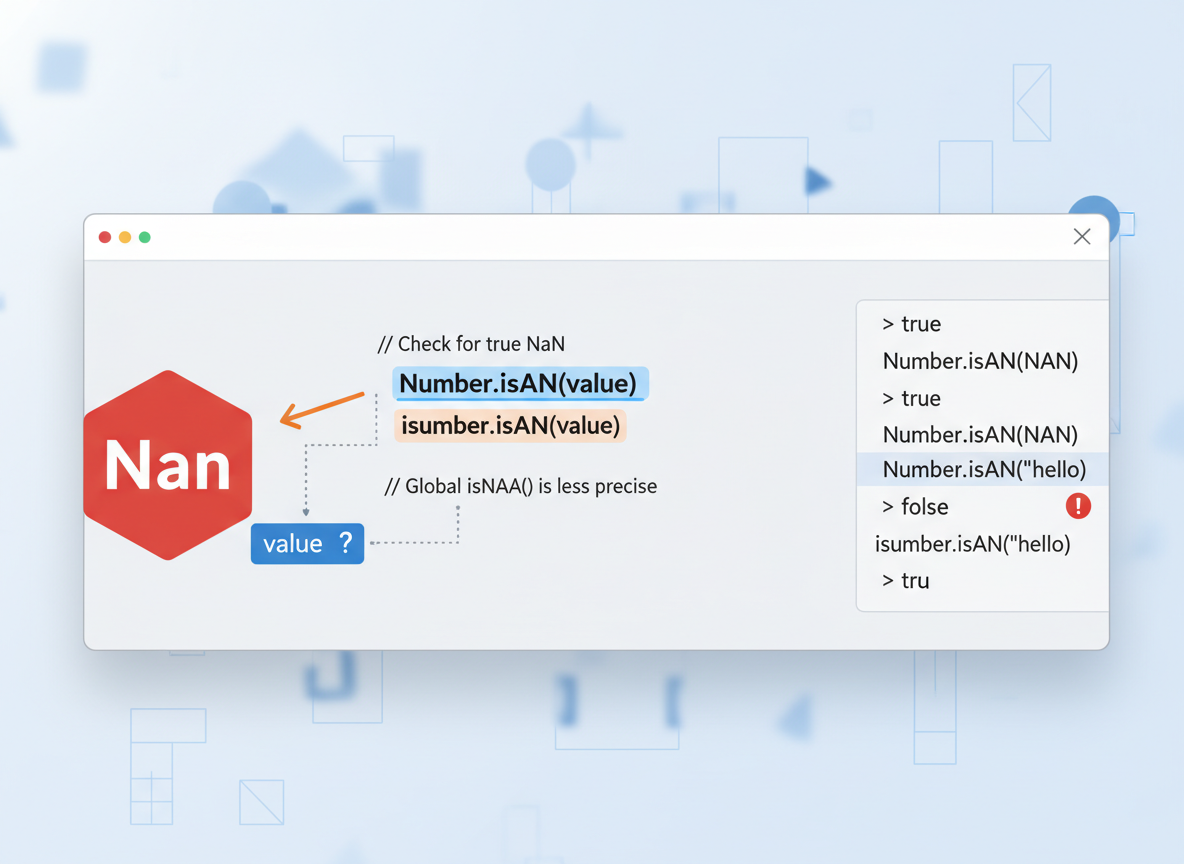
NaN checks
Use Number.isNaN to test NaN without extra coercion.
// NaN is "Not a Number" and is not equal to itself
const bad = Number("oops");
// NaN
console.log(bad === NaN);
// false
console.log(Number.isNaN(bad));
// true (use this)
console.log(isNaN("5"));
// false (string coerces to number 5)
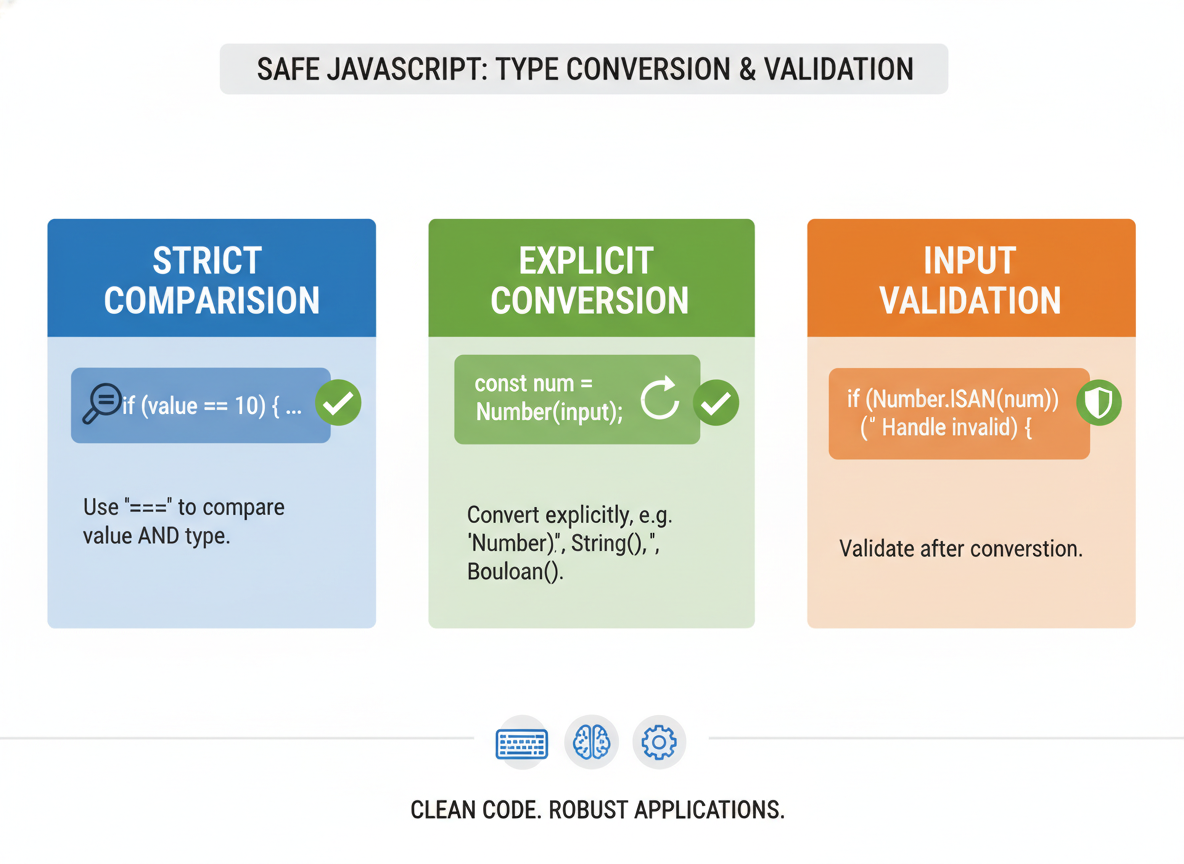
Safety checklist
Safe patterns:
- Prefer === and explicit casts.
- Use Number(x) for numeric strings; avoid clever tricks.
- Validate inputs; check Number.isNaN after parsing.
Explicit conversion quiz
Quick check: Explicit numeric conversion.

Recap
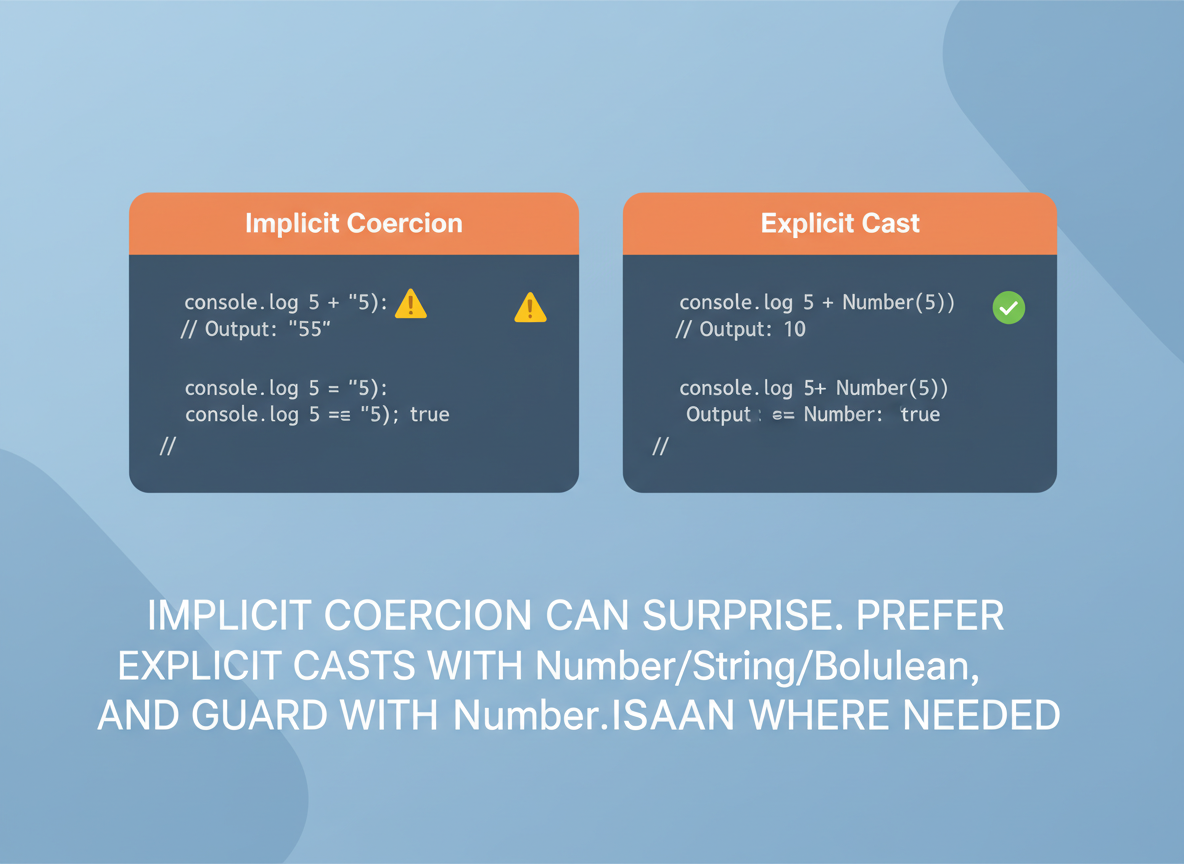
Recap: Implicit coercion can surprise. Prefer explicit casts with Number/String/Boolean, and guard with Number.isNaN where needed.

Learn JavaScript with an AI tutor — free
Write and run real code in your browser, get instant help from a 24/7 AI tutor, and pick up where you left off on the web or in the app.
- Courses
- 59
- Lessons
- 200
Frequently Asked Questions
Is the “Type Coercion: Safe Patterns to Avoid Surprises” lesson free?
Yes — any 3 lessons of the JavaScript Academy learning path, including “Type Coercion: Safe Patterns to Avoid Surprises”, are free to read in full here on the web. After that, CoddyKit PRO unlocks every lesson, plus interactive practice with a built-in code editor and a 24/7 AI tutor. The JavaScript Academy course includes 3 lessons in total.
What will I learn in “Type Coercion: Safe Patterns to Avoid Surprises”?
Understand implicit vs explicit coercion; prefer clear casts with Number/String/Boolean; handle NaN safely. You practise JavaScript Academy with hands-on code you run directly in the browser, and a 24/7 AI tutor answers your questions as you work through the lesson.
Do I need any experience to start JavaScript Academy?
No prior experience is required. JavaScript Academy on CoddyKit is structured for beginners through advanced learners, so you can start here or from the beginning and move at your own pace. This is lesson 3 of 3.
How long does the “Type Coercion: Safe Patterns to Avoid Surprises” lesson take?
Most CoddyKit lessons take about 5–10 minutes. Each one is bite-sized and interactive, so you make steady progress and pick up exactly where you left off across the web and the app.
Can I write and run code in this JavaScript Academy lesson?
Yes. Every JavaScript Academy lesson includes a built-in code editor, so you write and run real code right in your browser and get instant AI feedback — no local setup required.
All lessons in this course
- Primitives vs Objects & Core Types
- typeof, Truthy/Falsy, and == vs ===
- Type Coercion: Safe Patterns to Avoid Surprises