
Games · Free · iOS & Android
By CoddyKit
Startup Simulator: a turn-based startup strategy game for your phone
Startup Simulator: Growth Game is a free turn-based strategy game for iPhone and Android. You run a fictional company one turn at a time — retention, burn rate, runway, churn — and every decision has consequences that surface turns later. It is a game, not a business course.
- Price
- Free, with optional Founder Mode
- Platforms
- iOS and Android
- Genre
- Turn-based strategy
- Age rating
- 4+
No safe choices, only calculated risks.
Every option in the game trades one metric against another: extend the runway and growth stalls, buy capacity and the cash goes faster. The consequences do not all land on the turn you choose.
What it is
Startup Simulator: Growth Game is a free turn-based strategy game for iOS and Android. You run a fictional startup turn by turn, watching retention, revenue, customer acquisition cost, burn rate, runway, infrastructure load and churn move after every choice. Crises arrive daily — server outages, funding deadlines, competitor launches — and an in-game AI advisor called Alex reads your live metrics and briefs you before you decide. Runs can end in failure.
Background
What is runway, and why do startups run out of it?
Runway is how many months a company can keep operating before the cash runs out — its bank balance divided by net monthly burn. It shortens whenever spending rises or revenue falls, and it is the constraint every other decision sits inside. Startups run out because growth is bought with cash upfront while the revenue it produces arrives later, so the gap has to close before the countdown does.
Burn ratecash out per month
The net cash a company loses each month — everything it spends minus everything it earns. Divide the money in the bank by the burn rate and you get the runway, in months.
Customer acquisition costCAC
Total sales and marketing spend divided by the number of customers it brought in. The figure only means anything next to what a customer is worth over the time they stay.
Churn ratecustomers lost
The share of customers who leave in a given period. High churn means new growth has to replace losses before it adds anything, which is what makes a leaky product expensive to market.
Retentioncustomers who stay
The mirror of churn: the share of users still active after a period. It compounds, so a small improvement in retention usually moves revenue further than the same effort spent chasing signups.
How it works
How a run plays out
A turn is one situation, one decision, and the numbers that move afterwards. Short enough to take on a commute, long enough to lose.
Read the situation
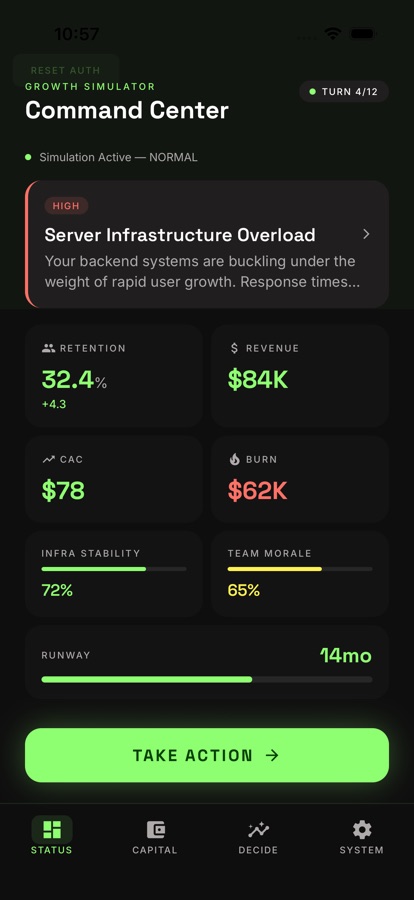
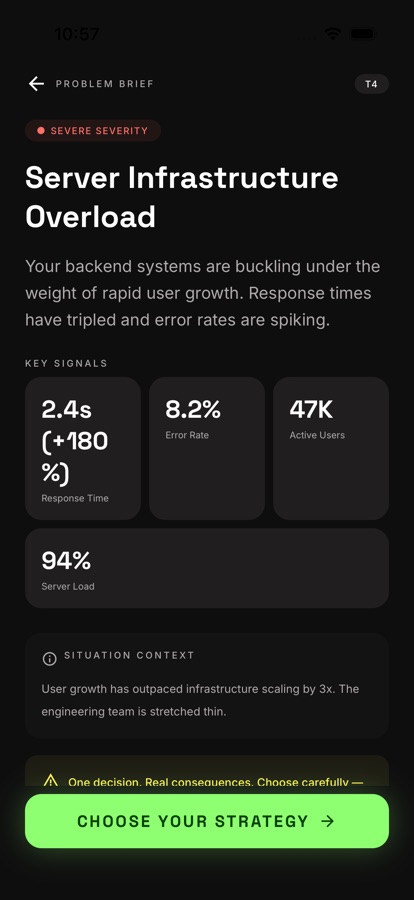
Open the Command Center. The turn number, simulation status and the metrics that matter sit on one screen — retention, revenue, CAC, burn, infrastructure stability, team morale, runway — with the current crisis at the top. A problem brief expands it with key signals and context.
Weigh the strategies
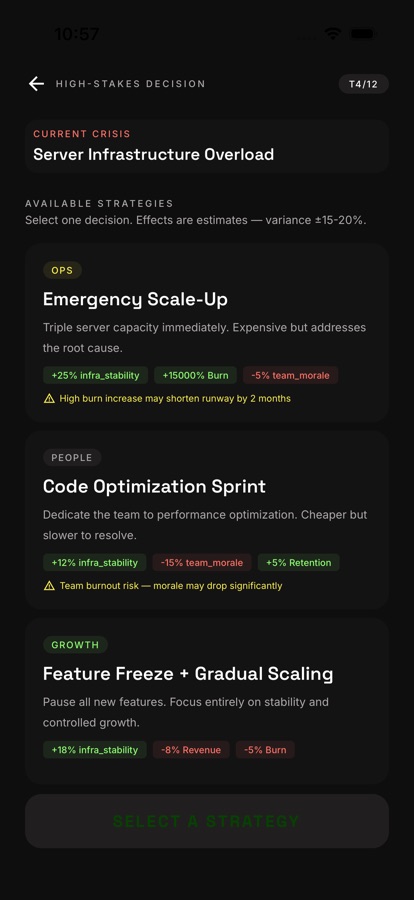
Pick one option from the available strategies. Each shows the effects it is projected to have on individual metrics, flags its risks in plain language, and states that the figures are estimates. There are no safe choices, only trade-offs between growth, stability and remaining cash.
Live with the consequences
Effects land immediately, then keep landing: side effects and hidden outcomes surface turns later, when correcting course may already be too late. Turns pay XP toward a career ladder that runs from Intern to Founder, and a run can end in failure.
What’s inside
What is actually in the game
7
Seven metrics to keep alive
Retention, monthly revenue, customer acquisition cost, burn rate, runway countdown, infrastructure load and churn rate. Most choices move several of them at once, usually in opposite directions.
AI
Alex, the strategic advisor
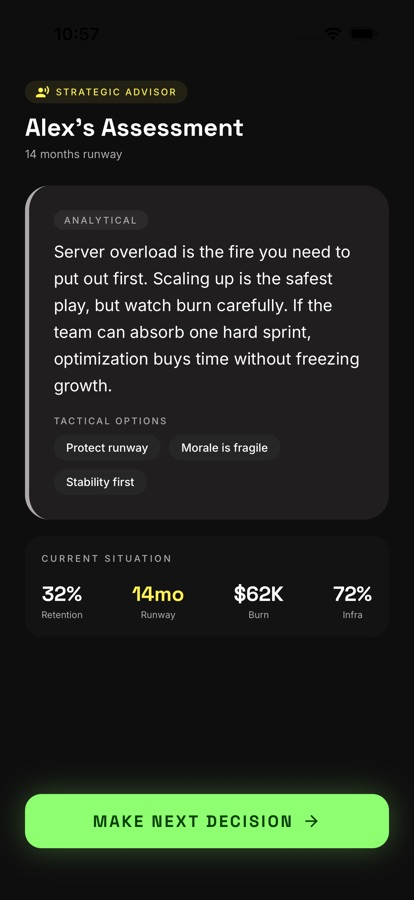
The in-game advisor reads your live metrics and writes a briefing for the situation you are actually in, instead of handing out generic startup tips.
Daily
A new crisis every day
Server outages at peak traffic, funding round deadlines, surprise competitor launches, PR disasters, key resignations. Each one tests a different part of holding the simulated company together.
6
Intern to Founder
A career ladder with six rungs — Intern, Analyst, Associate, Manager, Director, Founder. Advanced challenge tiers and deeper simulation layers unlock as you prove you can survive.
Risk
Warnings before you commit
Risk warnings and a hidden-consequence detection system sit next to before-and-after metric comparisons, so you can see what a strategy is projected to cost as well as earn.
Turn
Turn-based, and losable
The simulation advances turn by turn and has multiple failure states. Losing is a normal outcome, which is what makes the next run play differently from the last.
Inside the app
What it looks like
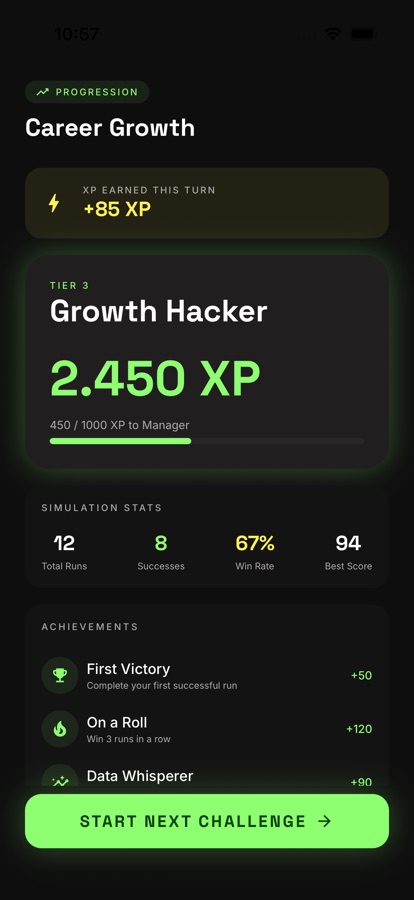
Fit
Who it’s for — and who it isn’t
A good fit if you
- Like turn-based strategy where numbers and trade-offs decide the outcome, not reflexes
- Have worked around startups and enjoy watching runway, CAC and churn behave under pressure
- Want short sessions — a daily crisis and a run you can get through on a commute
- Are happy to lose: multiple failure states and replaying a scenario differently are the point
- Prefer a dense dark data interface to cartoon business-tycoon art
Not the right tool if you
- Want business advice you can apply to a real company — the scenarios and numbers here are fiction
- Expect an accurate financial model; the game says outright that effects are estimates with variance
- Want unlimited turns, every difficulty mode and full advisor analysis without paying — those sit behind the Founder Mode subscription
- Prefer real-time or idle management games; every turn here waits for you to read and decide
Questions
Frequently asked questions
What's the best startup simulator game for iPhone or Android?
The thing that separates a good one from a reskinned idle game is whether the numbers interact. If cutting marketing spend does not visibly stall growth, you are tapping, not deciding. Startup Simulator: Growth Game runs turn-based on seven linked metrics — retention, revenue, CAC, burn, runway, infrastructure load and churn — and shows each option's projected effects and risks before you commit. It is free on iOS and Android, with a Founder Mode subscription that lifts the free limits.
What is burn rate, and why do founders watch it so closely?
Burn rate is the net cash a company loses per month: everything going out minus everything coming in. Founders watch it because it sets the deadline for everything else. Cash in the bank divided by monthly burn gives runway in months, so a hire, a server bill or a marketing push does not just cost money, it costs weeks of time. Gross burn counts only spending; net burn subtracts revenue and is the number that decides how long you have.
What counts as a good customer acquisition cost?
There is no universal number, because CAC only means something compared with what a customer is worth. Take total sales and marketing spend, divide by the customers it brought in, then set that against lifetime value. Software businesses often use a rough three-to-one ratio of value to cost, and a payback period under a year, as a health check. A low CAC with terrible retention is worse than a high CAC with customers who stay for years.
Why does churn matter more than new signups?
Because churn works against you every month while a signup only helps once. If five percent of customers leave each month, growth has to replace that five percent before it adds anything at all, and the bigger the base gets, the more of your acquisition budget goes to standing still. That is why retention improvements compound and signup pushes do not: reducing churn raises the value of every customer you already paid to acquire.
What actually causes most startups to fail?
Post-mortem surveys keep landing on the same short list: running out of cash, building something not enough people wanted, being outcompeted, and problems inside the founding team. Those overlap more than they look. A company usually runs out of money because it spent the runway learning something it could have learned cheaper. The failure is rarely one dramatic decision; it is a sequence of reasonable-looking choices that each cost a few weeks of time.
Can a startup simulator game teach you anything real?
It can make the vocabulary and the trade-offs familiar — what burn does to runway, why infrastructure spend and cash reserves pull in opposite directions, how a decision made on turn four bites on turn nine. What it cannot do is model your market, your customers or your team, and no game outcome predicts a real one. Treat Startup Simulator as a strategy game built on business mechanics, not as advice, a course, or a substitute for actual operating experience.
Is Startup Simulator: Growth Game free?
Yes, it is free to download on the App Store and Google Play. Free players get a daily challenge, the core metrics, and one full run every day. An optional Founder Mode subscription, monthly or yearly and cancellable at any time, removes those limits: unlimited turns per run, full AI advisor analysis on every decision, all difficulty modes from EASY through HARD, unlimited daily runs, and a bonus daily XP multiplier.
What does the AI advisor in the game do?
The advisor, Alex, produces a strategic briefing tuned to the state your company is currently in. It reads the live metrics — runway, retention, burn, infrastructure load — names the fire it thinks you should put out first, and lays out tactical considerations rather than generic startup platitudes. It is a game character giving in-game guidance about fictional numbers, not financial or business advice. Full advisor analysis on every decision is part of Founder Mode.
What platforms does it run on, and is it suitable for kids?
It runs on iPhone and Android, and it is rated 4+, meaning there is no objectionable content. That is a content rating rather than a recommendation: the game is dense reading about business metrics, crisis briefs and percentage changes, so the interest and reading level, not the rating, is the real gate. It also contains an optional Founder Mode subscription, so a device with purchases enabled can be charged.
Can you actually lose?
Yes, and that is designed in. The game has multiple failure states — the clearest one being the runway countdown reaching zero before the company reaches a sustainable position. Decisions carry delayed side effects and hidden outcomes that only surface several turns later, so a run can be lost by something you chose long before it showed up in the numbers. Losing ends the run; progress and achievements carry across attempts, and the scenario replays differently.
Start logging
Take the first turn
Free on iOS and Android. A fictional company, real trade-offs.
More from CoddyKit
Available on iOS and Android.