
Games · Free · iOS & Android
By CoddyKit
Silent Evidence: a noir detective game of fair-play murder cases
Silent Evidence is a free noir detective game for iPhone and Android where you solve fair-play murder mysteries yourself. Read autopsy reports, phone logs and letters, play the recorded interrogations, then name the culprit, the motive and the method. Every case is fictional, and every answer is in the file.
- Price
- Free, with optional Pro
- Platforms
- iPhone and Android
- Account
- No sign-up required
- Age rating
- 12+ — fictional murder cases
Every answer is hidden in the evidence.
Each case has exactly one solution, and everything needed to reach it is already in the file you were handed. Nothing is withheld for a twist, and no narrator walks you to the name at the end.
What it is
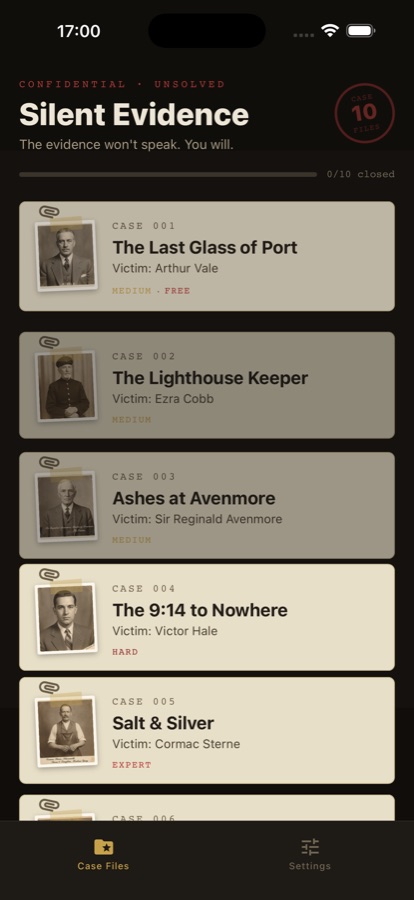
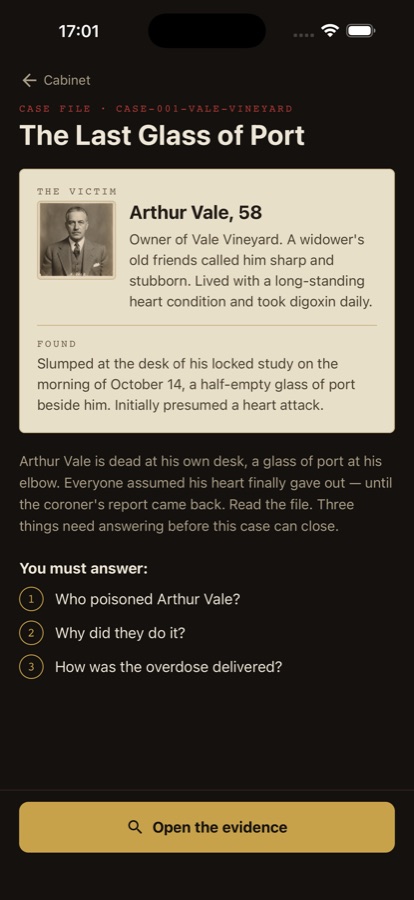
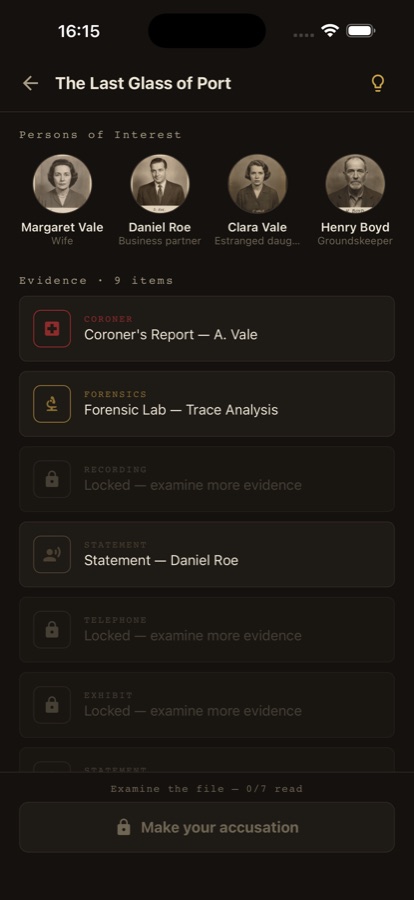
Silent Evidence is a free noir detective game for iOS and Android. Each case file is a self-contained, fictional murder investigation: you read the briefing, examine evidence such as coroner's reports, forensics, telephone logs and financial records, listen to recorded interrogations, then file a three-part accusation naming the culprit, the motive and the method. Ten hand-crafted cases ship with the app; the first is free start to finish, and Silent Evidence Pro unlocks the rest.
Background
What is a fair-play murder mystery?
Fair play is the rule that a detective story must give the reader everything needed to solve it before the detective explains. It comes out of Golden Age crime fiction — Agatha Christie, Dorothy L. Sayers, and Ronald Knox's list of commandments — which barred hidden twins, undisclosed poisons and last-page confessions. A fair-play puzzle can be reasoned to a single answer; an unfair one can only be waited out.
Red herringplanted distraction
A detail placed to look incriminating and lead you the wrong way — a suspicious debt, an argument the night before. In fair play it is allowed, provided the evidence that clears it is also somewhere in the file.
Locked-room mysterythe impossible crime
A killing in a space nobody could enter or leave. The genre's oldest set piece, and the purest test of deduction, because solving it means finding the assumption about the room you accepted without checking.
Means, motive, opportunitythe three legs
The classic frame for building a case: could this person have done it, why would they, and were they there to do it. Any suspect missing one of the three drops out, which is how a roster narrows.
Alibian account to test
A suspect's claim about where they were. An alibi is not proof — it is a statement to be cross-referenced against something independent, like a phone record, a ledger entry or the time on a recording.
How it works
How a case is worked
Every file follows the same shape: a briefing, evidence you open piece by piece, and an accusation that has to be specific. No timers, so a case can sit half-read until you come back to it.
Read the briefing and meet the suspects
Each case opens with a summary of the body, the scene and the situation, then a full suspect roster. Every suspect carries a public story and a secret worth digging for, so the first pass is about noting who benefits and whose account you will want to test later.
Work the evidence, and listen
Crime-scene photos, autopsy reports, forensic analysis, phone logs, financial records, letters and news clippings unlock piece by piece rather than all at once. Recorded interrogations use real recorded lines, not transcripts — the timing of a recording or a suspect's own phrasing is often what breaks the case.
File the three-part accusation
Name who did it, why they did it, and how. All three parts count, with partial credit for getting some but not all of them right, and the close is scored — a verdict reached with no hints and no wrong guesses is worth more than one you stumbled into.
What’s inside
What is actually in the case file
10
Ten hand-crafted cases
Investigations of escalating difficulty, from a quiet vineyard poisoning to a locked-room library murder. New case files are added over time, so the docket does not run out.
3
A three-part verdict
An accusation has to name the culprit, the motive and the method. Get some but not all of it and you take partial credit; miss it and the case stays open.
Audio
Recorded evidence
Dictaphone recordings and interrogations play as real recorded lines rather than text transcripts. A clock striking the hour or a half-spoken name can be the clue.
Lock
Evidence that unlocks in order
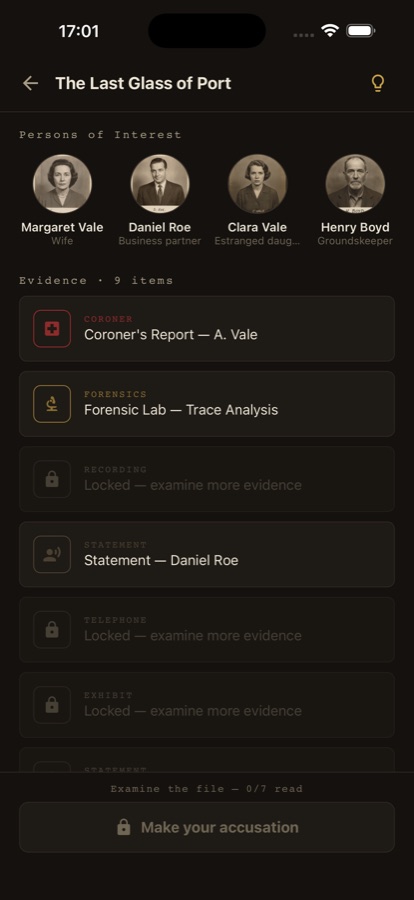
Exhibits open piece by piece, and some only after you have read something else first. The order you work through the file shapes what you end up noticing.
Hint
Tiered hints when you stall
A first nudge is always free. Deeper hints are unlocked by watching a short ad, or without ads on Pro, so being stuck never ends a case.
Badge
Scored closes and badges
Every case gets a score, and badges track real progress: your first verdict, a run of cases closed, a flawless conviction, a fully read file, a high score.
Inside the app
What it looks like
Fit
Who it’s for — and who it isn’t
A good fit if you
- Like whodunits, courtroom dramas and true-crime-style puzzles, and want to do the deducing yourself
- Enjoy cross-referencing an alibi against a phone log and building a case before you are sure
- Want a game with no timers and no live opponents, that waits while you sit with the file
- Prefer a single correct answer you can reason to, over a mystery that resolves itself in a cutscene
- Play in stretches on a phone and want progress kept exactly where you left it
Not the right tool if you
- Want action or fast reflexes — this is reading, listening and cross-referencing, and little else
- Are looking for a long campaign for free: only the first case is free start to finish, and later cases open just their first clues
- Want multiplayer, leaderboards or live competition, none of which the game has
- Are buying for a younger child — the game is rated 12+ and every case is a murder investigation
Privacy
What happens to your progress
There is no forced sign-up and no account wall between you and the first case — open the app and start reading. Progress, badges and best scores are kept on your device, so a cold case picks up exactly where you left the file. Cases are self-contained: no live opponents, and no correct-answer lookup online.
Full details are in the CoddyKit privacy policy.
Questions
Frequently asked questions
What's the best detective game where you actually solve the case yourself?
The test worth applying is whether the game lets you be wrong. If a narrator narrows the suspects for you, or the story advances no matter what you pick, you are reading a mystery rather than solving one. Look for a single correct answer, evidence given in full, and an accusation specific enough to fail. Silent Evidence works that way: ten fictional cases, a three-part verdict naming culprit, motive and method, and partial credit when you get only part of it. It is free on iPhone and Android.
What makes a murder mystery fair play?
Fair play means the reader is given everything needed to reach the solution before it is revealed. The idea was formalised in Golden Age crime fiction, notably by Ronald Knox and the Detection Club, and ruled out cheats like an unknown identical twin, an invented poison, or a culprit introduced on the last page. Misdirection is still allowed — the key detail can sit in plain sight — but nothing essential may be withheld. A fair puzzle can be reasoned out early; an unfair one can only be waited out.
How do you spot a red herring in a mystery?
A red herring is a detail planted to look incriminating and pull you off the trail — a debt, a threat overheard, a lie about something unrelated. Two habits catch most of them. First, ask what the detail proves rather than what it suggests: a lie about an affair is a lie about an affair, not about a killing. Second, test it against independent evidence such as a timestamp, a ledger entry or a phone record. In a fair-play mystery, whatever clears a red herring is also in the file.
What is a locked-room mystery?
A locked-room mystery is a killing in a place nobody could have entered or left — a bolted study, a library sealed from the inside, snow with no footprints. It is the genre's oldest set piece, going back to Poe's Rue Morgue and later refined by John Dickson Carr. The solution almost never involves a secret passage. It usually turns on an assumption you accepted without checking: when the death actually happened, or whether the room was really sealed at the moment everyone believes it was.
What do detectives mean by means, motive and opportunity?
It is the standard frame for testing a suspect. Means asks whether they could physically have done it — access to the weapon, the strength or the knowledge required. Motive asks why they would: money, fear of exposure, revenge, protecting someone else. Opportunity asks whether they were in a position to do it at the time it happened. A suspect who fails any one of the three usually drops out, which is how a roster of five or six narrows to one.
What kinds of evidence appear in a murder investigation?
Broadly three kinds. Physical and forensic evidence: the scene itself, photographs, and the coroner's or autopsy report establishing cause and approximate time of death. Documentary evidence: telephone logs, financial records, ledgers, letters and press coverage, which are useful because they were created for other reasons and are hard to fake after the fact. And testimony: what suspects and witnesses say, which is the least reliable and the most interesting, because it can be checked against the other two. Silent Evidence builds its case files from all three.
Is Silent Evidence free, and what does Pro unlock?
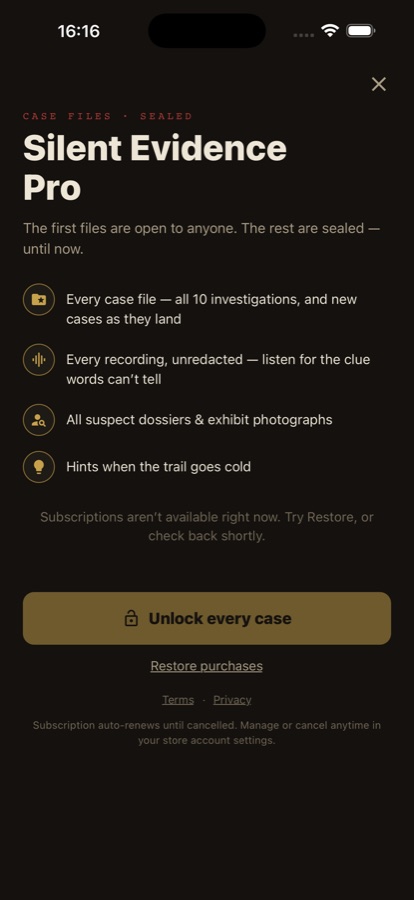
The app is free to download and the first case file is free to open and solve start to finish. Every case after that opens its first clues for you to examine. Silent Evidence Pro, listed at $9.99 in the App Store, unlocks all ten cases and every case added later, plus full-length recordings, complete suspect dossiers and exhibit photographs, and hints without watching ads. The free tier shows ads between cases; Pro removes them. Restore Purchases is on the paywall screen.
Do I need an account, and where is my progress saved?
No account and no sign-up. You open the app and start reading the first case immediately — there is no wall between you and the file. Progress, badges and best scores are stored on your device, so you can put a case down half-read and pick it back up exactly where you left it. Cases are self-contained, with no timers and no live opponents. Silent Evidence is available on iPhone and Android.
What happens if I get stuck on a case?
Hints are tiered rather than all-or-nothing. A first nudge is always free, and deeper hints are unlocked either by watching a short ad or by having Silent Evidence Pro, which lifts the hint limit without ads. Hints do cost you something, though: each case is scored, and a clean close with no hints and no wrong guesses is worth more than one you needed help with. There are no timers, so leaving a file open and coming back to it later is usually the better move.
Is Silent Evidence suitable for younger players, and are the cases real?
It is rated 12+, and the subject matter is what that rating implies: every case is a murder investigation, described through coroner's reports, forensics and interrogation transcripts rather than depicted action. The tone is noir and procedural — you are reading a case file, not watching a crime. Every case, victim and suspect is entirely fictional, written for the game and not based on real people or real events. For younger children, or anyone who would rather not read around a death, this is not the right game.
Start logging
Open the file, name the culprit
Free on iPhone and Android. First case free, start to finish.
More from CoddyKit
Available on iOS and Android.