
Reptile Care: Feeding Log
Reptile Care: Feeding Log — A husbandry diary that knows each species' own clock
Reptile Care is a free husbandry journal and feeding tracker for keepers of geckos, snakes, bearded dragons, tortoises, turtles and frogs. Log feeding, sheds, weight and terrarium readings across seven entry types, and let a feeding queue sort the whole collection by who is actually due, using each animal's species and life stage instead of one flat weekly clock.


- Price
- Free, Pro upgrade
- Platforms
- Android now, coming to iPhone
- Languages
- 10
- Account
- Not needed, guest mode works
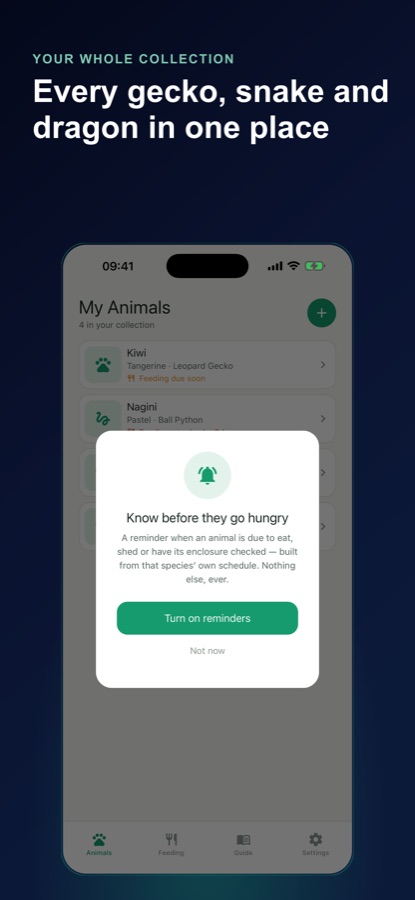
A juvenile and an adult are not on the same clock.
Most feeding reminders are a flat weekly repeat. A growing bearded dragon and a mature ball python eat on genuinely different schedules, and a reptile that refuses a few meals in a row looks completely different depending on whether anyone wrote down the last three.
What it is
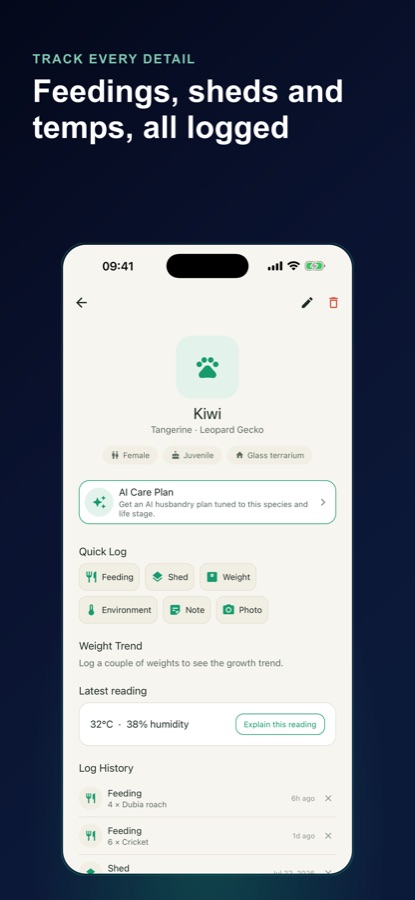
Reptile Care: Feeding Log is a husbandry journal for reptile and amphibian keepers, free on Android and coming to iPhone. You add each animal with its species and life stage, then log feeding, shed, weight, environment, supplement, note and photo entries as seven separate task types. A feeding queue sorts the collection overdue first, then due soon, then upcoming, with next-due dates set by species and life stage rather than one shared schedule, and a 29-species guide covers basking and cool-side temperatures, humidity, UVB, substrate and diet for each.
Inside the app
What it looks like
Background
What does keeping a feeding and care log for reptiles actually involve?
Reptile husbandry runs on species-specific numbers that do not generalize: a leopard gecko, a ball python and a bearded dragon each want a different basking temperature, humidity range and feeding interval, and a juvenile of any of them eats more often than the adult it becomes. A log exists because none of that is memorable across weeks, and because the signs that something is actually wrong — a refused meal, a skipped shed, a drifting enclosure reading — only mean something next to the pattern before them.
Feeding interval by life stagenot a flat schedule
Juvenile reptiles of most species feed more frequently than adults of the same species, because they are putting more of what they eat into growth. A schedule written for an adult ball python starves a hatchling of the same species, and the reverse overfeeds it — which is why a useful tracker sets the next-due date from species and life stage together, not a single interval for the whole collection.
Temperature gradient and UVBa range, not one number
Most reptiles kept in captivity need a thermal gradient — a warm basking side and a cooler side — so they can move to the temperature their body needs at a given moment, plus UVB lighting for species that use it to process calcium. A single ambient reading misses the gradient; keepers generally track the basking spot, the cool side and ambient humidity separately.
Brumationa seasonal slowdown, not illness
Many temperate reptile species enter a period of reduced activity and appetite during cooler months, called brumation, which is a normal seasonal response rather than a sign of sickness. Feeding often needs to pause and resume on a different clock during that window, which is easy to misread as a health problem if nothing in the log marks the season.
Refusal versus a feeding strike worth a vet visitthe pattern matters
A single refused meal is common and usually not concerning on its own. A run of refusals, especially alongside weight loss, is the pattern that is actually worth acting on — which only becomes visible if feeding and weight are both logged over the same stretch of time rather than remembered separately.
How it works
How the app is used
The collection is set up once per animal. After that, the habit is checking the feeding queue and logging what happened — everything else is built from those entries.
Add each animal
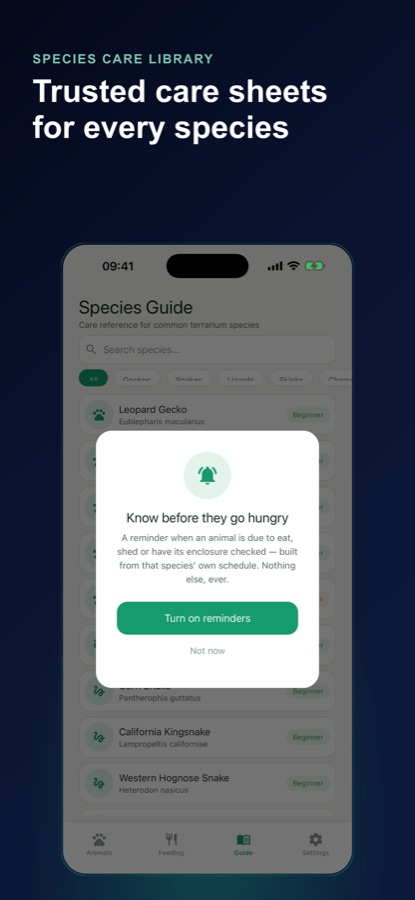
Create a record for every reptile or amphibian in the collection with its species and life stage. The 29-species guide covers geckos, snakes, bearded dragons, tortoises, turtles and frogs, with basking and cool-side temperatures, humidity, UVB, substrate, diet and common husbandry mistakes for each, so you can check a new species' needs before committing to it.
Work the feeding queue
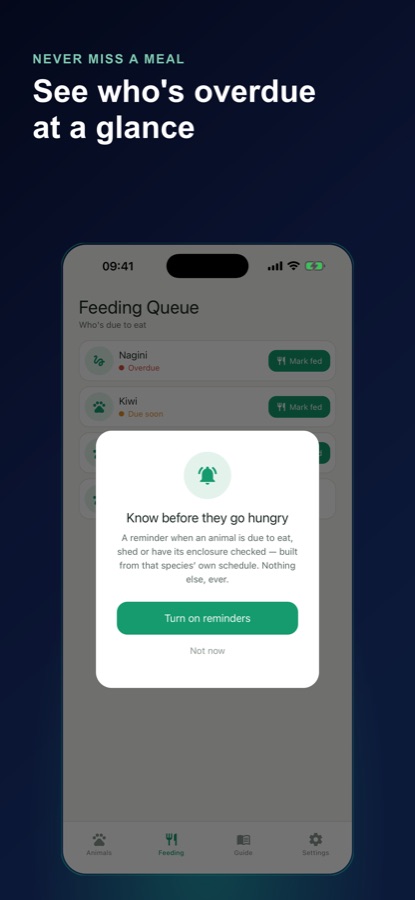
The Feeding tab sorts the whole collection overdue first, then due soon, then upcoming, with a one-tap Mark fed. Next-due dates come from each animal's species and life stage, so a juvenile and an adult are never flattened onto the same clock. Reminders answer with Fed, Refused or Snooze.
Log the rest as it happens
Shed, weight, environment readings, supplements, notes and photos each get their own entry type. Temperature and humidity readings are compared against the species guide's reference range and labelled in range, marginal or out of range, and a run of readings in one direction is flagged as drift.
What's inside
What the app tracks
7
Seven log types
Feeding, shed, weight, environment, supplement, note and photo each get their own record, so a shed date or a drifting humidity reading stays separate from a vague note.
29
Species care guide
Twenty-nine species from leopard and crested geckos to ball pythons, bearded dragons, tortoises, turtles and frogs, each with temperature, humidity, UVB, substrate, diet and common mistakes.
Queue
Life-stage feeding queue
The Feeding tab ranks the collection overdue, due soon and upcoming, with next-due dates set from species and life stage rather than one shared interval.
AI
AI care plan and reading explainer
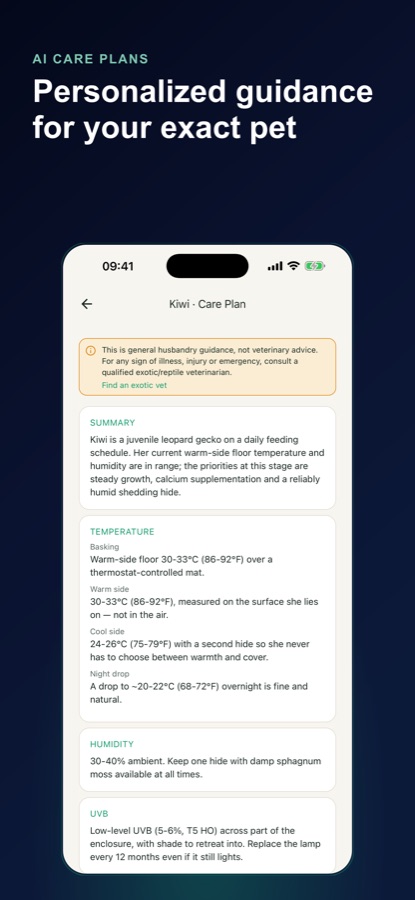
An optional AI care plan tuned to species and life stage, plus an explainer for an out-of-range temperature or humidity reading. Species, life stage and a log summary are sent only after you consent; health questions are refused and pointed to a vet.
Drift
Reading drift alerts
Environment readings are compared with the species guide's reference range and labelled in range, marginal or out of range, with a run of off-range readings flagged as drift rather than a single data point.
Vet
Vet visit summary
A summary of feeding, weight, shed and the latest readings, ready to share with an exotics vet, plus a flag when repeated refusals and weight loss show up together.
Fit
Who it's for — and who it isn't
A good fit if you
- Keep more than one reptile or amphibian on different feeding schedules
- Want next-due feeding dates set by species and life stage, not a flat weekly repeat
- Are choosing a first reptile species and want to check its real temperature and humidity needs first
- Want environment readings checked against a reference range instead of guessed at
- Want a feeding and weight history ready to hand an exotics vet
Not the right tool if you
- Want a diagnosis for a sick or injured animal — the app points you to a vet instead
- Expect the species guide to replace an exotics vet's hands-on judgement; it's general published guidance
- Are on iPhone today — Reptile Care is on Android now, with iOS coming
- Want everything free: AI care plans beyond the free allowance and unlimited animals are Pro
Questions
Frequently asked questions
What's a good app for tracking reptile feeding and care?
A reptile tracker needs to handle more than one feeding schedule at once, because a juvenile and an adult of the same species genuinely eat on different clocks. Reptile Care: Feeding Log does this with a feeding queue ranked by species and life stage, seven separate log types covering feeding through photos, a 29-species care guide, and reading-drift alerts for temperature and humidity. It's free on Android, with iOS coming.
How often should a pet reptile be fed?
It depends entirely on species and life stage, which is the most common mistake in flat feeding schedules. Juvenile reptiles of most species feed more often than adults of the same species because more of what they eat goes into growth, and a bearded dragon's schedule tells you nothing about a ball python's. Reptile Care's feeding queue sets each animal's next-due date from its own species and life stage rather than one shared interval.
Why did my reptile refuse to eat?
A single skipped meal is common and usually not a sign of a problem on its own — stress from a recent move, a coming shed, or seasonal brumation can all explain it. What's actually worth acting on is a run of refusals, especially alongside weight loss, which is a pattern that only becomes visible if both are logged over the same stretch of time. Reptile Care flags repeated refusals paired with weight loss with a prompt to see an exotic vet.
What is brumation, and does it affect feeding?
Brumation is a seasonal slowdown in activity and appetite that many temperate reptile species go through during cooler months — it's a normal response, not illness. Feeding typically needs to pause and resume on a different schedule during that window. Reptile Care's brumation record pauses feeding reminders and switches to a weekly weight check, without telling you when or how to brumate your own animal.
What temperature and humidity does my reptile need?
It depends on the species: most reptiles need a thermal gradient, with a warmer basking side and a cooler side to move between, plus species-specific humidity and UVB needs. Reptile Care's 29-species guide lists basking and cool-side temperatures, humidity and UVB for each covered species, and compares your own logged readings against that reference range — labelling them in range, marginal or out of range, with a run of readings in one direction flagged as drift.
Is Reptile Care: Feeding Log free?
Yes. Up to two animals, the full species guide, all seven log types, schedules and reminders, charts and history, and a small number of AI care plans are free, and the free version shows ads. Pro adds unlimited animals, unlimited AI care plans and reading explanations, and more species questions per day, with no ads.
Is Reptile Care available on iPhone?
Not yet. Reptile Care: Feeding Log is live on Google Play now; the iOS app is built and the App Store listing exists, but it has not launched there yet. The Android app already covers the full feeding log, species guide and AI care plan.
What does the AI care plan do, and is my data sent anywhere?
It generates a care plan tuned to one animal's species and life stage, covering things like temperature, feeding and supplement guidance. It runs only after you consent, and only the species, life stage and a short summary of recent logs are sent to an AI provider through the app's own server — never a photo or the animal's name. Health or symptom questions are refused by the AI and pointed to a vet instead.
Can the app replace advice from an exotics vet?
No, and it says so directly: Reptile Care is a husbandry record, not veterinary advice, and it does not diagnose, treat or dose anything. No number in the app guarantees that a temperature, humidity level, UVB setup, prey size or supplement schedule is safe for a specific animal. For any sign of illness or injury, or before changing supplements, the app points you to a qualified reptile vet.
Do I need an account to use Reptile Care?
No. You can start as a guest with no sign-up, and photos stay on your device. Creating an account later is optional and mainly useful for keeping your collection when you move to a new phone, rather than something required to begin logging.
Get started
Give every animal its own schedule
Free on Android now, with iOS coming — a husbandry log built around species and life stage.
More from CoddyKit
Available on Android.