
Organic Chemistry Lab 3D
Organic Chemistry Lab 3D — Rotate real molecules to learn mechanisms, chirality and spectra
Organic Chemistry Lab 3D is a free molecule-rotating chemistry lab for iPhone and Android. Every shape, angle, R/S label, IUPAC name and predicted spectrum is computed on your device by the app's own chemistry engine — nothing is looked up from a table of pre-written answers, so it all works offline.


- Price
- Free, Pro upgrade
- Platforms
- iOS and Android
- Languages
- 10
- Age rating
- 4+
- Version
- 1.0
- Requires
- iOS 15.1 or later
Organic chemistry is three-dimensional, and a flat page cannot show you why.
A hydrogen has to be anti-periplanar before it will eliminate. A carbocation loses all memory of which face the leaving group was on. Two drawings can be the same molecule or genuine mirror images. None of that is visible until you can turn the model.
What it is
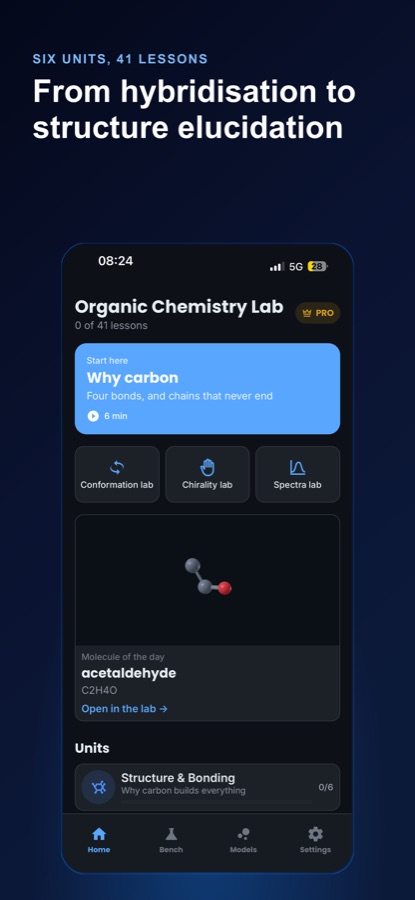
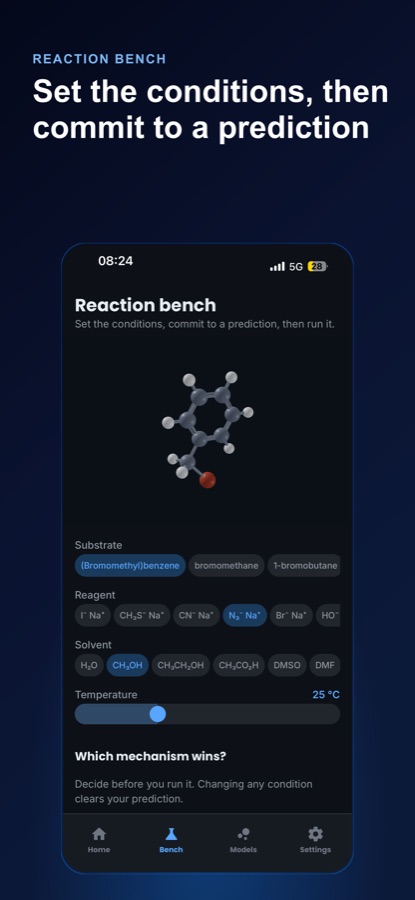
Organic Chemistry Lab 3D is a free iOS and Android app for learning organic chemistry through rotatable 3D molecules instead of flat diagrams. Four labs — Conformation, Chirality, a Reaction Bench and Spectra — let you drag a bond and watch a Newman projection and its energy curve respond, commit to an R or S assignment before priorities are shown, predict which mechanism (SN1, SN2, E1 or E2) a reaction will take, and identify a compound from its predicted NMR, IR and mass spectrum. A six-unit, 41-lesson course covers structure and bonding through aromatics and spectroscopy, and every computed value — bond angle, energy, mechanism verdict — comes from the app's own chemistry engine rather than a stored answer key.
Inside the app
What it looks like
Background
What are functional groups, and why does organic chemistry depend on 3D shape?
A functional group is a specific arrangement of atoms within a molecule — a hydroxyl, a carbonyl, an amine — that reacts in a predictable way regardless of what the rest of the molecule looks like, which is what lets organic chemistry organise millions of compounds into a manageable number of reaction patterns. But many of the reasons those reactions proceed, or don't, depend on geometry rather than just which atoms are present: a bond has to be lined up at the right angle for an elimination to happen, and two molecules can share an identical formula and identical bonds while being genuinely different substances because of how they're arranged in space.
Conformationthe same molecule, rotated
Conformations are different 3D arrangements of one molecule produced just by rotating around single bonds — no bonds break. A Newman projection, which looks straight down one carbon-carbon bond, is the standard way to see how these rotations change the energy and strain in a chain, and why a staggered arrangement is lower energy than an eclipsed one.
Chirality and R/Smirror images that don't superimpose
A chiral molecule has a non-superimposable mirror image, the way a left hand doesn't lay flat onto a right hand no matter how you turn it. The R/S system assigns a label to each chiral centre by ranking the groups attached to it with the CIP priority rules, giving a precise name to which of the two mirror-image versions you're looking at.
SN1, SN2, E1, E2the four-way substitution and elimination grid
These four labels describe the main ways a leaving group departs a carbon. SN2 is a single concerted step where the nucleophile attacks from the opposite side of the leaving group; SN1 goes through a flat carbocation intermediate that loses the original stereochemistry. E1 and E2 are their elimination counterparts, forming a double bond instead of swapping in a new group. Which one wins depends on the substrate, the nucleophile, the solvent and the temperature together.
Structure elucidationreading spectra backward to a structure
Structure elucidation is the process of working out an unknown compound's structure from instrumental data — typically ¹H NMR for the hydrogen environments, IR for functional groups, and mass spectrometry for molecular weight and fragmentation. None of the three spectra alone usually pins down a structure; combining signal count, splitting patterns and key fragment masses across all three is what narrows it to one answer.
How it works
How the app is used
A lesson explains an idea in a few short blocks, then hands you a 3D model or a live lab built on the same chemistry engine that wrote the lesson.
Read a lesson, then turn the model
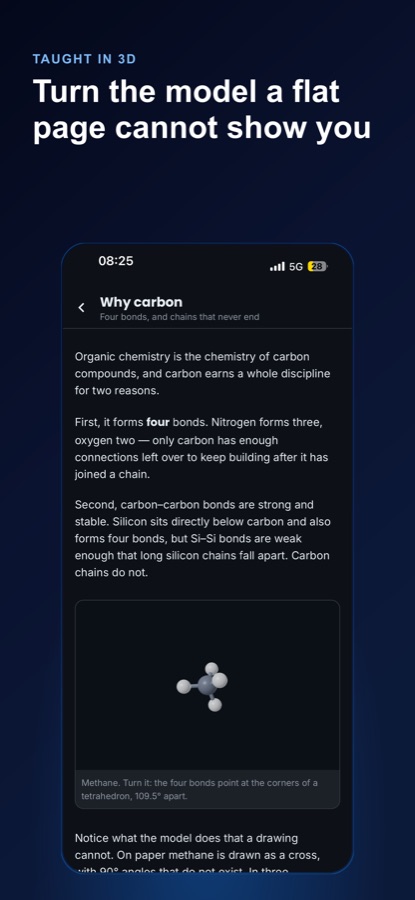
Each lesson pairs text with a rotatable 3D molecule — methane's four bonds pointing to the corners of a tetrahedron at 109.5°, for instance — so the geometry a paragraph describes is something you can actually spin around rather than take on faith.
Run one of the four labs
In the Reaction Bench, set a substrate, reagent, solvent and temperature, commit to a prediction of which mechanism wins, then run it and watch the nucleophile arrive at 180° from the leaving group. Conformation Lab, Chirality Lab and Spectra Lab apply the same drag-and-predict pattern to Newman projections, R/S assignments and unknown spectra.
Browse the molecule library
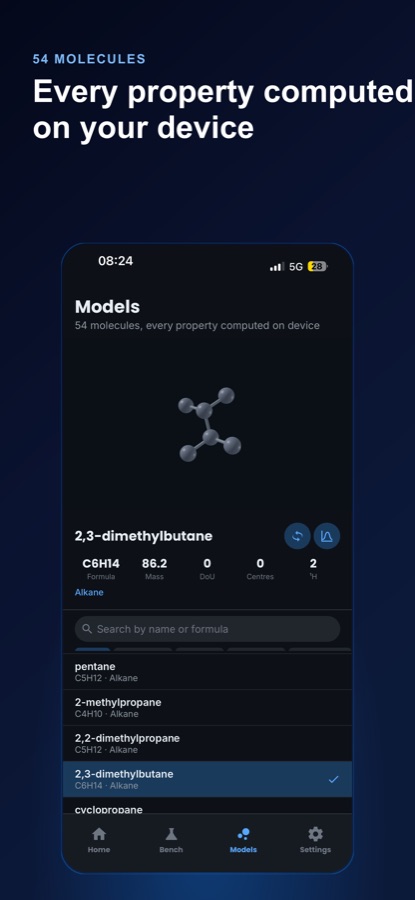
Search the 54-molecule Models library by name or formula to pull up any compound's 3D structure alongside its formula, mass, degree of unsaturation and number of stereocentres, each value computed fresh rather than pulled from a lookup table.
What's inside
What is actually in the app
4
Four instruments
Conformation Lab, Chirality Lab, Reaction Bench and Spectra Lab stay open to everyone, each built around dragging a real variable and watching a computed result follow it.
54
Molecule library
Search 54 molecules by name or formula and see each one's 3D structure, formula, molecular mass, degree of unsaturation and stereocentre count, every value computed on device.
41
Lessons across 6 units
Structure & Bonding, Naming & Conformation, Stereochemistry, Substitution & Elimination, Alkenes & Alkynes, and Aromatics, Carbonyls & Spectra take the course from hybridisation through full structure elucidation.
0
Nothing looked up
Every angle, energy, R/S label, IUPAC name, mechanism verdict and predicted spectrum is computed by the app's own chemistry engine rather than retrieved from a table of pre-written answers, so it also works with no signal at all.
AI
One narrow AI feature
A button explains, in words, why a computed answer is the answer. The AI is never asked what the answer is — the engine has already decided that — it only phrases the explanation.
Off
Fully offline
Because nothing is looked up from a server, every lesson, lab and the full molecule library work with no connection, on a train or in a basement library.
Fit
Who it's for — and who it isn't
A good fit if you
- Are taking a first or second organic chemistry course and keep losing the 3D picture on paper
- Want to predict a reaction mechanism before you're told the answer, then check yourself
- Find R/S assignments or Newman projections hard to picture from a flat diagram
- Want to practise reading NMR, IR and mass spectra the way a problem set actually asks
- Need a study tool that works with no signal, on a commute or in an exam hall waiting room
Not the right tool if you
- Want recorded, instrument-measured spectra rather than values predicted from standard correlation tables
- Want full access to all 41 lessons for free — Pro unlocks the lessons beyond Unit 1 and the first lesson of each unit
- Need inorganic or physical chemistry coverage — this app is organic chemistry specifically
- Want the AI to answer what the right answer is — it only explains an answer the engine has already computed
Questions
Frequently asked questions
What's a good app for learning organic chemistry mechanisms in 3D?
The useful test is whether an app computes its 3D models and verdicts live, or just plays a pre-rendered animation for each case. Organic Chemistry Lab 3D computes every angle, energy, R/S label and mechanism outcome with its own chemistry engine, so dragging a bond in the Conformation Lab or setting conditions in the Reaction Bench produces a result worked out on the spot. It covers 41 lessons across six units, free on iOS and Android, and works fully offline.
How do you tell SN1, SN2, E1 and E2 apart?
SN2 is a single concerted step: a strong nucleophile attacks the opposite face from the leaving group, favoured by a primary substrate and a polar aprotic solvent. SN1 goes through a flat carbocation intermediate, favoured by a tertiary substrate and a polar protic solvent, and loses the original stereochemistry in the process. E1 and E2 are their elimination counterparts, forming a double bond instead of a new substituent, with E2 needing the departing hydrogen positioned anti-periplanar to the leaving group. The Reaction Bench lets you set a substrate, reagent, solvent and temperature, predict which of the four wins, then run it and see the mechanism unfold.
What does R and S mean in chirality?
R and S are labels for the two possible arrangements at a chiral centre — a carbon bonded to four different groups. You rank the four groups by the CIP priority rules, based on atomic number, then check whether the sequence from highest to lowest priority runs clockwise (R, from the Latin rectus) or counterclockwise (S, sinister) when the lowest-priority group points away from you. Chirality Lab asks you to commit to R or S before showing the priorities, so you have to reason through the geometry rather than pattern-match the answer.
Why does a cyclohexane chair have both axial and equatorial positions?
A cyclohexane ring in its lowest-energy chair conformation keeps every carbon's bond angles close to the ideal 109.5°, but the hydrogens (or substituents) on each carbon still point in two distinct directions: axial, roughly perpendicular to the ring, and equatorial, roughly in the ring's plane. A ring flip swaps every axial position for equatorial and vice versa, and because a bulky substituent prefers the roomier equatorial position, which chair is favoured depends on what's attached. Conformation Lab's cyclohexane model lets you find the axial groups and watch the flip decide which chair wins.
How reliable are the NMR, IR and mass spectra in Organic Chemistry Lab 3D?
They are predicted from standard correlation tables rather than recorded on a real instrument, and the app says so wherever they appear. That makes them reliable for what structure elucidation actually depends on — how many signals appear, how they split, how they integrate, and which carbonyl type is present — while being approximate in the finer decimal places of an exact chemical shift. Spectra Lab is built around identifying a compound from exactly that kind of qualitative reading, the way a real problem set asks you to.
Is Organic Chemistry Lab 3D free?
Yes. Unit 1 in full, the first lesson of every other unit, all four labs with no restrictions, the entire 54-molecule library and three AI explanations a day are free on both the App Store and Google Play. Pro adds the remaining 30 lessons, unlimited AI explanations and removes ads, and the paywall is skippable everywhere it appears.
Does Organic Chemistry Lab 3D work without an internet connection?
Yes, entirely. Every shape, angle, energy value, name, mechanism verdict and predicted spectrum is computed by the app's own chemistry engine on your device rather than fetched from a server, so lessons, labs and the molecule library all work on a train, in a basement with no signal, or in airplane mode.
What does the AI feature in Organic Chemistry Lab 3D actually do?
It explains, in plain language, why a computed answer is the answer — for example, why a particular mechanism won under the conditions you set. It is never asked to decide what the answer is; the chemistry engine has already worked that out deterministically, and the AI only puts it into words, which keeps a fluent-sounding wrong explanation from substituting for a correct one.
Who is Organic Chemistry Lab 3D built for?
Anyone taking a first or second organic chemistry course — high school, university or exam preparation — and anyone who found the subject difficult on paper and suspects it might make more sense in three dimensions. The course assumes the kind of general chemistry background a student has going into organic chemistry, then builds from hybridisation and functional groups up to full structure elucidation.
Get started
Turn your first molecule
Free on iOS and Android — a 3D chemistry lab where nothing is looked up, only computed.
More from CoddyKit
Available on iOS and Android.