

Logic Gates Lab: Circuits
Logic Gates Lab: Circuits — Wire real logic gates and prove them with truth tables
Logic Gates Lab is a free circuit-building digital logic lab for Android, coming to iPhone. Every lesson ends on a 3D board where you wire real AND, OR, NOT, XOR and NAND gates, press Run, and watch a truth table prove row by row whether your circuit actually works — checked on your device, no server round-trip.


- Price
- Free, Pro upgrade
- Platforms
- Android now, coming to iPhone
- Languages
- 10
There's no 'it depends' in digital logic.
A circuit either produces the exact truth table or it doesn't. Logic Gates Lab computes the goal table for every lesson, project and exam question from the same Boolean functions it uses to grade your wiring, so a stated answer can never drift out of sync with what the simulator checks.
What it is
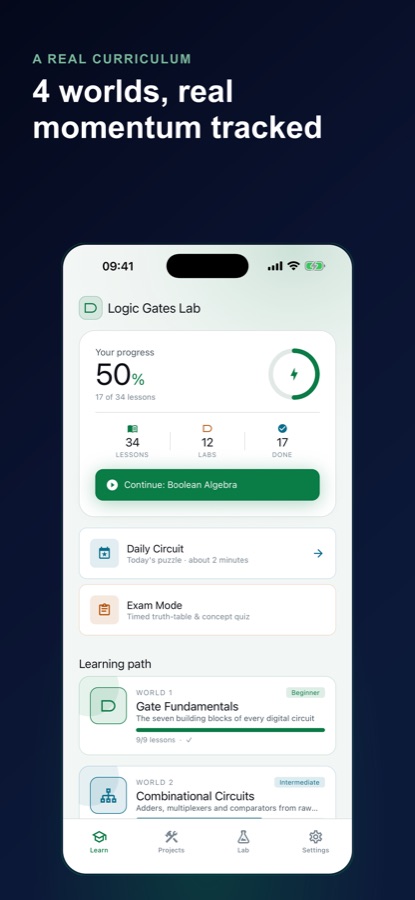
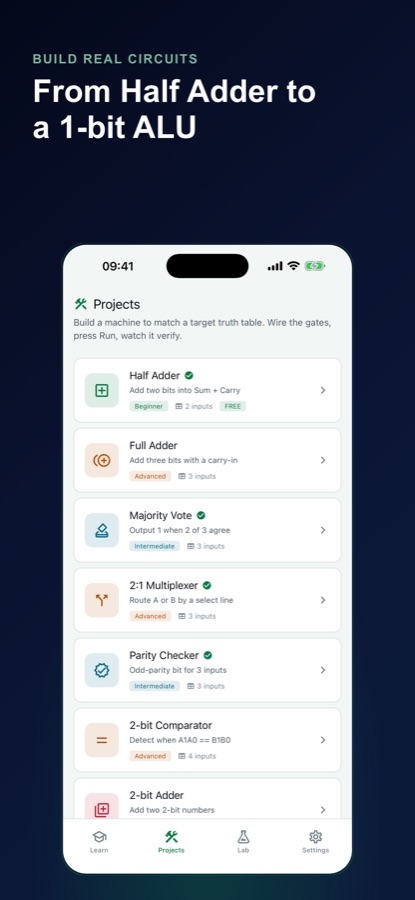
Logic Gates Lab is a free app for Android, coming to iPhone, that teaches digital logic and Boolean algebra by having you build circuits rather than read about them. You drag gates onto a 3D breadboard, wire their inputs, and press Run to see a truth table prove row by row whether the circuit matches the target. A 34-lesson, four-world course runs from bits and the seven basic gates through half and full adders, multiplexers, Boolean algebra and Karnaugh maps, into sequential logic with latches, flip-flops and counters, alongside 8 build projects up to a working 1-bit ALU and a free daily puzzle called the Daily Circuit.
Inside the app
What it looks like
Background
What is a logic gate, and how does a truth table describe it?
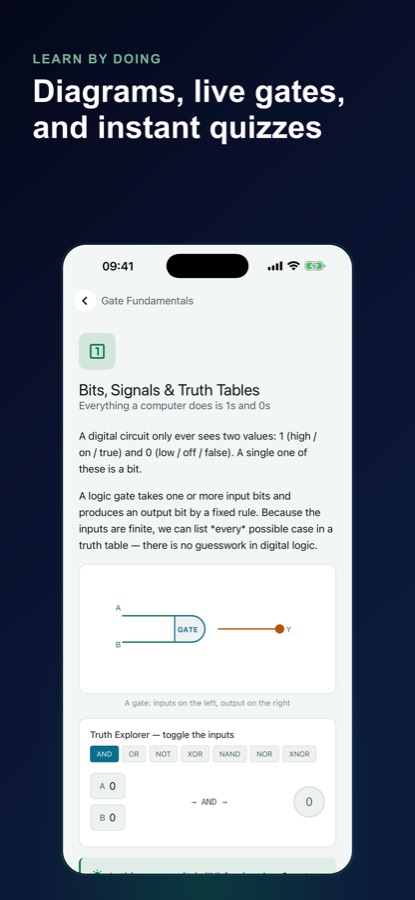
A logic gate is a small circuit that takes one or more binary inputs — each either 1 (on) or 0 (off) — and produces one binary output according to a fixed rule. A truth table lists every possible combination of inputs alongside the output the gate produces for each one, which is a complete and exact description of the gate's behaviour: because inputs are finite, nothing about what a gate does is ever left to guesswork or probability. Real circuits are built by wiring many gates together, and a handful of basic gates — AND, OR, NOT, XOR and NAND among them — are enough to construct everything from an adder to a full processor.
AND, OR, NOT, XOR, NANDthe basic gate set
AND outputs 1 only when every input is 1. OR outputs 1 when at least one input is 1. NOT flips a single input. XOR outputs 1 only when its inputs differ. NAND is AND followed by NOT, and is called the universal gate because any other gate can be built from NAND gates alone.
Half adder vs full adderthe first circuits that actually compute
A half adder adds two single bits and produces a Sum and a Carry output using an XOR gate and an AND gate. A full adder extends this to three inputs — two bits plus a carry-in from a previous addition — which is what lets adders be chained together to add numbers wider than a single bit.
Karnaugh mapsimplifying Boolean expressions visually
A Karnaugh map arranges a truth table's outputs into a grid where adjacent cells differ by only one input bit, which makes groups of 1s that can be combined into a simpler Boolean expression visually obvious. It's a practical alternative to algebraically applying Boolean identities and De Morgan's Laws by hand.
Sequential logiccircuits with memory
Combinational circuits like adders and multiplexers compute an output purely from their current inputs. Sequential logic adds memory: an SR latch or a D flip-flop holds a bit's value across a clock cycle, and chaining flip-flops together builds registers and counters — the building blocks a circuit needs to remember state rather than just react to it.
How it works
How the app is used
A lesson reads in a couple of short blocks, then drops you onto the board where the gate, the wiring and the truth table are all live.
Drag a gate onto the board
Pick an AND, OR, NOT, XOR, NAND or another gate from the lesson's toolbox and place it on the 3D breadboard, which you can rotate and pinch-zoom to see the wiring clearly.
Wire the inputs and press Run
Connect the gate's inputs, then run the circuit. The Truth Table view flips up beside the expected columns, with any row that doesn't match the target glowing red so you know exactly which input combination is wrong.
Fix the wire, rerun, clear the lesson
Adjust the wiring and run it again. Once every row in the truth table matches, the lesson clears itself — the same grading logic applies to the 8 build projects, from a half adder up to a 1-bit ALU, and to the daily Daily Circuit puzzle.
What's inside
What is actually in the app
34
Lessons across 4 worlds
From bits, signals and truth tables through the seven basic gates and De Morgan's Laws, to adders, multiplexers, decoders, Boolean algebra, Karnaugh maps and sequential logic.
12
Hands-on wiring labs
Twelve labs put you on a 3D breadboard you rotate, pinch-zoom and tap to toggle switches, wiring an actual circuit instead of reading a diagram of one.
8
Build projects to a 1-bit ALU
From a half adder up through a full adder, a majority vote circuit, a multiplexer, a parity checker, a comparator and a working 1-bit ALU, each graded against an exact target truth table.
0
Graded on-device
No AI grading and no server round-trip — your circuit is checked against real Boolean logic locally, so it works even in airplane mode.
150+
Exam Mode question bank
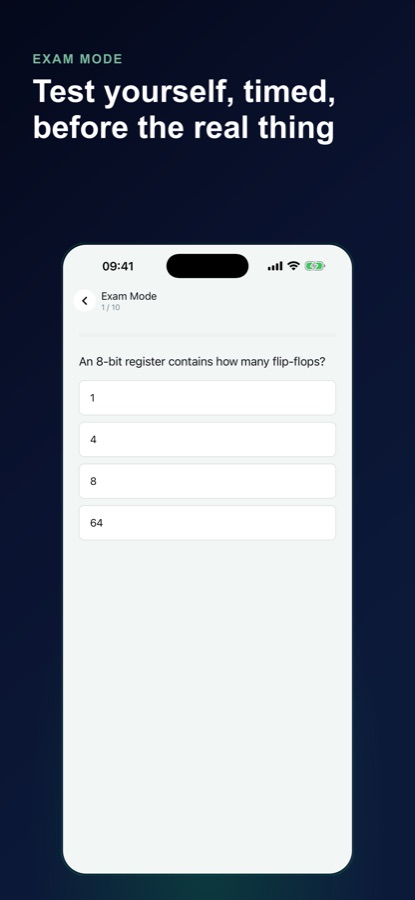
A bank of more than 150 questions on gate logic, truth tables, Boolean identities and binary conversion, sampled into a fresh timed set on every run.
AI
AI circuit tutor
Ask the tutor to explain, in plain language, why your specific circuit produces the truth table it does — tied to the exact wiring you built, not a generic explanation.
Fit
Who it's for — and who it isn't
A good fit if you
- Are taking a CS or EE course and want to actually wire AND/OR/XOR gates instead of memorising symbols
- Can already write code but can't yet say what a half adder or a flip-flop is
- Want to know what's really happening inside a chip, one gate at a time
- Like proving an answer against a truth table rather than trusting a worked example
- Want a free daily logic puzzle that works fully offline
Not the right tool if you
- Want to design or simulate real-world circuit boards with analog components — this is Boolean digital logic specifically
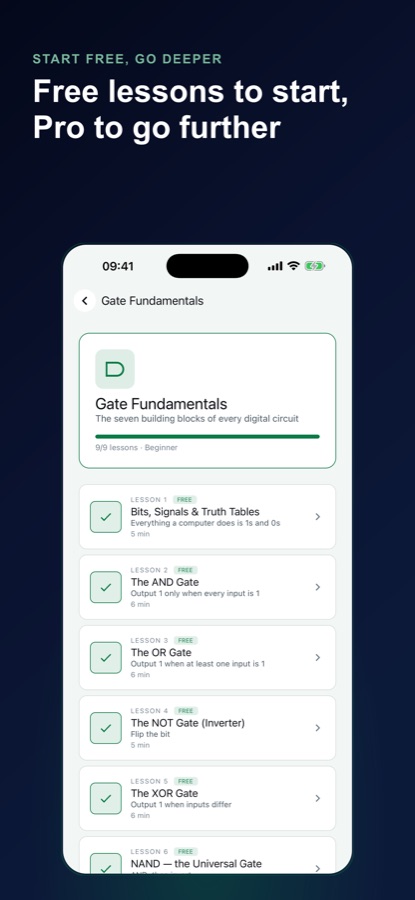
- Want every world and all 8 projects for free — Pro unlocks Worlds 2–4 and the projects past the Half Adder
- Need an iPhone app today — iOS is in development and the App Store page currently shows Coming soon
- Want AI to grade your circuit — grading is done on-device against real Boolean logic, with AI used only to explain results
Questions
Frequently asked questions
What's a good app for learning logic gates and digital circuits?
The useful test is whether you have to actually wire a circuit, not just read about one. Logic Gates Lab puts every lesson on a 3D breadboard: drag a gate, wire its inputs, press Run, and a truth table proves row by row whether it works. The course runs 34 lessons across four worlds, from the seven basic gates through adders, multiplexers and sequential logic, free on Android with iOS coming.
How do you read a truth table?
A truth table lists every possible combination of a gate or circuit's inputs in one row each, with the output it produces for that combination in the final column. Because inputs are finite — two inputs give four rows, three inputs give eight — a truth table is a complete description of a circuit's behaviour with nothing left to interpretation. Logic Gates Lab shows the expected truth table beside your wired circuit's actual output, with a mismatched row glowing red.
Why is NAND called the universal gate?
NAND is an AND gate followed by a NOT, and it's called universal because every other logic gate — AND, OR, NOT, XOR included — can be built using only NAND gates wired together in the right pattern. That matters in real chip design because manufacturing a single gate type repeatedly is simpler than manufacturing several different ones. Logic Gates Lab's Gate Fundamentals world covers NAND specifically as this universal building block.
What's the difference between a half adder and a full adder?
A half adder adds exactly two bits and outputs a Sum (via XOR) and a Carry (via AND), but it has no way to accept a carry coming in from a previous addition. A full adder takes three inputs — the two bits plus that carry-in — which is what lets full adders be chained together to add numbers wider than a single bit, such as the 2-bit adder Logic Gates Lab's projects build up to.
What is a Karnaugh map used for?
A Karnaugh map is a grid arrangement of a truth table's outputs, laid out so that any two adjacent cells differ by exactly one input bit. That layout makes groups of matching outputs visually obvious, letting you simplify a Boolean expression by inspection rather than by applying Boolean algebra identities and De Morgan's Laws step by step. Logic Gates Lab introduces Karnaugh maps in World 2 alongside the rest of Boolean algebra.
What's the difference between combinational and sequential logic?
A combinational circuit's output depends only on its current inputs — an adder or a multiplexer behaves this way. A sequential circuit has memory: an SR latch or a D flip-flop holds a value across a clock cycle, so its output depends on past inputs as well as present ones. Registers and ripple counters, built from chained flip-flops, are what let a circuit remember state rather than just react instantly. Logic Gates Lab's World 4 covers this sequential-logic layer.
Is Logic Gates Lab free?
Yes. All nine lessons of World 1 — every basic gate plus De Morgan's Laws, with all six of that world's hands-on labs — are free, along with an unlimited sandbox that saves 3 circuits, the Half Adder project, and the Daily Circuit puzzle every single day. Pro unlocks Worlds 2 through 4, the remaining 7 build projects up to the 1-bit ALU, unlimited Exam Mode runs, the AI circuit tutor and unlimited saved sandbox circuits.
Is Logic Gates Lab available on iPhone?
Not yet. The app is live on Google Play now; the App Store listing exists and will show Coming soon until the iOS version ships.
What is the Daily Circuit puzzle?
It's a fresh, date-seeded wiring puzzle every day: wire a circuit that matches a target truth table within a limited gate budget. It's free forever, works fully offline, tracks a streak of your best run, and offers an optional local reminder you can turn on in Settings.
How is a circuit actually graded in Logic Gates Lab?
Every goal table — in every lesson, project and exam question — is computed from the same small set of Boolean functions the simulator uses to check your wiring, run entirely on your device with no server round-trip. That means a stated answer can never drift out of sync with what the engine actually checks, and grading works even with no connection at all.
Get started
Wire your first gate
Free on Android, coming to iPhone — build real circuits and prove them with truth tables.
More from CoddyKit
Available on Android.