

Chess Opening Trainer: Drills
Chess Opening Trainer: Drills — A chess opening trainer that drills your own repertoire from memory
Chess Opening Trainer: Drills is a free-to-start Android chess opening trainer on Google Play for club players who keep losing the same way in the first ten moves. Build the lines you actually play move by move on a real board, add your own notes, and drill them from memory with spaced repetition.

- Price
- Free, Pro upgrade
- Platforms
- Android (Google Play)
- Starter packs
- 6 openings
- Languages
- 10
It is your repertoire, not someone else's move list.
Most opening apps hand you a ready-made tree to memorise. This one starts from the variations you really play, in the order your opponents really play them, with your own note on each branch. You decide what belongs in the repertoire, and the app makes sure you do not forget it.
What it is
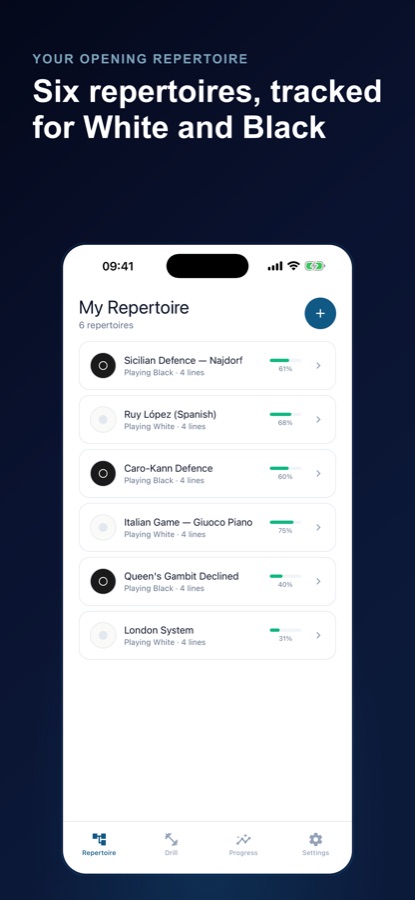
Chess Opening Trainer: Drills is a free-to-start Android app for building a personal chess opening repertoire and drilling it from memory. You enter lines on a real board, and only legal moves are accepted. In a drill the opponent's theory replies play automatically while you supply your own, and spaced repetition brings missed lines back sooner. Starter packs cover the Sicilian Najdorf, Ruy Lopez, Caro-Kann, Italian Game, Queen's Gambit Declined and London System.
Inside the app
What it looks like
Background
How do you build a chess opening repertoire, and why does drilling it work better than reading it?
A repertoire is the small set of openings you commit to playing, as White and as Black, with the main lines and the replies to your opponents' common deviations prepared in advance. Knowing the moves is not the same as being able to play them under the clock, so recall practice matters more than rereading. Spaced repetition, which revisits each line just before you would forget it, is the standard way to turn a written line into a reflex.
Repertoire by colourone tree for White, one for Black
A White repertoire is a plan you steer, for example the London System with 1.d4 and Bf4. A Black repertoire is a set of answers, such as the Sicilian Najdorf against 1.e4, so it has to cover everything the opponent might choose.
Main line and sidelineswhat your opponents actually play
Players at club level often leave theory early, so a repertoire that covers only the main line leaves gaps. Listing the legal replies you have not answered yet shows where to add a line.
Transpositionsdifferent move orders, same position
Many openings can be reached by more than one move order, such as a Queen's Gambit Declined position reached through two different orders of the first moves. A trainer that recognises transpositions avoids teaching you two answers to a single position.
Spaced repetitionreview just before you forget
A line you get right is scheduled further into the future, and a line you miss comes back sooner. Spending study time on the weakest lines, not on lines you already know, is the efficient way to build recall.
How it works
How the trainer works
The loop is build, drill, review: put your own lines on the board, answer them from memory and let the weakest ones rise to the top.
Build a line on the board
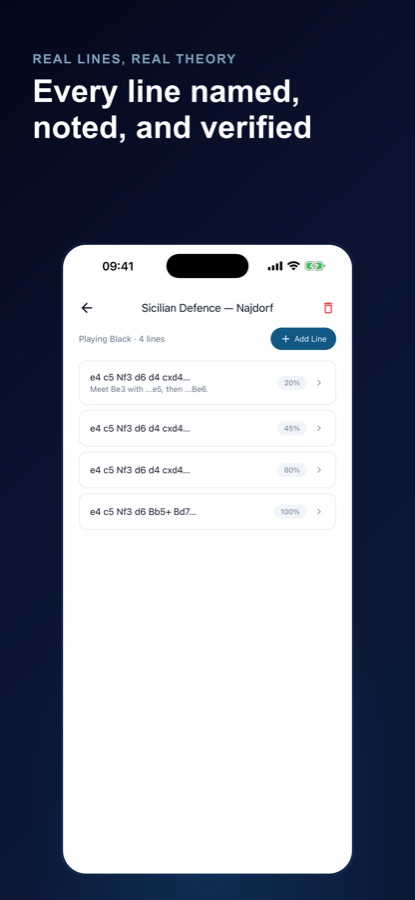
Start a repertoire as White or Black and play each move on the board, or paste a move list or import a PGN file. Only legal moves are accepted, so every saved line is a real sequence.
Drill from memory
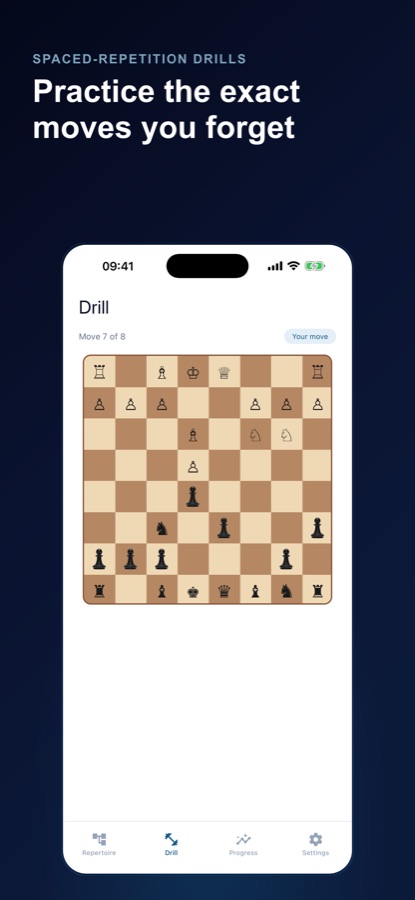
In a drill, the opponent's replies play out automatically and you supply your own. A miss shows the book move on the spot, and a note you attached to that move appears right when you go wrong.
Review the weakest lines first
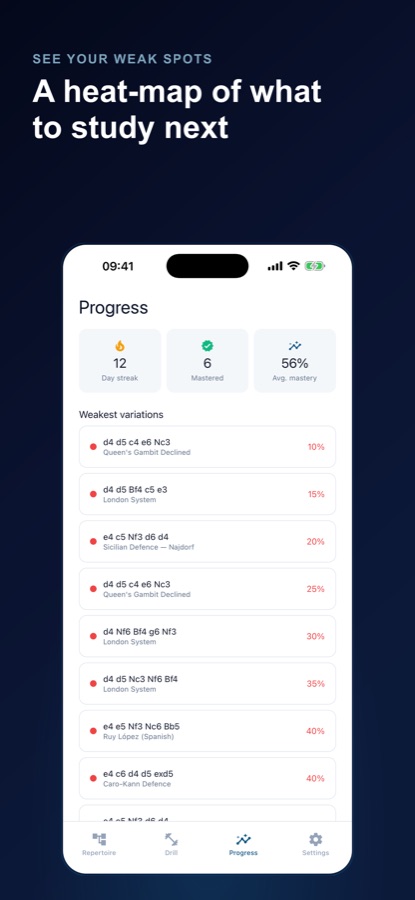
The Progress tab ranks every variation by mastery with the weakest at the top, next to your day streak and average mastery, so a short session goes where it helps most.
What's inside
What comes with the app
6
Starter packs
Ready-made first sets for the Sicilian Najdorf, Ruy Lopez, Caro-Kann, Italian Game, Queen's Gambit Declined and London System. Edit, extend or delete anything afterwards.
PGN
Paste and import
Paste a move list or import a PGN file to build faster, and export a repertoire as PGN or share a single line.
SRS
Spaced repetition drills
Lines are scheduled like flashcards. A slip deep in a variation costs less than a miss at the start, and two misses in a row trigger a short replay.
Gaps
Repertoire Gaps
Lists every legal opponent reply your saved lines do not answer yet. It is worked out offline, and you can optionally rank the gaps with AI.
AI
AI Coach
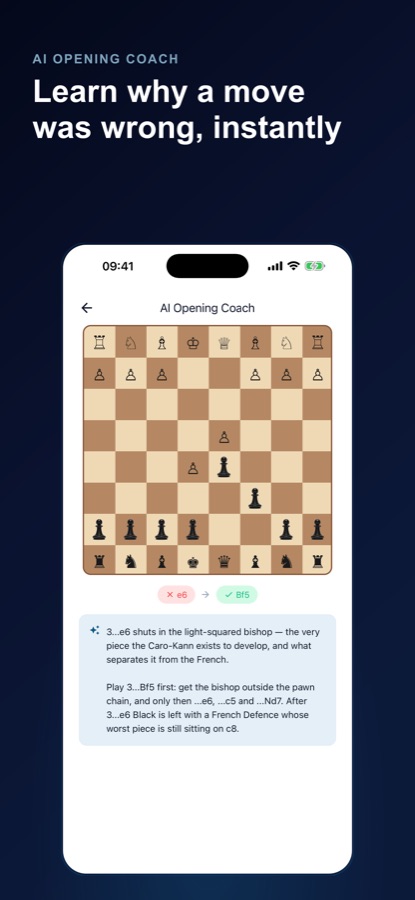
After a wrong move, ask for a plain-language explanation of why it fails in that position and what the better idea is. It explains opening theory and is not a chess engine, so double-check critical lines.
Notes
A note on every move
Attach the plan, the pawn break or the trap you are setting to any move. It shows in the drill when you need it.
Fit
Who it's for — and who it isn't
A good fit if you
- Are a club player who keeps getting a worse position out of the opening
- Want to study your own lines, not memorise a stranger's tree
- Like flashcard-style recall practice in short sessions
- Play both colours and want a separate repertoire for each
- Already keep opening files as PGN and want to drill them
Not the right tool if you
- Want to play full games against a computer, because this app trains openings only
- Want a chess engine to analyse positions, since the AI Coach explains theory and is not an engine
- Need an iPhone app, as it is currently on Google Play for Android
- Expect unlimited repertoires free, since the free plan has one and Pro lifts the limit
Privacy
Your lines stay on your device
You can train as a guest with no account. Your repertoire, drill history and streak are stored on your device. AI features ask for your permission first and then send only what they need, such as the position and moves or the PGN you paste, to the app's server, which passes it to a third-party AI model.
Full details are in the CoddyKit privacy policy.
Questions
Frequently asked questions
What is the best way to learn chess openings?
Choose a small repertoire for each colour, enter the lines you really play, and practise recalling them rather than rereading them. Chess Opening Trainer: Drills is built for that loop, with a real board, notes on each move and spaced-repetition drills.
How is a chess opening trainer different from a book or a video course?
A book shows you a line once, while a trainer asks you to play it from memory and brings back the ones you miss. In Chess Opening Trainer: Drills the opponent's replies play automatically and you supply your own moves, so you practise producing the move, not recognising it.
Which openings does the app include?
Starter packs cover the Sicilian Najdorf, Ruy Lopez, Caro-Kann, Italian Game, Queen's Gambit Declined and London System. You can edit, extend or delete any of them, or build your own from scratch, from a pasted move list or from a PGN file.
Can I import my own PGN files?
Yes. Chess Opening Trainer: Drills lets you paste a move list such as 1. e4 e5 2. Nf3 or import a PGN file to build faster, and you can export a repertoire as PGN or share a single line.
How does spaced repetition work for chess lines?
Each line is scheduled like a flashcard. A miss brings it back sooner, a clean run pushes it further out, and a slip deep in a variation counts for less than a miss at the start. A Coming up view shows what is due on which day.
What does the AI Coach do, and can I rely on it?
After a wrong move you can tap Ask AI Coach for a plain-language explanation of why it fails in that position and what the better idea is. It explains opening theory and is not a chess engine or a titled coach, so check critical lines yourself.
What are Repertoire Gaps?
Repertoire Gaps lists every legal reply from your opponent that your saved lines do not answer yet. It is computed offline. You can optionally rank the gaps with AI, which only reorders them and never hides a legal reply.
What is free and what does Pro add?
Free gives you one complete repertoire for White or Black with unlimited drilling, spaced repetition, progress, streak, notes, reminders and PGN export, plus your first five AI Coach explanations. Pro adds unlimited repertoires, unlimited AI Coach and gap rankings, AI game analysis, cloud backup with a weekly study plan, and no ads.
Do I need an account?
No. You can start training as a guest, and signing in is optional. Your repertoire and drill history are stored on your device.
Is Chess Opening Trainer on iPhone?
At the moment it is on Google Play for Android. The app is available in 10 languages with light and dark themes.
Get started
Build your first line today
Free to start on Android, in 10 languages.
More from CoddyKit
Available on Android.