
Lifestyle · Free · iOS & Android
By CoddyKit
Bonsai Care: a watering, pruning and repotting log for your trees
Bonsai Care is a free watering and pruning log for people keeping trees over years, not weeks. Add each tree, record watering, pruning, wiring, repotting and feeding as it happens, and build a side-by-side photo timeline that shows shaping a memory could never prove.
- Price
- Free, Pro upgrade
- Platforms
- iOS and Android
- Age rating
- 4+
- Version
- 1.6.0
Patience is hard to track.
Bonsai rewards patience, but the work happens on a timescale memory cannot hold — weeks between waterings, months between prunings, years between real shape changes. A dated log is what turns that into something you can actually see.
What it is
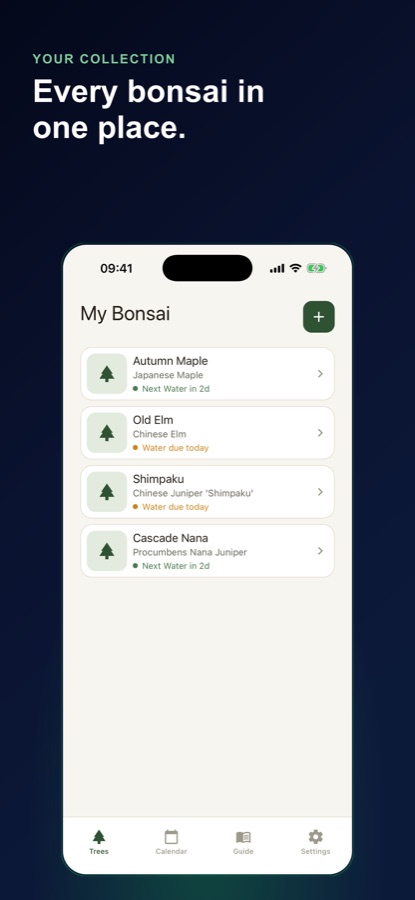
Bonsai Care - Tree Journal is a free iOS and Android app for keeping a care log for bonsai trees. You add each tree with its species and age, then record watering, pruning, wiring, repotting, fertilizing and photo sessions as six separate task types. A calendar shows every tree's upcoming and past tasks, photos stack into a side-by-side timeline, and a 42-species guide covers hardiness zones, difficulty and common problems.
Background
What does bonsai care actually involve?
Bonsai is ordinary horticulture done in a very small pot. The work splits into a routine part — watering, feeding, pinching and pruning — and a slow structural part: wiring branches into position, and repotting with root pruning every few years so the tree keeps a working root system in limited soil. What each part means in practice depends heavily on the species and on your climate.
Watering by observationnot by schedule
Bonsai are usually watered when the soil needs it rather than on fixed days. Keepers check the surface and just below it, then water thoroughly until it drains freely. Pot size, soil mix, species, season and weather all move the interval.
Repotting and root pruningevery few years
In a shallow pot roots eventually fill the available soil. Repotting means lifting the tree, trimming part of the root mass and returning it to fresh substrate. Timing is generally late winter to early spring for most species, before strong growth begins.
Wiringweeks to months
Wire is wrapped around a branch to hold it in a new position until the wood sets there. It stays on only until the shape holds — left too long it bites into the thickening bark and leaves scars that can be permanent.
Indoor versus outdoor speciesthe usual mistake
Tropical and subtropical trees such as ficus can live indoors in bright light. Temperate species like juniper, pine and maple are outdoor trees that need a cold winter dormancy, and generally decline if kept in a heated room.
How it works
How the app is used
The setup happens once, per tree. After that the daily habit is a single tap when you finish a task, and everything else — the calendar, the history, the photo comparison — is built out of those entries.
Add each tree
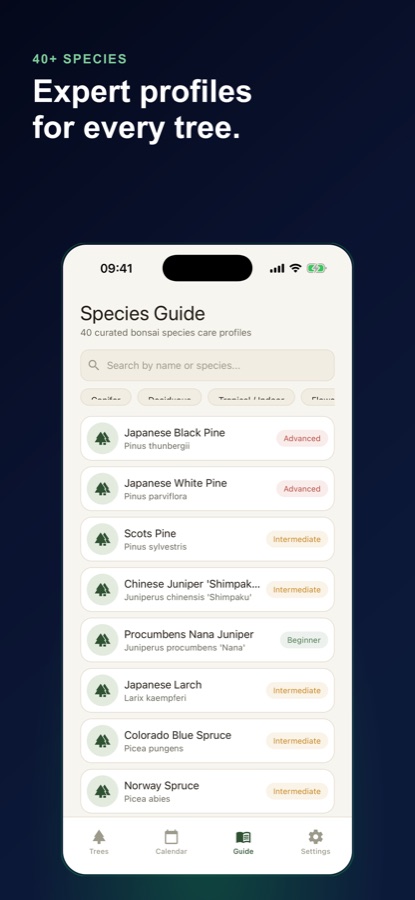
Create a record for every tree in the collection with its species and age. The species guide covers 42 profiles across conifers, deciduous, tropical, flowering and fruiting bonsai, so you can read hardiness zone, difficulty and indoor or outdoor needs before committing to a new one.
Log the work as it happens
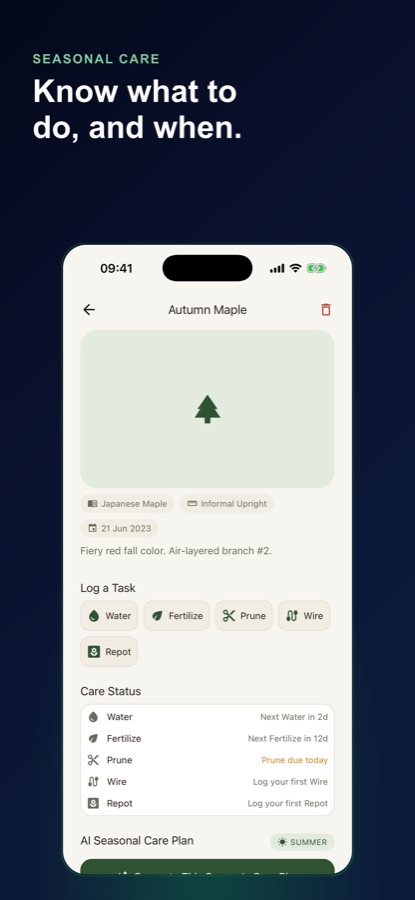
Record watering, pruning, wiring, repotting, fertilizing and photo sessions as six separate task types, so a wire removal or a repot date gets its own entry instead of being lumped into notes. Take a photo at the session and it joins that tree's timeline.
Read the history back
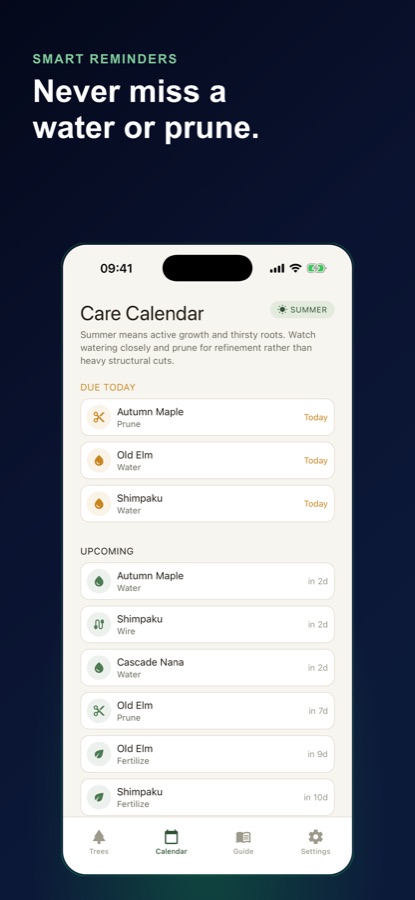
The calendar shows upcoming and past tasks across the whole collection at a glance, and each tree's page holds its full task history. Scroll back through months or years of one tree, and compare its photos side by side to see what the shaping actually did.
What’s inside
What the app tracks
6
Six task types
Watering, pruning, wiring, repotting, fertilizing and photo sessions each get their own record, so wire removal and repot dates stay separate instead of becoming a vague note.
2-up
Photo timeline
Take a photo at each session and compare shots side by side. Slow shaping and growth show up as a visible change rather than an impression you half remember.
42
Species guide
Forty-two profiles across conifers, deciduous, tropical, flowering and fruiting bonsai, each with hardiness zone range, difficulty, indoor or outdoor needs, and a table of common issues with cause and fix.
AI
Seasonal care plans
Generate a per-tree plan covering watering, fertilizing, pruning, wiring and repotting, tailored to that tree's species and the current season, with practical tips attached. Part of Pro.
N/S
Hemisphere-aware seasons
Set your hemisphere once and every seasonal cue — pruning windows, dormancy, repotting season — flips correctly if you are growing south of the equator.
Cal
Calendar and reminders
Upcoming and past tasks for the whole collection in one view, with reminders so no tree is forgotten. Watering, wiring and repotting reminders paced to the species on file are part of Pro.
Inside the app
What it looks like
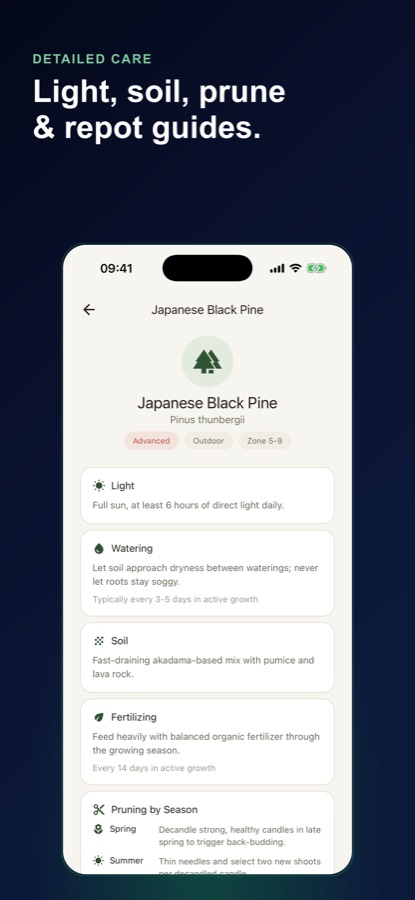
Fit
Who it’s for — and who it isn’t
A good fit if you
- Keep one tree and want a real log instead of relying on memory
- Have a growing collection on different watering and pruning schedules
- Are choosing a first species and want to know what it actually needs
- Want years of shaping progress side by side rather than half remembered
- Have looked at a tree and could not recall when it was last watered or pruned
Not the right tool if you
- Want a diagnosis for a struggling or valuable tree — that calls for an experienced grower, not a log
- Expect the species guide to replace hands-on bonsai instruction; it is general care reference
- Want everything at no cost: AI seasonal care plans and species-tuned reminders are Pro
- Want a shared collection log for a club or nursery team rather than a personal record
Questions
Frequently asked questions
What's the best app for tracking bonsai care?
The useful test is whether it holds a record that spans years, because that is the timescale bonsai actually works on. It also has to cover more than watering — wiring and repotting dates matter most when you are trying to remember them two seasons later — and it should keep photos next to the log. Bonsai Care - Tree Journal is built that way: six separate task types, a per-tree history you can scroll back through, side-by-side growth photos, a calendar across the whole collection, and a 42-species reference guide. Free on iOS and Android.
How often should I water a bonsai?
There is no fixed interval, and following one is the most common way to lose a tree. Bonsai are generally watered by observation: check the soil surface and just below it, and water thoroughly when it is approaching dry, until water runs out of the drainage holes. How often that falls due depends on species, pot size, soil mix, season, indoor or outdoor position and the weather that week. A tropical indoors and an outdoor pine in summer can differ by days. A dated log is useful precisely because it shows your own tree's real pattern.
Can bonsai be kept indoors?
It depends entirely on the species, and this is where most beginners go wrong. Tropical and subtropical trees — ficus is the usual starting point — can live indoors year round given bright light and reasonable humidity. Temperate species such as juniper, pine, maple and elm are outdoor trees. They need the seasonal cycle, including a cold winter dormancy, and generally decline in a heated room even though they are sold as houseplants. Check what a species needs before you buy it rather than after the needles start browning.
When should I repot a bonsai, and how much root can I prune?
For most species the usual window is late winter to early spring, as buds begin to swell but before strong growth starts, so the tree can recover into its growing season. Frequency varies widely: young or vigorous trees often go every one to two years, mature conifers considerably less often. Common practice is to remove a modest portion of the root mass — many growers work to around a third — and return the tree to fresh substrate. Species, age and climate all shift this, so check guidance for the tree you actually have.
How long should wire stay on a bonsai branch?
Only until the branch holds its new position on its own. That can be a few weeks on a fast-growing deciduous tree or many months on a slow conifer, so the honest answer is to check the tree regularly rather than trust a date. The risk is the wire biting into bark as the branch thickens, which leaves marks that can take years to grow out or never fully do. Most growers cut wire off in short pieces rather than unwinding it. Recording the date wire went on is what makes the check happen.
Do outdoor bonsai need winter protection?
Temperate species need their winter dormancy, so the goal is not to keep them warm — it is to protect the roots. In a shallow pot the root ball is far more exposed to freezing than the same species planted in the ground. Depending on the species' hardiness and how cold your winters get, keepers heel pots into the ground, mulch them, or move trees to a cold frame or an unheated shed or garage. Bringing a dormant temperate tree into a heated house is generally the worst option available.
Is Bonsai Care free?
Yes. It is free to download on the App Store and Google Play, and the core journal is free to use: multiple trees, the full care log across six task types, the photo timeline, the calendar view and the species guide. A Pro upgrade adds AI seasonal care plans and species-tuned watering, wiring and repotting reminders. The app is rated 4+ and the current version is 1.6.0.
Can I track more than one tree?
Yes. Each tree in the collection gets its own record, with its species, age, and full task history stored on that tree's page. The calendar shows upcoming and past care tasks across the whole collection at once, which is the part that matters when several trees are on different watering and pruning schedules. You can also scroll back through months or years of a single tree's log in one place, so the history stays per tree rather than becoming one undifferentiated list.
What do the AI seasonal care plans do?
They generate a plan for one specific tree, covering watering, fertilizing, pruning, wiring and repotting, tailored to that tree's species and the current season, with practical tips attached. It is part of the Pro upgrade. Treat it as general care reference rather than a substitute for hands-on bonsai instruction — for a tree that is struggling, or one that is valuable to you, the right move is to consult an experienced grower who can look at it.
Does it work in the southern hemisphere?
Yes. You set your hemisphere once and every seasonal cue flips accordingly, including pruning windows, dormancy and repotting season. This matters more in bonsai than in most hobbies, because nearly all published care advice is written for a northern calendar — an instruction to repot in March is straightforwardly wrong if your early spring falls in September. Setting it correctly at the start keeps the seasonal guidance aligned with the year you actually experience.
Start logging
Give every tree the record it deserves
Free on iOS and Android, with a log built for years rather than weeks.
More from CoddyKit
Available on iOS and Android.