Lifestyle · Free · iOS & Android
By CoddyKit
Backyard Chickens: an egg log and flock tracker
Backyard Chickens is a free egg log and flock manager for people who collect eggs every morning. Record each egg by flock or by hen, watch your laying trends build over the season, and ask a breed and coop advisor plain-English questions. It works offline, out by the coop.
- Price
- Free, Pro upgrade
- Account
- Not required
- Offline
- Works fully offline
- Age rating
- 4+
Replaces the notebook by the coop door.
A notebook records tallies you never add up. The same fifteen seconds spent in an app turns into laying rates, molt forecasts, and a real cost per egg by the end of the season.
What it is
Backyard Chickens is a free iOS and Android app for logging egg production and managing a backyard flock. You record eggs by flock or by individual hen, keep breed, age, and production history per bird, and see laying rates, a producer ranking, and molt forecasts built from your own log. It also tracks feed costs to give a real cost per egg, and includes a 45-breed reference library and an AI coop and breed advisor.
The advisor gives general husbandry guidance only. It does not diagnose or treat birds — see Guidance, not veterinary care.
Background
How does a hen's laying year actually work?
Laying is seasonal, not steady. A pullet starts around 18 to 24 weeks old, peaks in her first laying year, then produces gradually less each year after. Output tracks daylight, so it falls through autumn and winter, and it stops almost entirely during the annual moult. Broodiness, a move, a predator scare, or a feed change can each pause a hen for days.
Point of lay18-24 weeks
The age a pullet lays her first egg. Early eggs are often small, soft-shelled, or irregular for a few weeks before she settles into a steady rhythm.
Moultusually autumn
The annual feather replacement, typically starting in a bird's second autumn and lasting six to twelve weeks. Laying usually stops while protein goes into growing new feathers.
Photoperiodhours of daylight
Laying is triggered by day length. Most hens need roughly fourteen hours of light for consistent production, which is why output falls as the days shorten.
Broodinesssitting on the nest
A hormonal state where a hen stops laying and sits on eggs instead. Common in some breeds, rare in others — one reason breed choice changes your yearly egg count.
How it works
How the app is used
The daily part is deliberately tiny. Everything else — trends, rankings, molt forecasts, cost per egg — is built from that one repeated action, so the setup happens once and the habit stays short.
Set up the flock
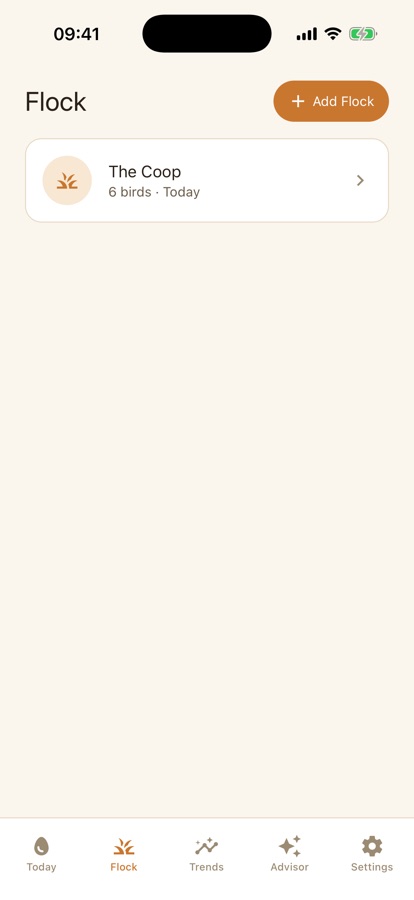
Add a flock and the birds in it, with breed, age, and notes on coop location, temperament, and care routine. Check the breed library first if you are still choosing birds, and set the daily egg reminder for a time that suits your morning.
Log this morning's eggs
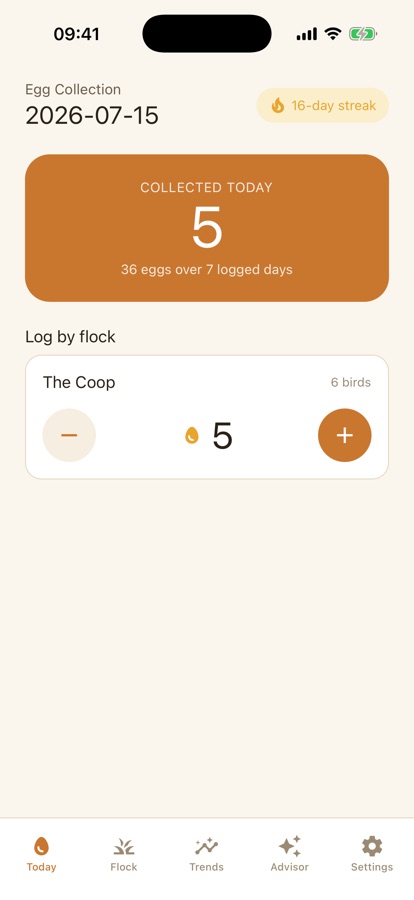
Record the eggs you collected, either as a flock total or per individual hen. It takes about fifteen seconds standing at the coop, and it works with no signal, so the entry happens now instead of being reconstructed from memory at the end of the week.
Read the trends
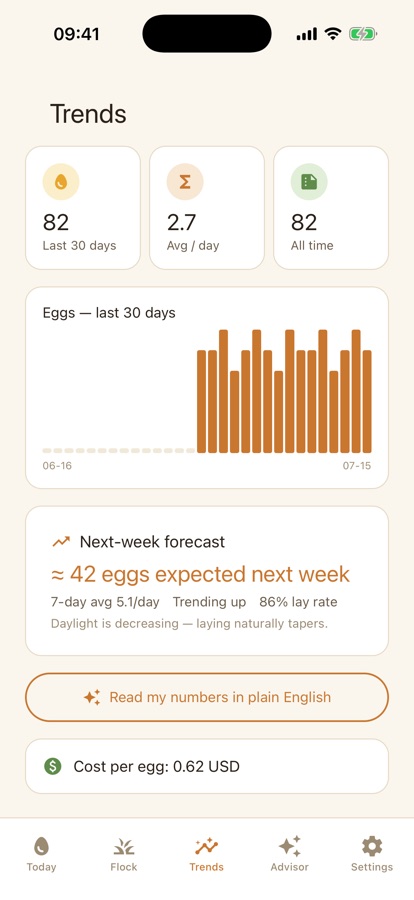
After a few weeks the log becomes production rates, a producer ranking for every hen, upcoming molt forecasts, and — once feed costs are in — your real cost per egg. Ask the advisor about breeds or coop sizing when you plan the next change.
What’s inside
What the app tracks
~15s
Daily egg log
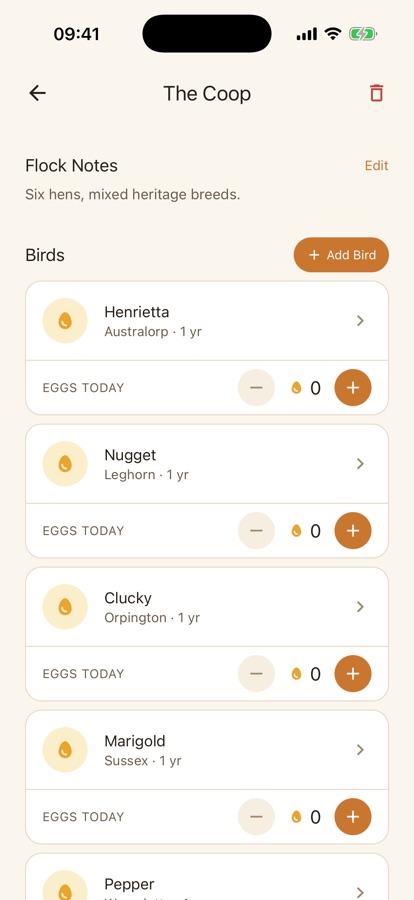
Record every egg collected, by flock or per individual hen. Short enough to do at the coop door, with a daily reminder at a time you pick.
45
Breed library
Forty-five common backyard breeds with typical egg colour, weight, temperament, cold and heat hardiness, and which ones tend to be good with kids.
/hen
Per-hen records
Breed, age, and production history for each bird, plus a producer ranking — so you know which hen earns her keep and which one slowed down.
Molt
Laying trends
Production rates and upcoming molt forecasts built from your own history rather than a generic chart, with days logged and eggs collected over any stretch.
$
Feed and cost tracking
Feed costs recorded alongside egg counts turn the question of what this hobby costs into an actual cost per egg instead of a guess.
AI
Coop and breed advisor
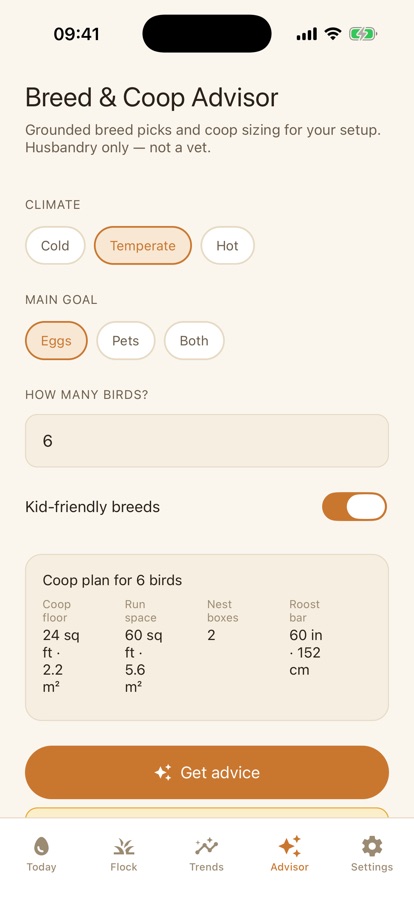
Ask which breeds suit your climate and how to size a coop for your flock. Guidance on husbandry only, never veterinary advice.
Inside the app
What it looks like
Fit
Who it’s for — and who it isn’t
A good fit if you
- Keep one flock and want a daily egg log that takes seconds
- Run several flocks and dozens of birds that need separate records
- Are choosing your first breeds and sizing a coop for the first time
- Want your real cost per egg instead of a rough estimate
- Have wondered which hen stopped laying, and when it actually happened
Not the right tool if you
- Need to know what is wrong with a sick or injured bird — that is a job for a poultry vet
- Want everything at no cost: unlimited flocks, per-hen tracking, and the full trend and advisor package are Pro
- Expect useful trends on day one — molt forecasts and laying rates come from your own accumulated log
- Want records on a computer rather than on the phone you carry to the coop
Safety and limits
Guidance, not veterinary care
Backyard Chickens is a record-keeping app. The advisor answers general husbandry questions — which breeds suit a climate, how to size a coop, when a moult is likely — and it gives guidance only, never veterinary advice. It does not diagnose or treat anything.
If a bird is sick or injured, or if you see a sudden drop in laying alongside changes in appetite, droppings, weight, or behaviour, contact a poultry vet. Keeping birds also carries ordinary hygiene duties — wash hands after handling birds or eggs, and follow the local regulations that apply where you live, including any notifiable-disease and avian-influenza rules.
Privacy
Where your records live
Flocks, hens, egg logs, and feed records are stored on your device and the app works fully offline, so a weak signal out by the coop never stops you logging. No account is forced on you to start. The daily egg reminder is a local notification scheduled on the phone itself.
Full details are in the CoddyKit privacy policy.
Questions
Frequently asked questions
What's the best app for tracking backyard chicken egg production?
The one that survives contact with a muddy morning. Logging has to take seconds at the coop rather than a trip back to a notebook, it has to work with no signal, and it should turn tallies into something you could not work out in your head. Backyard Chickens is built that way: a roughly fifteen-second egg log by flock or by hen, full offline storage, and trends, molt forecasts, and a real cost per egg built from your own entries. Free on iOS and Android.
How many eggs should a backyard hen lay?
It depends on breed and age more than anything else. Production hybrids such as sex-links and Leghorns commonly lay 250 to 300 eggs in their first laying year, while heritage and dual-purpose breeds often sit nearer 150 to 200. Output peaks in that first year, then falls by roughly ten to twenty percent annually. Day length, moult, broodiness, and stress all cause temporary pauses, so a run of empty nest boxes is usually seasonal rather than permanent.
Why did my hens suddenly stop laying?
The usual causes are shortening days, the annual moult, broodiness, age, or a recent stressor such as a move, a predator scare, extreme heat, or a change of feed. Hidden nests and egg eating also look exactly like a production drop. A dated log helps here, because it shows whether the fall was sudden or gradual and which individual birds are involved. If it comes with changes in appetite, droppings, or behaviour, speak to a poultry vet.
When do chickens moult, and do they stop laying?
Most hens go through their first full moult in their second autumn, as daylight shortens, and it usually runs six to twelve weeks. Laying typically stops or drops sharply during it, because feathers are largely protein and the bird's resources go into regrowing them. Keepers often switch to a higher-protein feed and handle birds less while new pin feathers are growing. Backyard Chickens forecasts upcoming moults from your own logged history rather than a generic calendar.
Do chickens need extra light in winter to keep laying?
Laying is driven by day length, and most hens need somewhere around fourteen hours of light for consistent production, which no winter provides in temperate regions. Some keepers add a timed light in the early morning to make up the difference; others deliberately let the flock rest through winter and accept fewer eggs. Both are legitimate. If you do use a light, add it in the morning rather than at night so birds are not left in sudden darkness away from the roost.
What should I check on my birds regularly?
A quick routine look covers comb and wattle colour, brightness of the eyes, appetite and water intake, droppings, weight and the feel of the keel bone, feather condition, the vent area, and general alertness in the flock. Checking under wings and around the vent at dusk catches mites and lice early. None of this is a diagnosis — a bird that is hunched, off feed, or breathing oddly needs a poultry vet, not an app.
How much coop space does a chicken need?
Common guidance for standard-sized breeds is about four square feet per bird inside the coop and eight to ten square feet each in the run, with roughly a foot of roost bar per hen and one nest box for every three or four hens. Bantams need less, large or confined birds more. Backyard Chickens has an advisor you can ask about sizing for your own flock and climate, and a 45-breed library covering temperament and hardiness before you commit.
Is Backyard Chickens free?
Yes. It is free to download on the App Store and Google Play, and you can log eggs and manage one flock at no cost without being forced to create an account. A Pro upgrade adds unlimited flocks, per-hen tracking, and the full trend and advisor package. The content rating is 4+.
Does it work offline, and do I need an account?
It works fully offline. Flocks, hens, egg logs, and feed records live on your device, so a weak signal out by the coop never stops you from logging this morning's eggs. No account is required to start using it. The daily egg reminder is a local notification you schedule for a time that fits your morning routine.
Can I track several flocks and individual hens?
Yes. Each flock keeps its own birds, notes, and egg history, including coop location, temperament, and care routines. Individual birds carry breed, age, and production history, so you get a producer ranking rather than one flock total, and you can see days logged and eggs collected over any stretch of time per flock or per bird. Multiple flocks and per-hen tracking are part of the Pro upgrade. The built-in advisor answers husbandry questions only and never gives veterinary advice.
Start logging
Give every flock the record it deserves
Free to start, works offline, and your records stay on your device.
More from CoddyKit
Not a medical device. Does not diagnose or treat any condition.