
Lifestyle · Free · iOS & Android
By CoddyKit
Aquarium Manager: a water test log and cycling coach for every tank
Aquarium Manager is a free app for tracking every fish tank you keep. Log ammonia, nitrite, nitrate and pH after each test, watch the trend line instead of a page of numbers, and let the built-in cycling coach tell you when it is safe to add fish.
- Price
- Free
- Platforms
- iOS and Android
- Age rating
- 4+
- Version
- 1.7.1
Most new tanks fail the same way.
Fish go in before the tank has finished cycling, ammonia and nitrite spike, and the fish pay for it. A written record of every test is what makes that mistake hard to repeat.
What it is
Aquarium Manager is a free iOS and Android app for fishkeepers who want their tanks written down instead of remembered. You log water test results — ammonia, nitrite, nitrate, pH and more — for each freshwater, saltwater, planted or reef tank, and the app charts them over time. A cycling coach reads your nitrogen-cycle numbers and says when it is safe to stock, while maintenance reminders cover water changes, filter cleans and tests.
The disease photo ID and AI diagnosis features are informational hobby guidance, not a veterinary diagnosis — see Safety and limits.
Background
What is the nitrogen cycle in an aquarium?
In a healthy aquarium, fish waste and leftover food break down into ammonia, which is toxic. One group of bacteria converts that ammonia into nitrite, which is also toxic, and a second group converts nitrite into far less harmful nitrate. Once both colonies are large enough to process the tank's daily waste, the tank is cycled; nitrate is then removed by water changes and taken up by plants.
Ammoniafirst stage
Produced constantly by fish, uneaten food and decaying plants. Toxic even at low levels: in a cycled tank a test should read 0 ppm, and anything above that calls for a water change.
Nitritesecond stage
Made by bacteria feeding on ammonia, and just as dangerous to fish because it interferes with their blood carrying oxygen. A cycled tank also reads 0 ppm nitrite; a spike means the colony cannot keep up.
Nitrateend product
The relatively harmless end of the chain. It builds up steadily and is removed by routine partial water changes and by live plants; many freshwater keepers aim to hold it under about 40 ppm.
Fishless cyclingthe safe way to start
Dosing a new tank with an ammonia source and no livestock until ammonia and nitrite both fall back to zero within a day. Nothing suffers while the bacteria establish themselves.
How it works
How the app is actually used
The routine is the same whether you keep one betta or a fish room: describe the tanks once, log every test you run, and let the schedule chase the maintenance instead of your memory.
Add your tanks
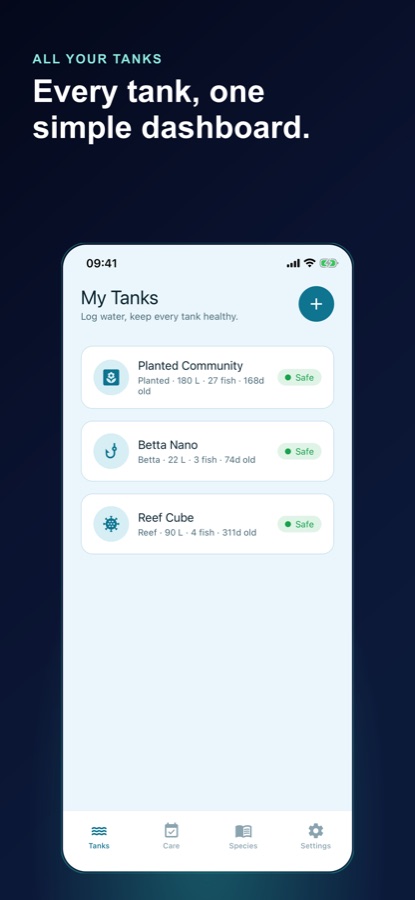
Create an entry for each tank you keep — freshwater, saltwater, planted or reef — with its livestock and its own history. Each tank carries its own stock list, so several tanks do not blur into one undated set of notes.
Log every test
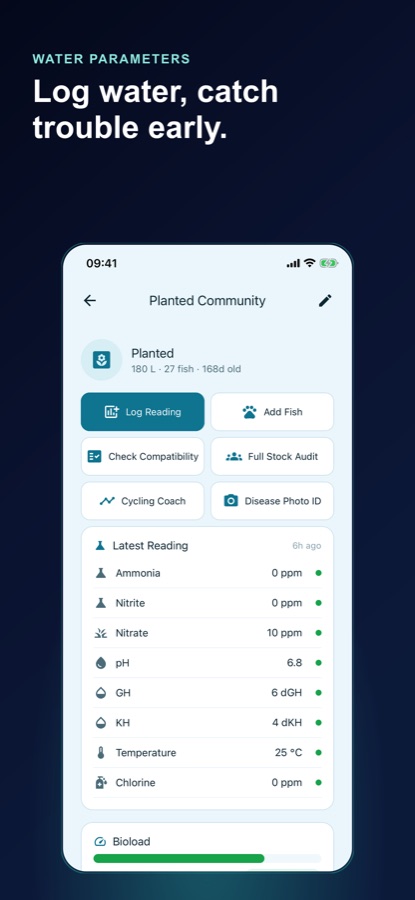
Run your test kit as usual, then enter the readings: ammonia, nitrite, nitrate, pH and more. The app charts them so a slow drift shows up as a line, and the cycling coach reads the same numbers to say whether stocking is safe yet.
Let the schedule chase you
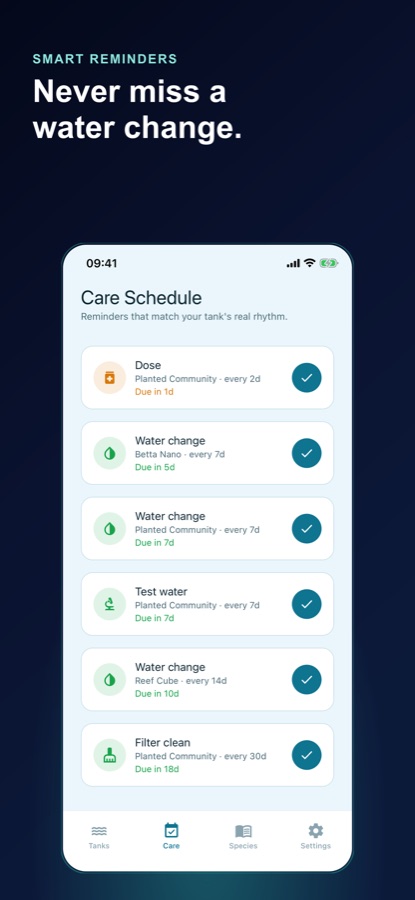
Set water changes, filter cleans and test reminders once and the maintenance schedule keeps bringing them back. Between tasks, the stock log records what lives where and the photo journal builds a timeline of each tank as it fills in.
What’s inside
What the app keeps track of
3
Water test log
Ammonia, nitrite and nitrate — the three nitrogen-cycle numbers — plus pH and more, charted over time so a slow drift is visible long before it becomes a crash.
CYCLE
Cycling coach
A step-by-step read of where your nitrogen cycle actually is, and a straight answer on whether the tank is ready for fish yet.
0-100
Tank health score
One number per tank, built from your water readings, how recent they are, the maintenance you have done and the current bioload.
vs
Compatibility and species guide
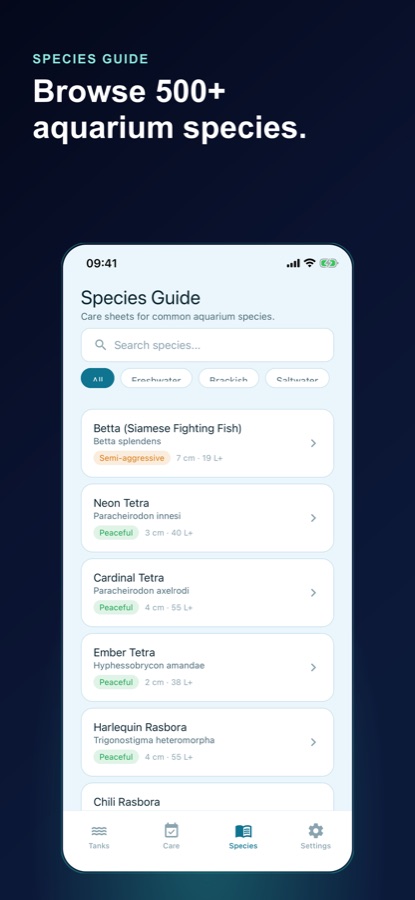
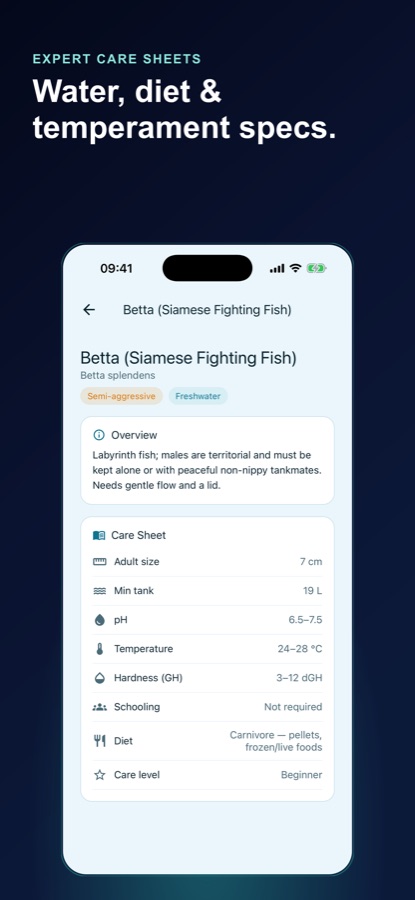
Check whether a species fits your existing tank before you buy it, and read care sheets covering tank size, feeding and temperament.
AI
Disease photo ID and AI diagnosis
Photograph a sick fish or describe the symptoms for hobby-level troubleshooting of common tank problems. A starting point before an aquatic vet, not a diagnosis.
DUE
Maintenance schedule
Water changes, filter cleans and test reminders are scheduled rather than remembered, with a stocking planner and a water change calculator for the volume to swap.
Inside the app
What it looks like
Fit
Who it’s for — and who it isn’t
A good fit if you
- Are cycling your first tank and want to know when it is genuinely safe to add fish
- Keep several tanks and want every water test in one history instead of scattered notes
- Run a reef or planted tank where slow chemistry drift turns into a crash
- Want water changes, filter cleans and tests on a schedule rather than in your head
- Like to check whether a species fits your tank before you buy it
Not the right tool if you
- Expect the app to measure your water — you still need a test kit; it records what you read
- Need a veterinary diagnosis; the disease tools are informational hobby guidance only
- Want controller, dosing-pump or sensor automation — this is a log and a reminder, not hardware
- Do not intend to test regularly; the value here comes from a run of readings over time
Safety and limits
Informational hobby guidance, not veterinary care
Aquarium Manager is informational hobby guidance, not a substitute for a veterinarian. The disease photo ID and AI diagnosis features give you a starting point for common tank problems; they do not identify a specific illness, and they can be wrong.
For a sick or valuable animal, consult an aquatic vet. If ammonia or nitrite is reading above 0 ppm, treat that as the first thing to deal with — a partial water change and easing off feeding do more for the tank than any app can.
Questions
Frequently asked questions
What is the best app for tracking aquarium water parameters?
The useful ones do three things: store every reading so you can see a trend rather than a single number, tell you plainly whether the tank is cycled, and remind you about water changes before they slip. Aquarium Manager is built around exactly that — a water test log for ammonia, nitrite, nitrate and pH charted over time, a cycling coach that reads those numbers, and a maintenance schedule. It is free on iOS and Android.
How long does it take to cycle a new aquarium?
Usually several weeks. The bacteria that convert ammonia to nitrite, and nitrite to nitrate, have to multiply until they can process everything the tank produces in a day, and that commonly takes around four to six weeks in a new setup. Warmth, surface area in the filter and seeded media from an established tank all speed it up. Testing every day or two is the only way to know where you actually are.
What do ammonia, nitrite and nitrate readings actually mean?
Ammonia comes from fish waste, uneaten food and decay, and is toxic even in small amounts. Bacteria turn it into nitrite, which is also toxic because it interferes with the fish's blood carrying oxygen. A second group turns nitrite into nitrate, which is far less harmful and builds up slowly. In a cycled tank ammonia and nitrite should both read 0 ppm, with nitrate present and kept down by water changes.
How do I know when it is safe to add fish?
The tank is ready when it can process a dose of ammonia within about 24 hours and still test 0 ppm ammonia and 0 ppm nitrite, with nitrate showing on the test. One clean result is not enough; you want that pattern to hold for several days. Then stock slowly, a few fish at a time, so the bacteria colony can grow to match the new bioload instead of being overwhelmed.
How often should I change the water in a fish tank?
A partial change of roughly a quarter of the volume every week or two suits most freshwater community tanks, but the tank decides, not the calendar. Rising nitrate means change more water or more often; heavily stocked and heavily fed tanks need more than lightly stocked planted ones. Match temperature and treat tap water for chlorine before it goes in, and never strip and scrub the filter media at the same time.
What is new tank syndrome and how do I avoid it?
New tank syndrome is what happens when fish are added before the nitrogen cycle is established: ammonia climbs with nothing to consume it, nitrite follows, and the fish are poisoned by their own waste. The reliable way around it is fishless cycling — dose an ammonia source into an empty tank and wait until ammonia and nitrite both fall to zero within a day. Testing throughout is what tells you where you are.
Is Aquarium Manager free?
Yes. Aquarium Manager is free to download from the App Store and Google Play, and it is rated 4+. It covers logging your tanks, water test history, the cycling coach, the maintenance schedule, the species guide and compatibility checks. Terms of use and the CoddyKit privacy policy are both linked from the store listing if you want to read them before installing.
Does it work for saltwater and reef tanks?
Yes. A tank can be set up as freshwater, saltwater, planted or reef, and each one keeps its own livestock list and its own reading history. Reef and planted keepers are one of the groups the app is aimed at, because those tanks are where slow chemistry drift does the most damage — the charted history is what makes a gradual change visible before it turns into a crash.
Can the app tell me what disease my fish has?
Not definitively, and it should not be treated that way. You can photograph a sick fish for informational guidance, or describe the symptoms for hobby-level troubleshooting of common tank problems, and both are meant as a starting point rather than an identification. For a sick or valuable animal, consult an aquatic vet. In practice, checking your water first solves a large share of problems that look like disease.
Do I still need a liquid test kit?
Yes. Aquarium Manager records and charts the readings you take; it cannot measure the water itself. You need your own test kit for ammonia, nitrite, nitrate and pH, and the app turns those numbers into a history, a tank health score out of 100, and a cycling read on whether stocking is safe. Without regular testing there is nothing for the trend line to show.
Start logging
Give every tank a written record
Free on iOS and Android, with a cycling coach built in.
More from CoddyKit
Not a medical device. Does not diagnose or treat any condition.