

Fraud Simulator: Investigation
Fraud Simulator: Investigation — A detective game where nothing in the records is highlighted
Fraud Simulator: Investigation is a free-to-start detective game about white collar crime for Android, made for anyone who likes logic puzzles, mysteries or accounting and audit. Every day a new case file lands on your desk, with ledgers, invoices, approvals, payroll runs, bank statements and access logs and no warning icons. Request records, mark what looks wrong, connect them on an evidence board and name the culprit, the scheme and the amount.

- Price
- Free daily case, Pro upgrade
- Platforms
- Android
- Interface
- 10 languages
- Genre
- Detective and investigation
Fraud shows up between two records, not inside one.
A single invoice looks ordinary. The pattern appears when two records share a counterparty, an approver or an amount just under an approval limit. The game asks you to find those links yourself, as an auditor or forensic accountant would.
What it is
Fraud Simulator: Investigation is a free Android detective game in which you solve a white collar crime case in about ten minutes. Each case gives a brief and a limited budget of moves, raw company records with nothing highlighted, an evidence board for connecting marked records, and a final accusation naming who did it, which scheme, how much was taken and the proof. The server scores you out of 100 and a debrief explains the control that would have stopped it. Sixteen fraud schemes appear across a corporate and a cyber track.
Highlights
What a case looks like
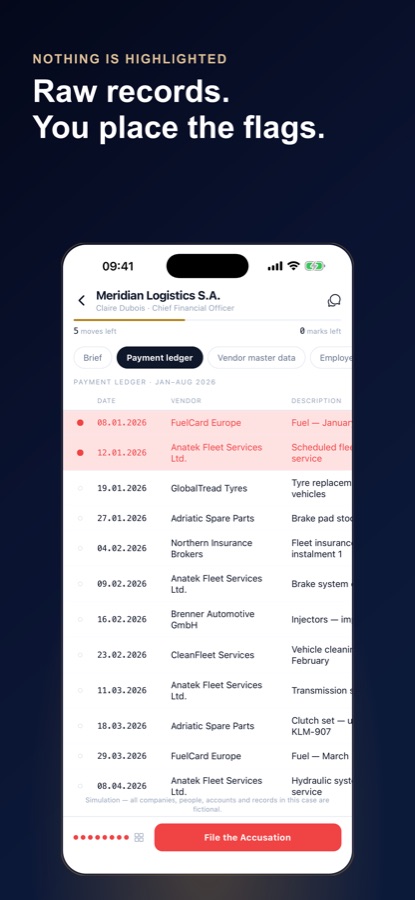
Raw records, you place the flags
A payment ledger for a logistics company lists dates, vendors and descriptions, with a counter of moves left and marks placed. Two rows are marked in red by the player, and nothing is highlighted for you.
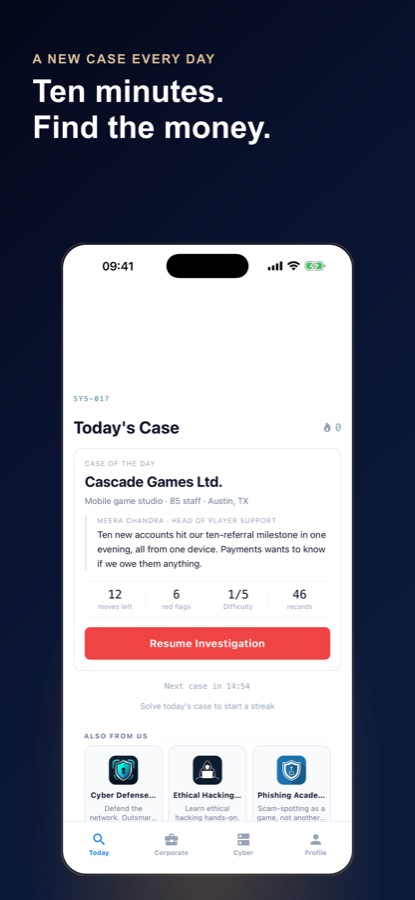
A new case every day
Today's Case shows the company, a request from a head of player support, and counters for moves left, red flags, difficulty and records. A timer shows when the next case arrives.
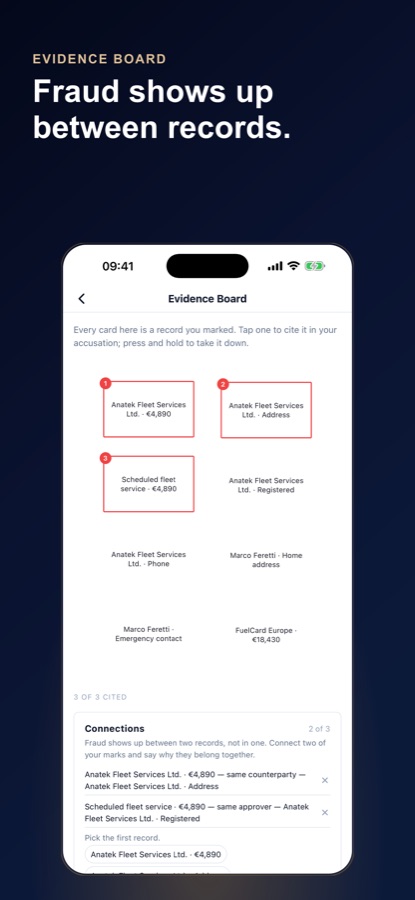
The evidence board
Marked records become cards on the board, and a Connections list lets you join two of them with a reason, such as same counterparty or same approver.
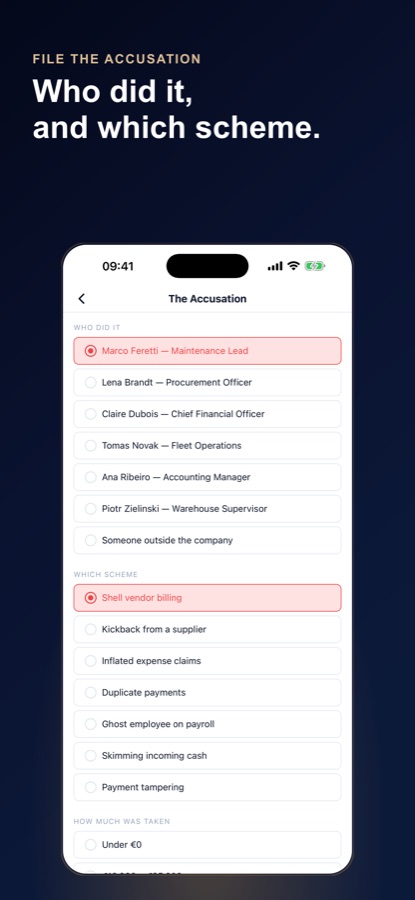
The accusation
A list of suspects, a list of schemes such as shell vendor billing, kickback from a supplier and ghost employee on payroll, and amount ranges to choose from.
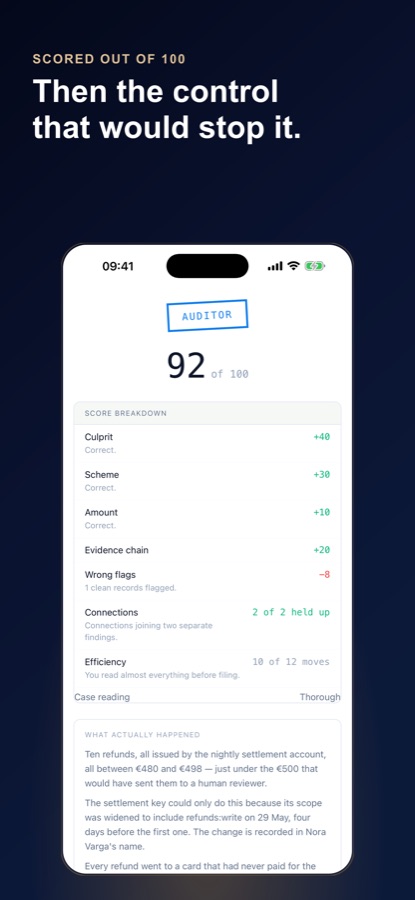
Score and explanation
The verdict is scored out of 100 with a breakdown for culprit, scheme, amount, evidence chain, wrong flags, connections and efficiency, followed by what actually happened.
How it works
How an investigation works
Each case follows the same shape, so you can start in a minute and get better at reading records over time.
Read the brief and choose your moves
Start with a brief and a limited number of moves. Every record you request costs a move, so deciding what to read is part of the investigation. Mark the rows and fields you would question.
Pin evidence and connect it
Pin marked records to the evidence board and connect two of them, for example same counterparty, same approver, or either side of an approval threshold. A clean record flagged by mistake costs points.
File the accusation
Choose who did it, which scheme and how much was taken, and cite your evidence. The server scores you out of 100, grades you from Trainee to Senior Investigator, and shows a debrief.
Background
How do investigators recognise fraud in company records?
Fraud examiners rarely find fraud by reading one record. They look for patterns across records: payments just below an approval limit, the same person who creates and approves, a supplier whose address matches an employee's, or an account that logs in from a new device before money moves. Spotting them is a skill of recognition, and the controls that stop them are usually simple, such as separation of duties and independent review. This is the reasoning the game trains, from the investigator's side of the desk.
Red flagssignals, not proof
A red flag is something unusual that deserves a closer look, such as a round amount, a rushed approval or a supplier with no phone number. It does not prove wrongdoing. The game charges points for flagging clean records, because accusing without evidence is its own mistake.
Approval thresholdsjust under the limit
Companies often require a second reviewer above a set amount. A series of payments sitting just under that amount is a classic pattern, because each one avoids review while the total is large.
Separation of dutiesthe control that stops it
A basic control is that the person who creates a supplier is not the person who approves its payments. When one person holds both roles, a fake supplier can be paid without anyone else seeing the whole chain.
Corporate and cyber fraudtwo tracks
Corporate cases work from invoices, supplier master data, approvals, payroll and bank statements. Cyber cases work from sign-in logs, API credentials, device fingerprints and payout records, such as account takeover, refund abuse or card testing.
Debrief and controlslearning after the verdict
After you file, the case explains what actually happened, the red flags you found and missed and the control that would have closed the gap. Understanding the control is the part that carries over to real work.
What's inside
What is in the game
Daily
A new case every day
The same daily case for every player, free, plus an archive of earlier case files to work through.
16
Fraud schemes
From shell vendor billing, kickbacks and ghost employees to account takeover, refund abuse and card testing.
2
Two tracks
Corporate cases use invoices, supplier data, approvals, payroll and bank statements. Cyber cases use sign-in logs, API credentials, device fingerprints and payout records.
AI
Question a suspect
Ask a suspect in your own words and an AI language model answers in character. It is optional, and a disclosure comes first.
100
Scored debrief
A score out of 100, a rank from Trainee to Senior Investigator, the red flags you found and missed and an audit of which records you opened.
Arcs
Chapters and streaks
Multi-chapter arcs where earlier marks carry forward, streaks, perfect verdicts, flag accuracy and a record by fraud family.
Fit
Who it's for — and who it isn't
A good fit if you
- Enjoy detective games and logic puzzles that reward real deduction
- Study accounting or audit and want practice reading records
- Are curious how white collar crime gets caught, with no background needed
- Want a short daily puzzle of about ten minutes
- Like to learn the control behind a mistake, not just the score
Not the right tool if you
- Want a fraud reporting service or advice about your own accounts; this is a simulation
- Need case files in languages other than English, since the interface has ten languages but case files are in English for now
- Want a game with no ads; the free version shows ads and Pro removes them
Privacy
What the game does and does not do
Every company, person, account and record in the game is invented. It is not connected to any bank, employer or law enforcement agency, never touches your own money and is not a substitute for professional accounting, audit or legal advice. The daily case needs no account, and the answer key stays on the server, not on your device.
Full details are in the CoddyKit privacy policy.
Questions
Frequently asked questions
What is a fraud simulator game?
It is a detective game that puts you in the role of an auditor or fraud analyst. In Fraud Simulator: Investigation (called simply Fraud Simulator inside the app) you receive raw company records with nothing highlighted, decide what to read, mark what looks wrong, connect the evidence and file an accusation. It is a simulation for learning and entertainment.
Who is Fraud Simulator: Investigation for, and how long does a case take?
It is for players who enjoy detective games and logic puzzles, accounting and audit students, and anyone curious how white collar crime gets caught. No accounting knowledge is needed, because every case ends with a debrief that explains the scheme and the control that would have stopped it. A case is designed to be solved in about ten minutes with a limited budget of moves, and each record you request uses one.
What kinds of fraud appear in the game?
Sixteen schemes appear across two tracks. Corporate cases include shell vendor billing, kickbacks, inflated expense claims, duplicate payments and ghost employees on payroll. Cyber cases include account takeover, refund abuse and card testing.
Does the game teach people to commit fraud?
No. Every file is read from the investigator's side of the desk, and the aim is to recognise patterns, red flags and the control that would have stopped them. All companies and people in the game are invented.
Is Fraud Simulator free?
The daily case is free for everyone and needs no account. Free play also includes one archive case a day, and you can watch an optional ad for one more. Pro removes the daily archive limit and the ads, raises the suspect interview allowance and extends the personal debrief to archive cases. It is offered as a subscription or a one-time purchase.
How is my accusation scored?
The server scores it out of 100, with points for naming the culprit, the scheme and the amount and for the evidence chain. Wrong flags and unsupported connections cost points, and efficiency reflects how many moves you used. Your rank runs from Trainee to Senior Investigator.
Can I play on iPhone?
Fraud Simulator: Investigation is available on Android through Google Play. This page does not offer an iPhone version.
Can I play without an internet connection?
A local case keeps you playing without a connection, and your result syncs when you reconnect. The daily case, scoring and the optional suspect interview use the server.
Get started
Open the file. Nothing in it is highlighted.
A free detective game for Android, with a new fraud case every day.
More from CoddyKit
Available on Android.