Tworzenie serwera GraphQL z Apollo
Zaimplementuj API GraphQL w Node.js za pomocą Apollo Server, podłącz je do źródeł danych i zdefiniuj resolvery.
Tworzenie serwera GraphQL z Apollo to bezpłatna lekcja Node.js Backend Development Bootcamp na CoddyKit. To lekcja 3 z 4. Możesz przeczytać całą lekcję poniżej za darmo — a potem ćwiczyć ją interaktywnie w przeglądarce z wbudowanym edytorem kodu i tutorem AI dostępnym 24/7. To część ścieżki edukacyjnej Node.js Backend Development Bootcamp, a Twój postęp synchronizuje się między webem a aplikacją CoddyKit. Kurs Node.js Backend Development Bootcamp zawiera 4 lekcji w sumie.
Części tej lekcji nie zostały jeszcze przetłumaczone i są wyświetlane po angielsku.
Meet Apollo Server
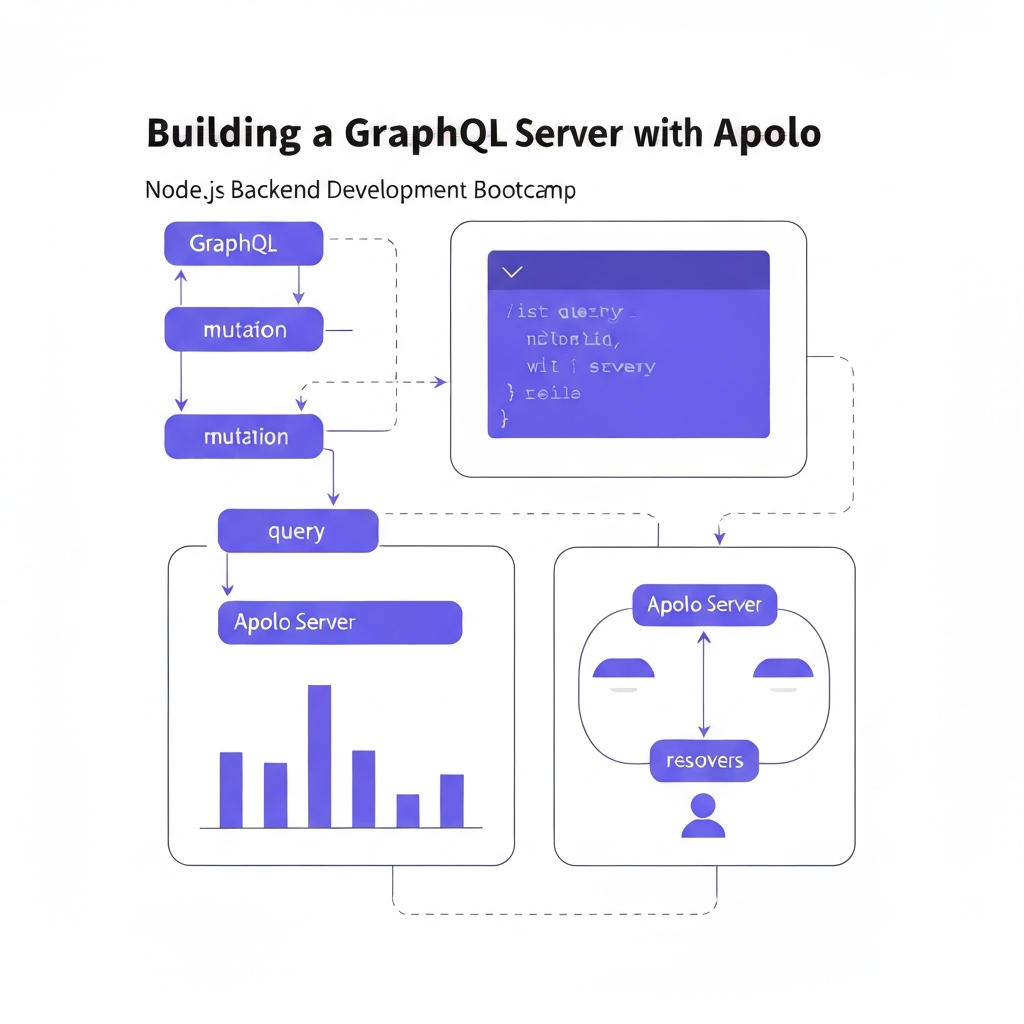
Welcome to building a GraphQL server! We'll use Apollo Server, a popular open-source library that helps you implement a production-ready GraphQL API in Node.js.
- It's easy to set up.
- It integrates with many Node.js frameworks like Express.
- It provides powerful tools like GraphQL Playground for testing.
Apollo Server handles the heavy lifting, letting you focus on your data.
Project Setup for Apollo
Let's get started by setting up our project. Open your terminal and run these commands to create a new Node.js project and install the required libraries:
apollo-server: The core library for building our GraphQL server.graphql: The JavaScript implementation of the GraphQL specification.
Here's how to do it:
mkdir my-graphql-api
cd my-graphql-api
npm init -y
npm install apollo-server graphql
Once installed, you're ready to write some code!
Schema & Resolvers: The Core
A GraphQL server has two main parts:
- Schema (Type Definitions): This defines the shape of your data and the operations clients can perform (queries, mutations). Think of it as the contract between client and server.
- Resolvers: These are functions that tell GraphQL how to fetch the data for each type and field defined in your schema. They are the "backend logic" for your API.
Together, they define your API's capabilities and how it interacts with your data.
Crafting Your GraphQL Schema
We define the schema using a special template literal tag called gql (from apollo-server). This allows us to write GraphQL Schema Definition Language (SDL).
The most important type is Query, which defines all the ways clients can read data from your API. Let's define a simple Query that returns a "hello" message.
const { gql } = require('apollo-server');

const typeDefs = gql`
  type Query {
    hello: String
  }
`;

console.log('Your schema is ready!');
Building Your Resolvers
Now that we have our schema, we need to tell GraphQL how to actually get the data for the hello field. This is where resolvers come in.
Resolvers are functions that match the fields in your schema. When a client queries hello, the corresponding resolver function will be executed.
const resolvers = {
  Query: {
    hello: () => 'Hello from your GraphQL API!',
  },
};

console.log('Resolvers are defined!');
Launching Your First Server
Let's put it all together! We'll combine the typeDefs and resolvers with ApolloServer to create a complete, runnable GraphQL server.
Create a file named index.js and add the following code. Then, run it with node index.js.
const { ApolloServer, gql } = require('apollo-server');

// 1. Define your schema (type definitions)
const typeDefs = gql`
  type Query {
    hello: String
  }
`;

// 2. Define your resolvers (how to fetch data)
const resolvers = {
  Query: {
    hello: () => 'Hello from your GraphQL API!',
  },
};

// 3. Create an Apollo Server instance
const server = new ApolloServer({ typeDefs, resolvers });

// 4. Start the server
server.listen({ port: 4000 }).then(({ url }) => {
  console.log(`🚀 Server ready at ${url}`);
  console.log('Try opening your browser to test it!');
});
Defining Custom Data Types
A simple "hello" isn't very exciting. Let's define a custom type, like Book, with its own fields. This shows how you structure more complex data.
Update your typeDefs to include the Book type and a books query that returns a list of them.
const { gql } = require('apollo-server');

const typeDefs = gql`
  type Book {
    title: String
    author: String
  }

  type Query {
    hello: String
    books: [Book]
  }
`;

console.log('Schema updated with Book type!');
Resolving Custom Types
To make the books query work, we need to update our resolvers. For now, we'll use an in-memory array of objects to simulate a database. In real applications, resolvers connect to databases or other APIs.
Let's update the resolvers to provide data for our books query.
const books = [
  {
    title: 'The Great Gatsby',
    author: 'F. Scott Fitzgerald',
  },
  {
    title: 'To Kill a Mockingbird',
    author: 'Harper Lee',
  },
];

const resolvers = {
  Query: {
    hello: () => 'Hello from your GraphQL API!',
    books: () => books,
  },
};

console.log('Resolvers updated for books!');
Full API with Books
Here's the complete index.js file with our new Book type and its resolver. Run this with node index.js.
Once running, open the URL in your browser (e.g., http://localhost:4000). You'll see the GraphQL Playground, where you can test queries like:
query {
  books {
    title
    author
  }
}
const { ApolloServer, gql } = require('apollo-server');

const typeDefs = gql`
  type Book {
    title: String
    author: String
  }

  type Query {
    hello: String
    books: [Book]
  }
`;

const books = [
  {
    title: 'The Great Gatsby',
    author: 'F. Scott Fitzgerald',
  },
  {
    title: 'To Kill a Mockingbird',
    author: 'Harper Lee',
  },
];

const resolvers = {
  Query: {
    hello: () => 'Hello from your GraphQL API!',
    books: () => books,
  },
};

const server = new ApolloServer({ typeDefs, resolvers });

server.listen({ port: 4000 }).then(({ url }) => {
  console.log(`🚀 Server ready at ${url}`);
  console.log('Explore your API in GraphQL Playground!');
});
Schema vs. Resolvers Check
You've learned about the two fundamental parts of a GraphQL server: the schema (type definitions) and the resolvers.
Which of the following best describes the primary role of GraphQL Resolvers in an Apollo Server?
Apollo Server: Quick Recap
Great job! You've successfully built your first GraphQL server with Apollo Server.
- We installed
apollo-serverandgraphql. - We defined our API's structure using Type Definitions (
typeDefs) written in GraphQL SDL. - We implemented Resolvers to specify how to fetch data for the fields in our schema, using mock data.
- We launched our server using
ApolloServerand explored it with GraphQL Playground.
This is the foundation for building powerful and flexible GraphQL APIs. Next, you can explore mutations, arguments, and connecting to real databases!

Ucz się JavaScript dzięki korepetycjom AI — za darmo
Pisz i uruchamiaj kod w przeglądarce, otrzymuj natychmiastową pomoc od korepetytora AI dostępnego 24/7 i kontynuuj naukę w sieci lub w aplikacji.
- Kursy
- 22
- Lekcje
- 92
Często zadawane pytania
Czy lekcja „Tworzenie serwera GraphQL z Apollo” jest bezpłatna?
Tak — pełny tekst „Tworzenie serwera GraphQL z Apollo” jest dostępny za darmo tutaj w sieci. Aby ćwiczyć ją interaktywnie (wbudowany edytor kodu i tutor AI dostępny 24/7) i odblokować resztę kursu Node.js Backend Development Bootcamp, przejdź na CoddyKit PRO. Kurs Node.js Backend Development Bootcamp zawiera 4 lekcji w sumie.
Co nauczysz się w „Tworzenie serwera GraphQL z Apollo”?
Zaimplementuj API GraphQL w Node.js za pomocą Apollo Server, podłącz je do źródeł danych i zdefiniuj resolvery. Ćwiczysz Node.js Backend Development Bootcamp z praktycznym kodem, który uruchamiasz bezpośrednio w przeglądarce, a tutor AI dostępny 24/7 odpowiada na Twoje pytania podczas pracy nad lekcją.
Czy potrzebuję doświadczenia, aby zacząć Node.js Backend Development Bootcamp?
Nie wymagamy żadnego doświadczenia. Node.js Backend Development Bootcamp w CoddyKit jest strukturyzowany dla początkujących i zaawansowanych użytkowników, więc możesz zacząć tutaj lub od początku i uczyć się w swoim tempie. To lekcja 3 z 4.
Ile czasu zajmuje lekcja „Tworzenie serwera GraphQL z Apollo”?
Większość lekcji CoddyKit trwa około 5–10 minut. Każda lekcja to mały, interaktywny krok, dzięki czemu robisz systematyczne postępy i zawsze wracasz dokładnie do tego samego miejsca — na webie i w aplikacji.
Czy mogę pisać i uruchamiać kod w tej lekcji Node.js Backend Development Bootcamp?
Tak. Każda lekcja Node.js Backend Development Bootcamp zawiera wbudowany edytor kodu, więc piszesz i uruchamiasz prawdziwy kod bezpośrednio w przeglądarce i od razu otrzymujesz sprzężenie zwrotne od AI — bez konfiguracji na komputerze.
Wszystkie lekcje w tym kursie
- Wprowadzenie do serverless z Node.js
- Zasady projektowania API GraphQL
- Tworzenie serwera GraphQL z Apollo
- Subskrypcje GraphQL dla danych w czasie rzeczywistym